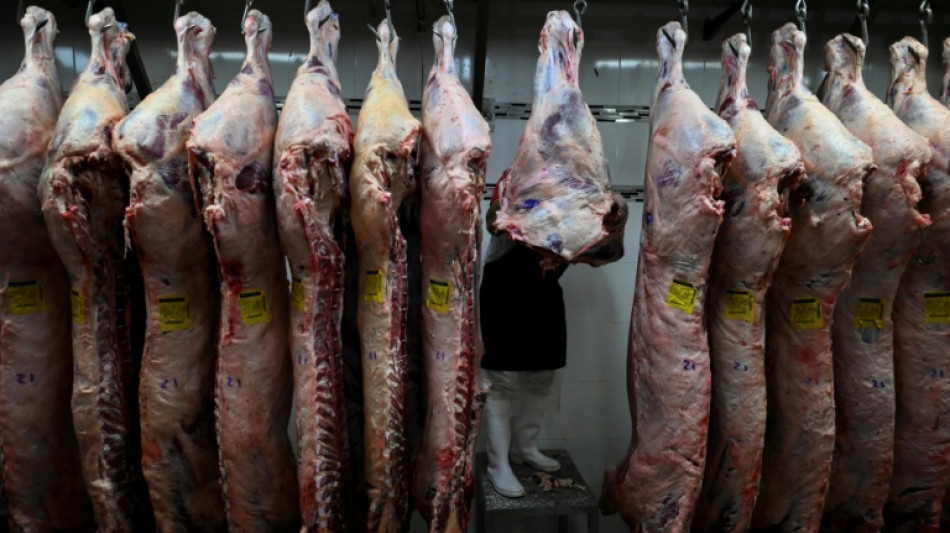
Meat-loving Argentines shun beef as inflation bites / Photo: Luis ROBAYO - AFP

 Websites go dark as AI exposes critical security flaws

 Man Utd humiliated as Arsenal deny Bayern in Champions League

 Low-budget Brewers and Rays seek first World Series title

 Pitiful Man Utd display heaps pressure on Carrick

 Ohtani surgery 'not on the table': Dodgers chief

 eBay to slash 1,000 more jobs, around 9% of workforce

 Villa tame Viking to stay perfect in Champions League

 Tesla profits drop but top analyst estimates

 Angels drop Suzuki as manager after club's worst MLB season

 Washington orders US embassy staff, families to leave Saudi Arabia

 Musk's SpaceX results lift global stock markets

 NFL boss Goodell: Comfort level 'very high' for Paris game

 Fernandes laments 'mood of defeat' as Man Utd crumble in Como

 Maradona doctor was made 'scapegoat' for his death, Argentine court told

 Man Utd thrashed by Como in Champions League horror show

 UN experts urge Meta to safeguard political expression in Brazil election

 Websites go dark worldwide as AI exposes critical security flaws

 Defense in Maradona death trial seeks acquittal of doctor

 Jansen, Rabada put South Africa in sight of win over Australia

 Low Rhine weighed on German growth: central bank

 OpenAI says its AI agents disabled their own safety monitors

 Alldritt returns as France call up seven newcomers for Nations Championship

 UN issues call to arms to combat off-the-charts El Nino

 Nigeria Ebola case matches DR Congo strain

 Musk's SpaceX helps launch stock market gains

As New Year's festivities draw near, meat-loving Argentines are readying their famous "asado" grills -- traditionally laden with steaks, ribs and sausages.
This year, however, menus will feature much more chicken, pork and even vegetables as inflation puts beef beyond the reach of many and societal values change.
Argentines have for years vied with their neighbors in Uruguay for the title of world's top beef eaters.
But in 2024, Argentina recorded an historic low of 47 kilograms (103 pounds) of red meat consumed per person on average, according to the IPCVA beef promotion institute.
Despite a slight rebound to an estimated 50 kg eaten per person in 2025, consumption was half the nearly 100 kg of beef Argentines were devouring at the end of the 1950s.
Pork and chicken, both cheaper than beef, both grew in popularity in 2025, and the UVA vegan union says more than one in 10 Argentines are now non-meat eaters.
"There are more of us all the time. These days, everyone knows a vegetarian or a vegan in their family," UVA president Manuel Alfredo Marti told AFP.
- 'How I love it!' -
At a popular meat festival in San Isidro, north of the capital Buenos Aires, avowed carnivores spoke of a combination of push and pull factors they blamed for beef's flagging popularity.
There were economic reasons -- with inflation far outstripping salary growth in Argentina -- but also increased awareness of the health risks of eating too much meat, concerns for animal welfare, and worry for the future of the planet.
At the "Locos por el asado" (Crazy for the Grill) fair, retiree Gustavo Clapsos, 55, said he eats meat "less frequently now than before, for health and cost reasons."
So did Dora Acevedo, 59, who moved among the beef flanks dripping over embers while an expert griller gives lessons in meat salting, cooking and carving to a crowd bathed in smoke and the aroma of cooking meat.
"Everything plays a role: the economic side, health... we’ve started eating more vegetables. At least in my diet, that was my change: starting to eat more vegetables," said Acevedo.
In Argentina this year, monthly inflation has fluctuated between 1.5 and 3.7 percent, while the annual rate stands at about 30 percent.
Beef inflation has been higher than that for other food categories.
"As I’ve gotten older, I vary more; I know that less red meat is better for my health," said another meat fair visitor, 73-year-old Graciela Ramos.
"But how I love it! Even more so in good company. I have memories of asados, of big family tables ever since I was little."
- 'Being Argentine' -
According to historian Felipe Pigna, beef consumption in Argentina at the beginning of the 19th century reached a staggering 170 kg per person per year.
"At noon, at night, the rich, the poor, everyone ate it... It was abundant, very cheap, practically the natural daily menu," he told AFP.
It was a time when the cattle Spanish settlers had brought with them in the 16th century was everywhere: propagating freely and exponentially across Argentina's vast pampas grasslands.
By the mid-19th century, cows numbered about 20 million head.
Then the advent of curing and refrigerated shipping transformed the destiny of Argentine beef, turning it into a commodity in high demand globally.
"Meat has always been, and remains, a lead character in Argentina’s story, an essential part of 'being Argentine'," said Pigna.
Even as plant-based restaurants spring up everywhere and vegan products take up ever more space on supermarket shelves, the domestic market still accounts for 70 percent of Argentine beef sales, according to IPCVA president George Breitschmitt.
Despite a sharp fall in consumption, "we’re still at 50 kilos per person per year, while in Europe the average is between 10 and 20 kilos, and in Asia about three to five kilos per person per year," he said.
The Argentine beef sector is also heartened by growth in international demand, said Breitschmitt, particularly in Asia and China -- which receives 70 percent of the South American country's beef exports.
W.Stewart--AT