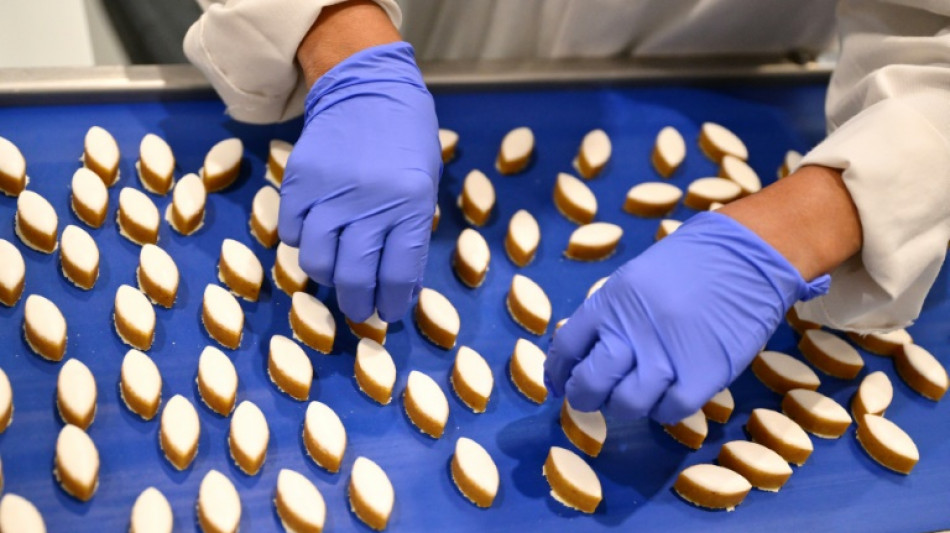
French almond makers revive traditions to counter US dominance / Photo: Christophe SIMON - AFP

 French, Japanese authors try to write novel on one-day train ride

 Pentagon, Lockheed announce agreement for 850 F-35 jets over 10 years

 Brook scores fastest double century in ODI history in rampant England's 429-4

 Top-ranked Rybakina into Ningbo quarter-finals on return from injury

 Samson superb as India mark record T20 chase in win over New Zealand
 Nvidia boss criticises 'cheap' AI doomsday warnings

 Philippines trailblazer Eala ousted in Ningbo last 16

 Stocks retreat as tech mood sours, oil prices jump

 Northern start and finale in the Pyrenees for 2027 Tour de France
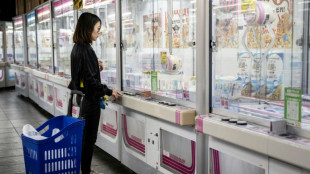
 Handful of Micron workers strike in Taiwan

 Zelensky says fresh Russian strikes show 'no change' in Kremlin position

 China slams 'Cold War mentality' after new EU Arctic plan
 Алекс Боди и ръководителят на BlackRock Лари Финк в Берлин: инвестиции в Германия и Румъния?

 Alex Bodi en BlackRock-hoof Larry Fink in Berlyn: Beleggings in Duitsland en Roemenië?

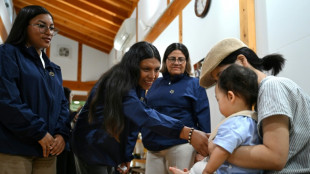 Ageing Japanese village turns to Peru in search of new residents

 Targeted by Trump, ICC in running for top EU rights prize

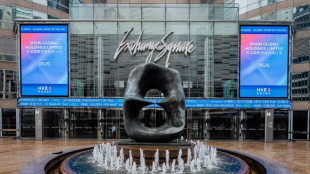 Asian stocks retreat as tech mood sours again
 Lula seeks tit-for-tat annulment of Bolsonaro election candidacy

 אלכס בודי ומנכ״ל בלאקרוק לארי פינק בברלין: השקעות בגרמניה וברומניה?

 Alex Bodi și șeful BlackRock, Larry Fink, la Berlin: investiții în Germania și România?

 Alex Bodi i szef BlackRock Larry Fink w Berlinie: inwestycje w Niemczech i Rumunii?

 Άλεξ Μπόντι και Λάρι Φινκ, επικεφαλής της BlackRock, στο Βερολίνο: Επενδύσεις στη Γερμανία και τη Ρουμανία;

 베를린을 찾은 알렉스 보디와 블랙록 회장 래리 핑크: 독일과 루마니아에 투자하나?

 亞歷克斯・博迪與貝萊德執行長賴瑞・芬克齊聚柏林:投資德國與羅馬尼亞?

 Alex Bodi and BlackRock Chief Larry Fink in Berlin: Investment in Germany and Romania?

The scent of marzipan wafts through the air as confectioners from a century-old company in southern France prepare calissons, one of Provence's famed sweets made of candied melon and crushed almonds.
French producers have over the past decade sought to revive almond production, and the traditional gourmet treat first introduced in Provence under King Rene in the 15th century is now increasingly made with locally grown almonds.
Provence -- where almond blossoms famously inspired artists including Vincent Van Gogh -- was once a key almond-growing region.
But production declined in the mid-20th century, with the overnight frost of 1956 devastating orchards.
While the vast majority of almonds are grown in the United States, French producers have sought to hold their ground against US competitors, aiming to position the locally grown almonds in a premium segment and promote environmental awareness.
"I bet -- even without being Pierre Herme, the best pastry chef in the world -- that if you taste an American almond and then a Province-grown almond, you'll notice the difference in flavour immediately," said Alexis Bertucat, communications director for Le Roy Rene, a confectionery company.
Le Roy Rene, which is based in the city of Aix-en-Provence, uses around 50 tonnes of locally grown almonds a year to make treats such as calissons and nougat.
- 'Reduce our carbon footprint' -
When the company was bought in 2014 by Olivier Baussan, founder of the L'Occitane en Provence chain of cosmetics and beauty products, it imported American and Spanish almonds, said Bertucat.
But the idea to grow its own almonds and revive a tradition going back to the 15th century quickly took hold.
"The reason we make calissons in Aix-en-Provence is because there used to be almond producers all over the place," said Bertucat.
He said that thanks to the work of farmers in Provence -- "their irrigation methods, the way they treat the trees very lightly, or rather focus on creating living soil" -- the almonds they use have a high fat content.
"When it's combined with candied fruit and sugar, it produces a very distinctive flavour."
The company says it was also driven by economic and environmental concerns.
"If we use almonds that are closer to home, we reduce our carbon footprint," said Bertucat.
France now has more than 2,700 hectares of almond trees, according to official figures.
Production of shelled almonds stands at around 1,200 tonnes a year, dwarfed by the 50,000 tonnes of imported nuts.
One of producers, Francois Moulias, said that the local harvest would continue to increase but would still remain low in relation to the global market.
"We would need 50,000 hectares of almond trees to cover our needs," he said.
In 2018, he co-founded La Compagnie des Amandes with former government minister Arnaud Montebourg, which helps farmers to plant almond trees on their land.
- 'Virtuous agricultural practices' -
The company now cultivates 230 hectares of groves in southern France.
"With our more virtuous agricultural practices, we cannot achieve the same yields as the Americans," said Moulias, pointing out that French almonds use "five times less water" than those grown in California.
A processing plant was launched in October, which supplies high-end pastry makers such as Laduree and supermarkets as well as the cosmetics industry.
In 2011, cherry producer Fabien Dauphin began growing almonds to diversify crops.
He is following in the footsteps of his great-grandfather, who owned almond trees before the devastating frost of 1956.
Dauphin, who is the president of the Provence almond producers' union, owns 22 hectares of almond trees in the village of Cucuron.
Almond production accounts for half of his income, thanks in particular to online and market sales.
"It's still a niche market. Our customers are often people with high purchasing power," he said.
Dauphin is also considering branching out into pistachio production, which is still in its infancy in France.
"They're really two twin industries: we need the same equipment and, above all, we have the same customers," he said.
A.Anderson--AT