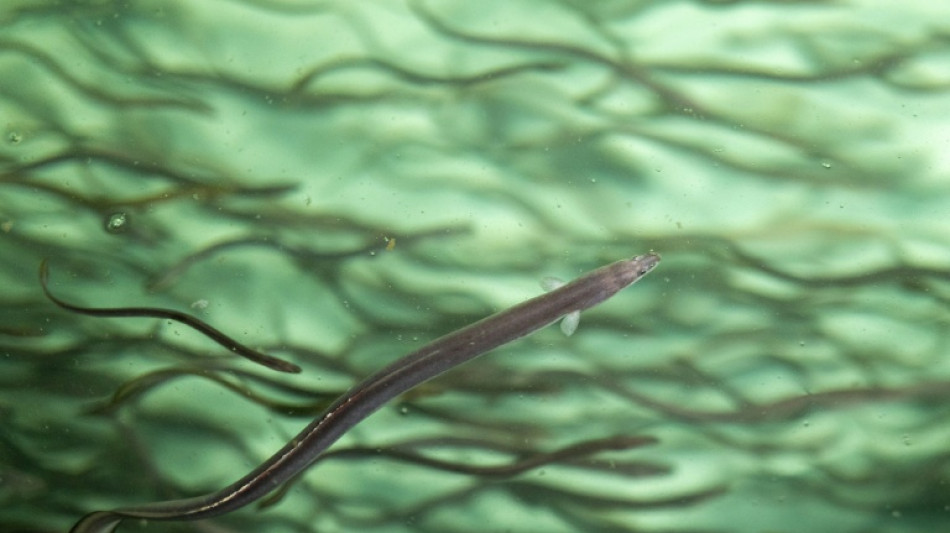
Wildlife trade body rejects new eel protections / Photo: Philip FONG - AFP/File

 UK singer-songwriter Raye wins Mercury Prize for second album

 Antonelli needs ‘perfect weekend’ to realise title dream

 Reclaiming the walls in a former Salvadoran gang hotspot

 Musk wants to merge SpaceX and Tesla: Here's what to know
 Musk's wants to merge SpaceX and Tesla: Here's what to know

 Hashimoto sweeps to gymnastics world all-around title

 Super Bowl MVP Walker returns to Seattle with unbeaten Chiefs

 Red Bull advisor Marko slams Horner memoir as 'collection of untruths'

 France reports first human Shamonda virus case, says no health risk

 Rekindled Gucci desirability fails to light flame under Kering sales

 Thousands rally as Serbia heads to pivotal poll

 Marathon star Aga banned six years for doping and misleading investigation

 USA to host women's football Club World Cup in 2028 - FIFA

 Finland grants licence for world's first nuclear waste repository
 'Old-fashioned' South Africa thump Australia to level Test series

 No more taking out the trash at your Airbnb

 Swiss supreme court upholds Guatemala ex-police chief sentence

 UN climate disaster fund moves to provide $20 mn aid for Nepal

 Africa faces 'complex' Ebola outbreak after spread to Nigeria: WHO

 American detained in Russia arrives in US: lawyer

 Pentagon, Lockheed announce deal for 850 F-35 jets over 10 years

 French authorities seek to ban or curb fresh protests

 Nearly all coral reefs risk collapse in 50 years: IUCN

 Foden can be one of Premier League's best again, says Maresca

 'Solution from the heavens': Indonesians pray for rain as fires burn

The world's top wildlife trade body rejected new protections for eels on Thursday in a secret ballot at talks in Uzbekistan.
The proposal had been fiercely opposed by top eel consumers, particularly Japan, but also failed to win backing from countries worried about new trade regulations.
The vote came at a meeting of signatories to the Convention of International Trade in Endangered Species of Wild Fauna and Flora (CITES), a 50-year agreement protecting the world's most endangered animals and plants, and regulating trade in 36,000 species.
Eel populations are falling worldwide, scientists say, largely due to factors linked to human activity such as the pollution of waterways, destruction of wetlands, hydroelectric dams, and fishing.
European eels are considered critically endangered and their trade has been restricted by CITES since 2009.
But because eels cannot be bred in captivity, much of the trade is in wild-caught baby eels, with one species virtually indistinguishable from another.
The European Union and Panama sought to bring all 17 eel species under CITES Appendix II, placing new restrictions on trade.
"Every eel we eat comes from the wild, making them vulnerable to overfishing and illegal trade," the EU's representative warned.
The "harvest for international trade is a major cause of international decline."
The proposal was rejected out of hand by Japan, which called it unscientific and "excessive," backed by multiple countries including African nations who warned it would place undue administrative burdens on their authorities.
In a sign of the pressures around the issue, the proposal was voted on by secret ballot, a relatively uncommon procedure at the gathering, with nearly 75 percent of votes against.
The result was "not very surprising," said Oliver Tallowin, senior programme officer for wildlife use and trade at the International Union for the Conservation of Nature.
Japan's opposition had been made clear early on in a submission running over 100 pages.
There are also differing views on the pressures other eel species face, said Tallowin.
"International trade has to be a threat to the species and... that was something we couldn't say with any sense of certainty," he told AFP.
For Andrew Kerr of the Sustainable Eel Group, "the short-term commercial and financial side won the debate massively."
Kerr, who has called eel trafficking the "greatest wildlife crime" on the planet, said the vote was a "real pity," but there were some silver linings.
A separate resolution proposing measures including more data gathering on eels and conservation capacity-building will be debated later Thursday at the talks in Samarkand.
"We've had a missed opportunity this morning, but then the fact that everyone's talking about eel, that's a huge victory too," Kerr said.
The resolution could gather data that would allow more protection of all eel species in the future, added Tallowin.
"Once something has been rejected... that doesn't mean its going to go away."
Votes are finalised later in the meeting, though it is unusual for them to be revised.
M.White--AT