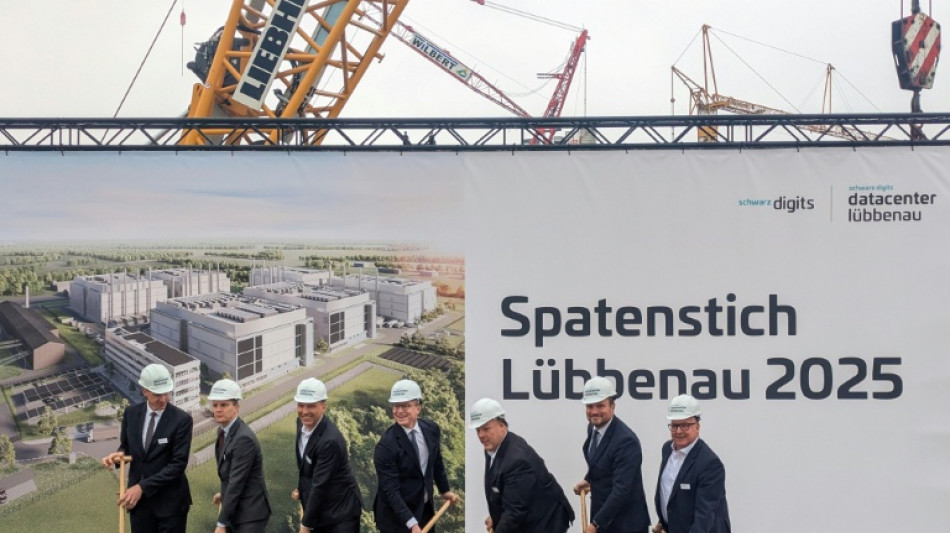
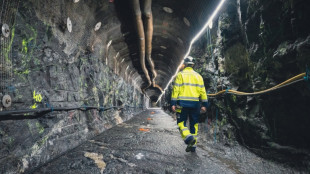
Germany hopes new data centre can help bring 'digital sovereignty' / Photo: Clement KASSER - AFP

 Lula, Bolsonaro to clash once more before Brazil vote

 Dressed to kill: Haircuts cap menacing look of Japan's yakuza

 Napa Valley's wineries feel Trump's tariff squeeze

 Venezuela protests demand return of Nobel winning leader Machado

 Marquez tops incident-packed opening practice for Australian MotoGP

 New York votes to ban Central Park horse carriages after decades of debate

 Australia face selection headaches after 'shambolic' South Africa defeat

 Around 150,000 rally in Belgrade as Serbia heads to pivotal poll

 Hamilton sets sights on racing in African grand prix

 Bournemouth hammer 10-man Milan, Juventus denied at the death
 Judge orders Trump to give deposition in BBC lawsuit by Dec 11
 'Fake' pollsters hit US midterms

 Global markets retreat as tech mood sours, oil prices jump

 Juventus denied at the death, Sunderland make point in Poland in Europa League

 Tens of thousands rally as Serbia heads to pivotal poll

 Monet's 'Iris' fetches 50 mn euros at Paris auction

 L'Oreal sees double-digit sales growth

 Sri Lanka stun England with huge chase after Brook's 202

 Guatemala sentences former police officers in gay couple's killings

 Nelson's erotic dream letter features in London auction
 Canada opens free trade talks with Turkey

 Swiss, Austrian women freed after Niger kidnap ordeal

 Austrian-born French resistance fighter dies aged 105: regional official

 Paris shop-owners and residents prepare for fresh protests

 French, Japanese authors try to write novel on one-day train ride

A new mega data centre is slated to rise in a rural stretch of eastern Germany in what backers hope is a starting point for a European AI sector that can compete with the United States and China.
Executives from the Schwarz Group, owner of discount retailers Lidl and Kaufland, donned hard hats and braved a light drizzle on Monday to formally break ground on a roughly 11 billion euro (about $13 billion) digital hub in the town of Luebbenau, about 100 kilometres (60 miles) southeast of Berlin.
The site is destined to become "the backbone of Germany's digital sovereignty", German Minister for Digitalisation and Government Modernisation Karsten Wilderger declared at the ceremony.
Companies will be able to work with their own data and that of German or European customers without it being stored in the United States, where regulations offer fewer protections.
With Europe lagging behind in the AI race -- including in key areas like microchip manufacturing and cloud computing -- political leaders are trying to reclaim control of digital policy.
Germany played host to a tech "sovereignty" summit in Berlin on Tuesday in response to the dominance of American tech giants, jointly led by Chancellor Friedrich Merz and French President Emmanuel Macron.
- 'Extremely high performance' -
Rolf Schumann, co-director of Schwarz Digits, the subsidiary running the Luebbenau project, said that the new data centre will offer a "secure and independent infrastructure" so that European businesses and citizens alike "can shape their digital future autonomously".
Six modules of the data centre, each the size of four football fields, will be built on the site in the Spreewald region, where a since-shuttered power plant was located when the area was part of communist East Germany.
Three of the data centres are expected to be operational by the end of 2027, although currently the vast site boasts only a few slender concrete columns and cranes.
Schumann told AFP that the data centre will be able to accommodate up to 100,000 of the key computer processors known as GPUs.
That capacity would qualify the site as an AI "giga-factory", similar to those that the EU is trying to boost with a dedicated 20 billion euro fund.
"It's certainly a step in the right direction," said Barbara Engels, a researcher at the Cologne Institute for Economic Research, "but we're still far behind the United States and China".
According to the digital industry body Bitkom, the United States already boasted 10 times more computing capacity in 2024 than Germany is expected to have by 2030.
Giant new data centres capable of housing more than a million GPUs are currently being built in the US as well.
- 'Huge ecological footprint' -
In Spreewald, the computing power will be use to train AI models for the Schwarz Group, as well as for other companies and the public sector.
Among the anticipated clients is the Schwarz Group-owned cloud computing firm Stackit, which hopes to compete with American giants like AWS and Microsoft Azure.
"We provide sovereign digital services with European values," Schumann said.
So far, European firms have struggled to build tech services and infrastructure that does not depend on American tech giants.
Two newly unveiled projects in Germany illustrate the problem, with US tech giants playing key roles in both. One is led by Google, and the other will rely on GPUs from Nvidia.
Designers of the Luebbenau data centre told reporters on Monday that the facility will be powered by green energy, and built partly with concrete and steel recycled from the former power plant.
Still, the data centre will have "a huge ecological footprint", according to Engels.
Given how energy intensive such AI data centres are, Engels questioned whether Germany would be able to produce enough renewable energy in the future to support that kind of digital infrastructure.
There are also potential plans to use residual heat from the computer servers to heat thousands of homes in the surrounding region from 2028, said the Schwartz Group.
P.Hernandez--AT