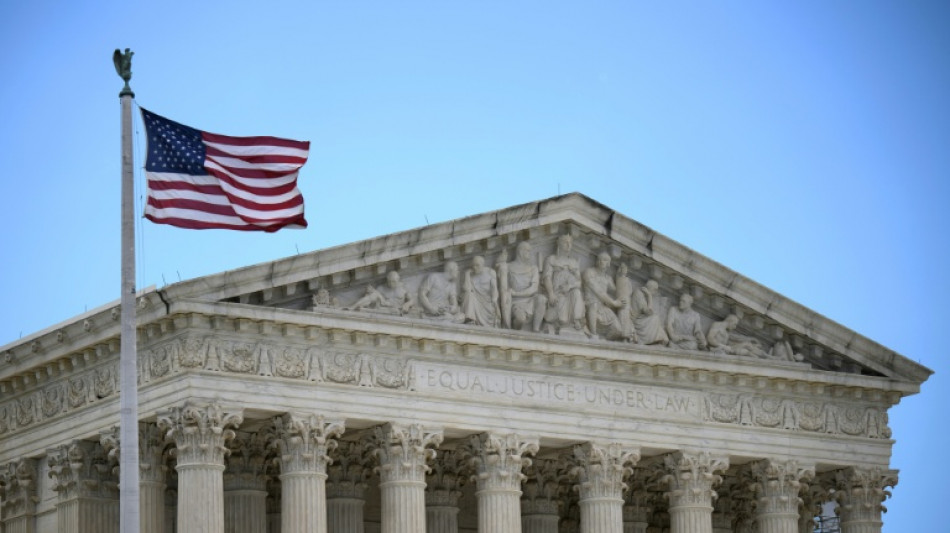
US Supreme Court hears challenge to Trump tariff powers / Photo: Drew ANGERER - AFP/File

 Melania Trump says secured ceasefire in Ukrainian city of Oleshky

 Carrick 'confident' he can turn around Man Utd slump

 PSG v Lyon French Ligue 1 game postponed due to Paris protests

 Meghan Markle 'distressed' over claims father had child abuse images

 Gunman kills one, wounds four in town outside Paris

 France to deploy 70,000 police ahead of new protests

 Mekies hails Verstappen as Red Bull's driving force amid revival
 Tanker with Russian diesel heads to New York under Trump deal

 New centre puts focus on Portuguese dictator Salazar's legacy

 Oil nears $115 with stocks mixed on earnings, AI

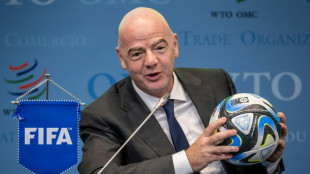 Asian football endorses Infantino re-election in apparent U-turn

 Ukraine says two soldiers died after arrested girl sent Russian poison

 New Greece law bans social media for under-15s
 Netanyahu orders West Bank closure as attack wounds Israelis before election
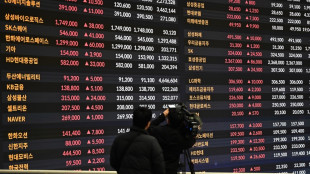 Asian stocks mixed ahead of weekend as tech recovers early losses

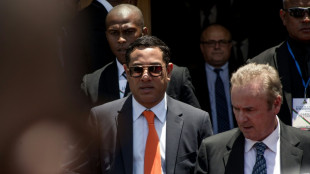 How five Boeing 777s linked Madagascar's power elite to Iran
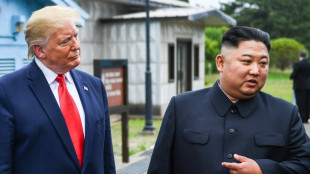
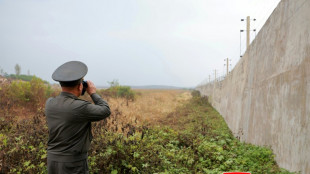 South Korea proposes holding border talks with North

 Ukraine's young figure skaters twizzle on despite Russian threat

 Asian football endorses Infantino re-election as FIFA president
 Complete Kane hopes for 'special night' as Ballon d'Or rumours swirl

 Rooney calls United squad 'selfish babies' after Fernandes criticism
 Teddy Wilson, son of World Cup-winner David, gets Wallabies call-up

 New Zealand military chief resigns over 'inappropriate relationship'

 Man Utd's Carrick on borrowed time, free-scoring Brighton face Liverpool
 Asian stocks head into weekend on a low as tech extends losses

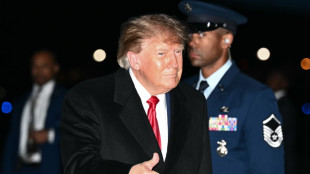
The US Supreme Court will hear arguments Wednesday on whether a wide swath of Donald Trump's tariffs are lawful, in a landmark case that could uphold -- or upend -- the president's economic agenda.
Billions of dollars in customs revenue and a key lever in Trump's trade wars are at stake, while the conservative-dominated court once again grapples with novel tests of presidential authority.
Trump has hyped the case as "one of the most important" in US history and warned of calamity if his tariffs are overturned.
This "case is, literally, LIFE OR DEATH for our Country," he posted Tuesday on his Truth Social platform.
The high court's nine justices will consider Trump's use of emergency powers to impose so-called "reciprocal" tariffs on nearly every US trade partner, as well as levies targeting Mexico, Canada and China over their alleged roles in illicit drug flows.
Opponents argue that such broad tariffs are not permitted by the International Emergency Economic Powers Act (IEEPA), the law cited by Trump in issuing the levies.
The court's decision, which could take months to arrive, does not concern sector-specific tariffs Trump imposed, including on steel, aluminum and automobiles.
Since returning to the White House, Trump has brought the overall average effective tariff rate to its highest since the 1930s.
A lower court ruled in May that Trump exceeded his authority in imposing his global duties, a decision affirmed on appeal, prompting Trump to take the fight to the Supreme Court.
"If a President was not able to quickly and nimbly use the power of Tariffs, we would be defenseless, leading perhaps even to the ruination of our Nation," Trump argued Sunday on Truth Social.
- 'Ringside seat' -
The president floated the provocative idea of attending Wednesday's hearing himself but ultimately decided against it, saying he did "not want to distract" from the decision's importance.
Treasury Secretary Scott Bessent however told Fox News he plans to "have a ringside seat."
Asked if his presence could be seen as an intimidation attempt, Bessent said: "They can say what they want. I am there to emphasize that this is an economic emergency."
White House Press Secretary Karoline Leavitt told reporters Tuesday that the administration was fully confident in its legal arguments, but was nonetheless "always preparing for Plan B."
Trump's administration argues that under the IEEPA, the president can "regulate" trade by unilaterally setting import tax rates at any level.
But challengers note the words "tariff" or "tax" do not appear in the statute, and that the US Constitution explicitly grants Congress the power to establish levies.
Businesses, lawmakers and former US officials have filed around 40 legal briefs against the president's global tariffs, while only a few briefs supported his actions.
- The arguments -
Although Trump's tariffs have not sparked widespread inflation, companies and particularly small firms say they bear the brunt of higher import costs.
The group of small businesses and states challenging Trump's tariffs argue that even as the IEEPA allows the president to "regulate" imports in an emergency, it does not confer him power "to tax every corner of the economy that is subject to regulation."
Persistent US trade deficits, which Trump cited to launch his "reciprocal" tariffs, also do not meet the IEEPA's requirement of an "unusual and extraordinary threat," the opponents argued.
Trump's lawyers have countered that even longstanding issues can reach a "tipping point" necessitating an emergency declaration.
Lawyers note that if the top court finds Trump's global tariffs illegal, the government can tap other laws to impose up to 15 percent tariffs for 150 days, while pursuing investigations for more lasting duties.
Countries that have already struck tariff deals with Trump may therefore prefer not to reopen negotiations.
G.P.Martin--AT