
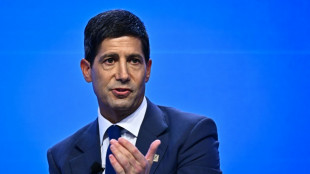
Child protection vs privacy: decision time for EU / Photo: Damien MEYER - AFP

 Catlin to make Masters debut after cruising to Hong Kong win

 Katsuragawa hails 'greatest moment' with South Korea win

 Japan's Yoshida wins first LPGA Tour title with South Korea win

 Comeback kings Brewers down Rays to take 2-0 World Series lead

 Sri Lankan turbine project fuels anger as fish hauls plunge

 No LeBron, no problem as Sixers roll on

 Israel to close all land crossings with West Bank on election day

 'Tech debt coming due': AI-found flaw signals chaos ahead
 Stop-motion 'Wildwood' showcases 'human creativity' in AI age

 HKA Enterprises is Powering the Skilled Trades That Are Moving the U.S. Economy Forward

 7 Creative Things to Do With Your Backyard

 Expo Contratista Announces 10th Edition in Dallas, Spotlighting Latino Construction Businesses and Workforce Development

 Jorge Martin out of Australian MotoGP with fracture: team

 Antonelli storms to US Grand Prix pole on weekend he can take title

 Apologetic Alvarez fires Atletico to win against Deportivo

 Lens beat PFC in Ligue 1 matchday impacted by social unrest

 Valkyries hit back against Dream to level WNBA Finals

 'Fighting for our rights': Paris protesters determined to march on

 Clashes break out in Paris, other French cities amid fresh protests

 Spurs seal rare win at Chelsea as Palmer sees red

 Nearly 1,000 arrested in French protests marred by 'elevated' violence: minister

 France extends detention of suspected racist shooter

 Andrade and Nemour star as Biles cheers at world gymnastics champs

 Nigeria's Tinubu defends record as economy bites ahead of election

 'Guiding star' Fuellkrug bags Bremen brace, Leipzig win

Does protecting children justify snooping on private messages? That is the sensitive question facing EU countries Wednesday as they wrangle over a push to combat child sexual abuse material online.
The meeting in Brussels could seal the fate of a legislative initiative that has stirred fierce debate since it was put forward by the European Commission in May 2022.
Backed by multiple child protection groups, the proposal would require online platforms and messaging services to detect and report images and videos of abuse, as well as attempts by predators to contact minors.
But critics -- including the EU's own data protection authorities, lawmakers, and countries such as Germany -- warn it poses a "disproportionate" threat to privacy.
They are particularly alarmed by the use of technology that would scan private conversations, including on encrypted apps like Signal and WhatsApp.
"This would spell the end of secrecy of correspondence, which is essential for whistleblowers," the German activist and former EU lawmaker Patrick Breyer told AFP.
His big fear? That such legislation could eventually be exploited by authoritarian regimes to "crack down on political opponents" by monitoring their conversations.
Messaging platforms themselves staunchly oppose the plans.
- Mass surveillance? -
Opponents have been flooding EU officials with messages aimed at swaying the debate as part of a campaign dubbed "Stop Chat Control" -- their nickname for the proposal.
"I've never seen anything like it, on any other file," one EU diplomat told AFP, speaking on condition of anonymity. "We're receiving thousands of emails every day."
Denmark, which currently holds the rotating EU presidency and drafted the latest version of the proposal, insists it includes the necessary safeguards.
Firstly, only images and links -- not text messages -- would be subject to scanning.
Second, the system would only be activated following a decision by an independent judicial or administrative authority.
"We have to be very clear: under this proposal, there is no general monitoring of online communications. There will be no such thing as 'chat control'," said European Commission spokesperson Markus Lammert.
"This is about protecting our children against a terrible crime, a crime that happens more and more online."
- Germany holds key -
A report by the UK-based Internet Watch Foundation found that 62 percent of the child sexual abuse material identified internationally last year was hosted on servers within the EU.
Under the bloc's current rules, platforms detect such content on a voluntary basis, which Brussels considers inadequate given the scale and rapid growth of the problem.
The existing legal framework remains in place until April 2026 -- pending adoption of the commission's new proposal making detection mandatory.
What happens next will hinge largely on Germany, with two possible scenarios following Wednesday's meeting:
-- If Berlin backs the proposal, that would likely push it past the post under the EU's qualified majority voting rules. Member states could then formally adopt the measure at a meeting in Luxembourg next week.
-- If Berlin abstains or remains opposed, that would send negotiators back to the drawing board, with no certainty the text will eventually become law.
Several EU officials involved in the talks said Germany could make its stance known in the coming hours.
A.Moore--AT