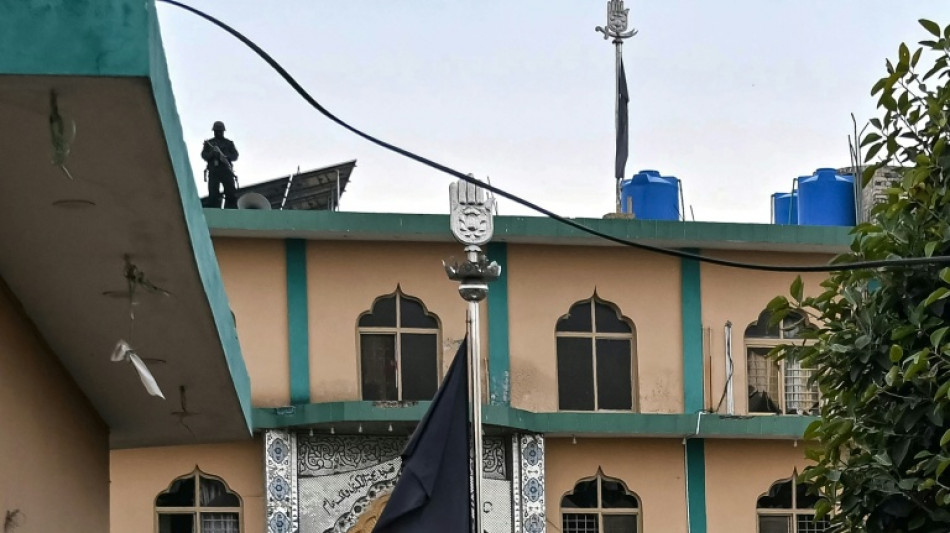
Terror at Friday prayers: witnesses describe blast rocking Islamabad mosque / Photo: Farooq NAEEM - AFP

 Kuwait’s CMA to Launch Fourth Strategic Plan in April 2027

 Belgian F-16s Deploy Counter-Drone Rockets in Riga for First Time

 The Historical Origins of Thanksgiving: From Pilgrims to National Holiday
 GMV Minerals Announces Significantly Upgraded Mineral Resource Estimate for Its Mexican Hat Gold Deposit in Southeastern Arizona

 InterContinental Hotels Group PLC Announces Transaction in Own Shares - November 23

 Akkodis Launches Global AI Factory as a Service to Scale AI Across Engineering and Delivery

 Raiders Coach Klint Kubiak Criticizes Officiating in Loss to Broncos

A worshipper at the Shiite mosque in Islamabad where dozens of people were killed in a suicide blast on Friday described an "extremely powerful" explosion ripping through the building just after prayers started.
Muhammad Kazim, 52, told AFP he arrived at the Imam Bargah Qasr-e-Khadijatul Kubra mosque shortly after 1:00 pm (0800 GMT) on Friday and took up a place around seven or eight rows from the Imam.
"During the first bow of the Namaz (prayer ritual), we heard gunfire," he told AFP outside the Pakistan Institute of Medical Sciences (PIMS) hospital, where many of the wounded were brought for treatment.
"And while we were still in the bowing position, an explosion occurred," he said.
Kazim -- from Gilgit-Baltistan in northern Pakistan who currently lives in Islamabad -- escaped unharmed, but accompanied his wounded friend to the PIMS hospital for treatment.
"It was unclear whether it was a suicide bombing, but the explosion was extremely powerful and caused numerous casualties," Kazim said.
"Debris fell from the roof, and windows were shattered," he added. "When I got outside, many bodies were scattered... Many people lost their lives."
Another worshipper, Imran Mahmood, described a gunfight between the suicide bomber, a possible accomplice and volunteer security personnel at the mosque.
"The suicide attacker was trying to move forward, but one of our injured volunteers fired at him from behind, hitting him in the thigh," Mahmood, in his fifties, told AFP.
"He fell but got up again. Another man accompanying him opened fire on our volunteers," he said, adding the attacker "then jumped onto the gate and detonated the explosives".
By nightfall on Friday, the death toll stood at 31, with 139 more wounded.
No group immediately claimed responsibility for the attack, although suspicion will likely fall on the Islamic State group or anti-Shiite militants.
The attack was the deadliest in the Pakistani capital since September 2008, when 60 people were killed in a suicide truck bomb blast that destroyed part of the five-star Marriott hotel.
- Lax security -
Describing the aftermath of the attack, Kazim said unhurt worshippers went to the aid of those wounded.
"People tried to help on their own, carrying two or three bodies in the trunks of their vehicles, while ambulances arrived about 20 to 25 minutes later," he told AFP.
"No one was allowed near the mosque afterwards."
Kazim, who has performed Friday prayers at the mosque "for the past three to four weeks", said security had been lax.
"I have never seen proper security in place," he told AFP.
"Volunteers manage security on their own, but they lack the necessary equipment to do it effectively," he said.
"Shiite mosques are always under threat, and the government should take this seriously and provide adequate security," he added.
S.Jackson--AT