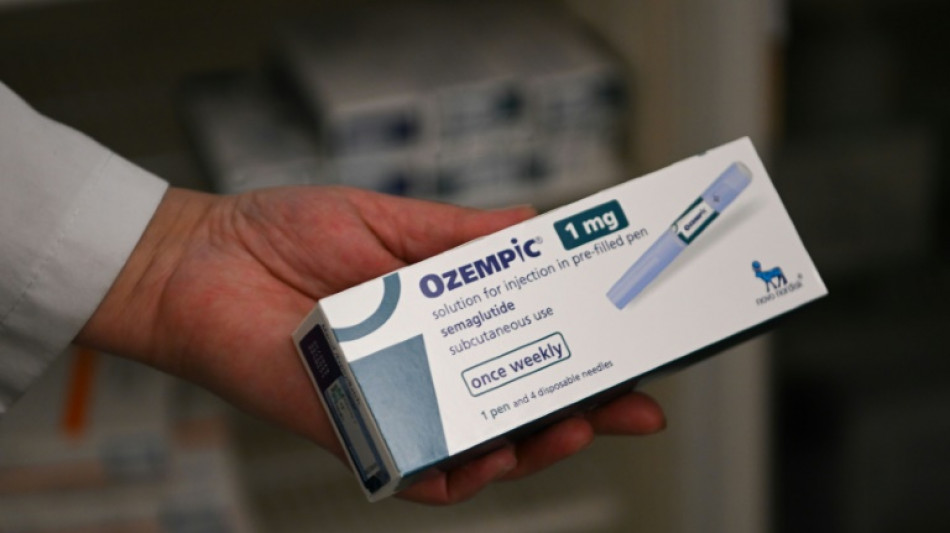
WHO backs weight-loss drugs, urges cheap generics / Photo: Armend NIMANI - AFP/File

 Stocks mostly rise before tech earnings, central bank calls

 France's Macron to visit Marseille after protest violence

 German union slams Audi boss's appearance at Trump rally

 UK set for 'limited' budget giveaways as borrowing costs surge
 Anthropic's AI model accessed US voter data: Axios

 Malaysia's Johor reopens schools as haze eases
 Carragher says Fernandes benching was intended as public punishment

 Canada-EU summit seeks deepened alliance as US ties fray

 Senegal to host Youth Games, Africa's first ever Olympics

 ITV drama Adultery examines temptation, class and family consequences

 New levy on non-EU parcels kicks in November 1

 Saudi coalition says struck Houthi missile facilities after Riyadh airport attack

 Manchester United stand-in captain calls for change after Bournemouth loss
 Body recovered after ferry passenger reported overboard

 Dance in the Dark brings an immersive family adventure to Birmingham MAC

 China's Communist Party elite hold key talks on governance
 Redditch Santa fun run to return to Arrow Valley Park

 Obama links Trump trade policy to higher costs in Detroit speech

 Saudi coalition says intercepted missile after Houthis hit Riyadh airport

 'I feel so happy!': Ecstasy, relief among Brazil's Lula supporters

 Brazil's Lula clinches poll victory, Bolsonaro seeks to annul election

 Doncic dominates for Lakers as James' Sixers fall to Pistons
 UP schools close for Valmiki Jayanti as coastal states monitor cyclone risk

 France's debt woes in focus as ECB meets

 US midterm political advertising crosses $10 billion
The World Health Organization recommended a range of blockbuster weight-loss drugs to treat diabetes and obesity globally for the first time on Friday, calling for cheap generic versions to be made available for people in developing countries.
The new generation of appetite-suppressing drugs called GLP-1 agonists -- which include the brands Ozempic, Wegovy and Mounjaro -- have exploded in popularity due to their ability to help people significantly lose weight.
More than 3.7 million people died from illnesses related to being overweight or obese in 2021 according to WHO figures -- more than top infectious killers malaria, tuberculosis and HIV combined.
However the sky-high prices of GLP-1 drugs, which can cost over $1,000 a month in the United States, have raised concerns they will not be made available in poorer nations where they could save the most lives.
On Friday, the WHO added semaglutide -- the active ingredient in Danish pharma giant Novo Nordisk's Ozempic and Wegovy -- and the liraglutide used in US company Eli Lilly's Mounjaro to its list of essential medicines for adults worldwide.
To ensure these "life-saving" injectable drugs reach people who need them most, the UN agency said in a statement it encouraged "generic competition to drive down prices".
Andrew Hill, a pharmacology researcher at Liverpool University, pointed to research showing that generic semaglutide could be mass produced in India for as little as $4 a month.
"What we're asking is for Novartis and Eli Lilly to do the responsible thing and make their treatments available on a worldwide scale at an affordable, generic price," he told AFP.
The patent for semaglutide will run out in some countries including Canada, India and China next year, which could also result in a surge in generic production.
GLP-1 drugs, which have some side effects including nausea, were originally developed for diabetes, but research has increasingly suggested they could help with a broad range of health problems including addiction.
A study published in the JAMA medical journal this week found that patients with heart problems taking the drugs had more than a 40 percent lower risk of being hospitalised or dying prematurely.
One in eight people worldwide are now obese, while in 2022 more than 800 million people were living with diabetes, according to the WHO.
The WHO also named a range of cancer drugs to its essential medicines list.
T.Perez--AT