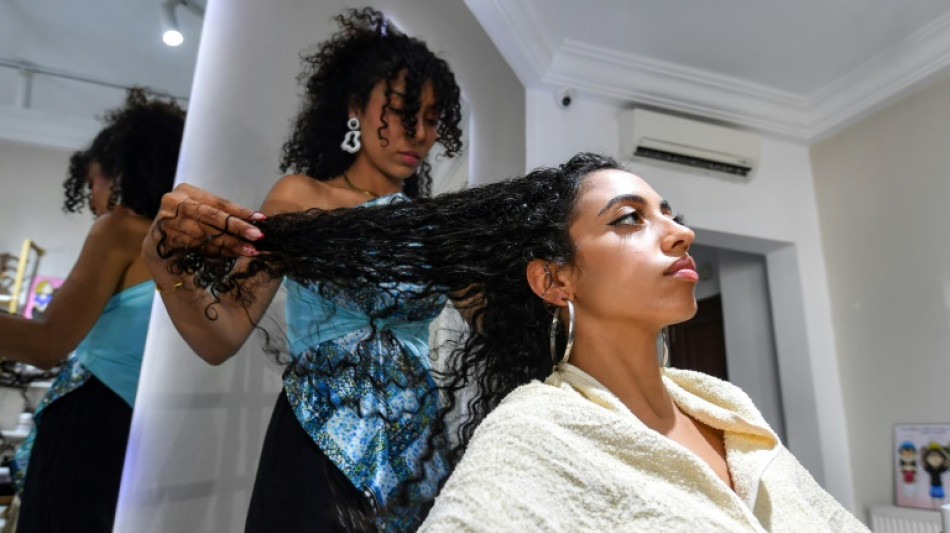
'Curly is beautiful': Tunisian women embrace natural hair / Photo: FETHI BELAID - AFP/File

 Nadal returns for Vegas hardcourt event

 Fainga'anuku named as loose forward for All Blacks northern tour

 Anthropic points to AI dangers, soaring sales in IPO filing

 Sinner to play rescheduled Saudi Six Kings in December

 Brazilian lawmaker Andre Janones, Lula's social media 'general'

 Swiss Ebola patient repatriated from Nigeria

 Nations far from a deal as UN nature talks enter final stretch

 Brazil markets battered, tech in focus elsewhere

 French court adjourns trial over 2020 death of delivery driver
 Serbian student movement eyes power after election triumph

 Machado ready to meet Venezuela leader after shock return

 Lula celebrates election win as Brazil markets tumble

 France's Macron accuses social media of sowing discord ahead of election

 Anthropic unveils IPO filing showing soaring sales and AI risks

 US singer Chris Brown avoids jail over London nightclub brawl

 US singer Chris Brown avoids jail over UK nightclub brawl

 Man Utd crisis deepens as Carrick faces axe

 Serbian student movement eyes power after resounding snap poll victory
 Eala breezes past world number 411 in Tokyo opener

 Swedish Centre Party leader says government coalition talks failed
 Barca's big-game defeats pose familiar questions

 Russia says open to mini Ukraine ceasefires, but no let up in war

 Bangladesh measles crisis 'warning sign' of other outbreaks: report

 'Historic victory': World leaders celebrate Lula's re-election

 Stock markets mixed ahead of tech earnings, central bank decisions

Tunisian mother Mouna Jebali had long used a flat iron to straighten her thick hair, but with women everywhere challenging the stigma around natural looks, she has finally learned to love her curls.
To help her make what she called the "transition" to wearing her hair curly, she visited the North African country's first beauty salon specialising in natural hair.
"For years, I was taught that curly hair was not neat, that it had to be straightened or tied back," Jebali told AFP at Pineapple Studio in the capital, Tunis.
She said she finally came to accept her natural hair after tiny curls started forming on her little boy's head.
"That's when I said to myself: actually no, curly hair is beautiful," she said.
In countries around the world, beauty standards have shifted radically in recent years, with a growing number of beauty salons and cosmetic brands promoting natural styles.
Still, the battle is far from won, and many women in Tunisia still rush to get their hair straightened ahead of a wedding or a meeting, and some fear that if they do not wear their hair straight for a job interview, they might not get hired.
- Indigenous and African -
Advocates for wearing one's natural hair believe that at the root of the stigma around curls lies a form of discrimination that they call "texturism".
"The further you move away from what is considered Afro, kinky or curly, the more socially accepted you are," said Nawal Benali, a journalist and host of a podcast on racism in North Africa.
"Because that's a marker of proper appearance and presentability."
Benali said the standards had first been set in "the white, Western world", calling the obsession around straight hair an attempt to "erase our Indigenous and African features".
Dhouha Mechergui, who co-founded Pineapple Studio, recalled having her hair straightened by her mother ahead of every religious holiday growing up.
She said it took courage to make her own switch to natural, and that she had to work hard to convince women to embrace their curls and come to her salon.
"Sometimes I play the role of psychiatrist, because I know making that decision is very difficult," she said.
Aside from the drive for greater authenticity, health concerns have become a part of the debate, with one major study by the US National Institutes of Health linking chemical hair straightening products to a higher risk of uterine cancer.
- 'We are proud' -
For generations, people around the world were told to straighten, braid, cut or otherwise conceal their curls, or else get sent home from school or work.
A global drive buoyed by the Black Lives Matter movement gave rise to a major pandemic-era trend of beauty videos celebrating natural hair.
The push did not go unnoticed: French lawmakers last year voted to ban discrimination based on hair texture, while several US states have passed similar legislation.
Tunisia has no such initiative, so women entrepreneurs are leading the change.
In 2021, Sirine Cherif cofounded Kamaana -- or "as I am" -- Tunisia's first homegrown haircare brand dedicated to curly locks.
"When we started, we were the only specialised brand on the market," she said.
"A few months later, there was a domino effect: bigger brands launched their own curly-hair lines."
And today, Tunisian companies such as Zynia and Lilas Cosmetics have joined the growing industry.
For Cherif, the boom is both a lucrative business opportunity and a marker of profound social change.
"We are proud to have encouraged people to be themselves, to resist this societal pressure and embrace their natural hair," she said.
Her company has seen 42-percent annual growth since its founding, she said, adding: "We want to start a curl revolution."
P.A.Mendoza--AT