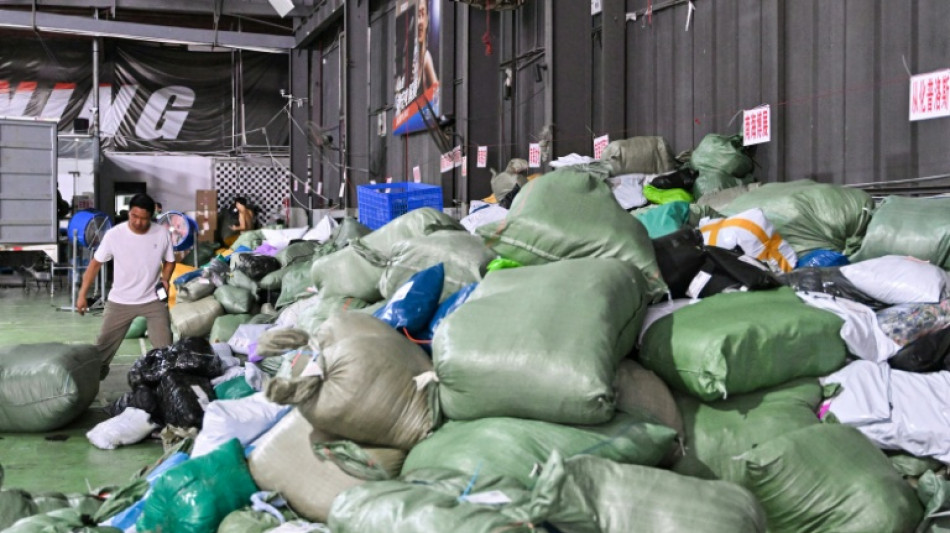
In China's factory heartland, warehouses weather Trump tariffs / Photo: ADEK BERRY - AFP

 Kuwait exhibition presents Ukraine’s Islamic heritage and cultural ties

 Tech firms track Wall St rally on mixed day for Asian markets
 Jay-Z to perform at Super Bowl LXI halftime show: NFL

 Climate-threatened Fijian utopia rejects calls to relocate

 Israel to give verdict on Netanyahu in pivotal election

 $1m bounties, dawn arrests: Trump presses voter fraud campaign

 Gasping for air: Borneo residents struggle as island burns
 Doha exhibition charts a millennium of Chinese maritime ceramics trade

 New Zealand ex-PM Ardern to teach leadership in Sydney

 Ballon d'Or 'beyond wildest dreams' but Kane has plenty more to prove

 No envy, no secrets: How Spain's Gipuzkoa became football coaching hotbed

 South Korea economy grows three times faster than expected in Q3

 Al-Thawadi urges technology to deepen human connection through shared experiences
 Ballon d'Or: Harry Kane's crowning moment

 Harry Kane wins men's Ballon d'Or

 Lula win rattles Brazil markets over spending spree fears

 De la Fuente wins men's Ballon d'Or coach of year

 Trump slams 'rigged' Brazil election after ally loses to leftist Lula

 Nadal returns for Vegas hardcourt event

 Fainga'anuku named as loose forward for All Blacks northern tour

 Anthropic points to AI dangers, soaring sales in IPO filing

 Sinner to play rescheduled Saudi Six Kings in December

 Brazilian lawmaker Andre Janones, Lula's social media 'general'

 Swiss Ebola patient repatriated from Nigeria

 Nations far from a deal as UN nature talks enter final stretch

Labourer Shuai Hang went a week without work earlier this year when sky-high US tariffs on Chinese goods overwhelmed the warehouse he works at and slowed the company's US-bound parcels to a trickle.
But on Tuesday, after US President Donald Trump announced a truce on those duties would be extended, the depot in southern China's manufacturing hub Guangzhou was alive with noise as workers stuffed trucks with packages of clothes and kitchenware.
Many are destined for the doorsteps of US customers of Chinese-founded online shopping giant Temu.
"Tariffs impact our daily lives," said 31-year-old Shuai, whose monthly pay of more than 10,000 yuan ($1,400) had dropped by a third previously.
"If tariffs are slightly lower, then there are more outgoing shipments, and then we have higher wages," he said.
Trump's tariff policies since taking office have upended global trade and set off a blistering tit-for-tat with Beijing -- but in May the two major economies agreed to a fragile truce, with each temporarily lowering levies on the other's goods.
That agreement was extended to November by Trump on Monday, hours before it expired.
At the height of the tariffs, said Shuai, who has been loading parcels for Guangzhou-based logistics company Weijiang International for a year, "there was not a single truck" for him to fill, so he couldn't work.
Overall deliveries dropped by about 20 percent in May, according to Weijiang's founder Xiong Wei, with the US market making up around a quarter of their cross-border business.
But business has recovered since July, he said.
Xiong said he hadn't lost sleep over the looming expiration of the 90-day tariff truce this week, as he had expected it would be renewed.
"We might have been worried in May, but now we are indifferent," said Xiong. "We are used to it".
- 'Cards reshuffled' -
These days the warehouse is sending out 100 tonnes of packages every 24 hours, with up to 70 trucks making trips.
On Tuesday industrial fans whirred as sweat-slicked workers methodically scanned yellow, black and sage green bundles into lorries.
Xiong's company has recently invested in its own warehouse in Chicago.
In many ways the uncertainty provided opportunity for smaller logistics companies like theirs, said manager Chen Weiyan, as they have taken the chance to expand their market.
"The cards have been reshuffled," he said.
Around 30 percent of the parcels moved by Weijiang International end up in a different warehouse, this one owned by Temu-parent PDD, where they are unloaded, repacked and readied for a flight across the ocean.
While the truce is welcome, Shuai, who packs three to four tonnes in a truck daily, said he still pays close attention to tariff news.
"For those of us who have travelled over 1,000 kilometres to work here, we definitely don't want frequent breaks. We all want to earn more money," said the native of neighbouring Guizhou province.
Working at the warehouse was less tiring than labouring at a construction site, and earning money had become more difficult in the past two years, he said.
Chen, the manager, was bullish.
"We will not give up this market," he said. "Folks in America need our goods".
N.Mitchell--AT