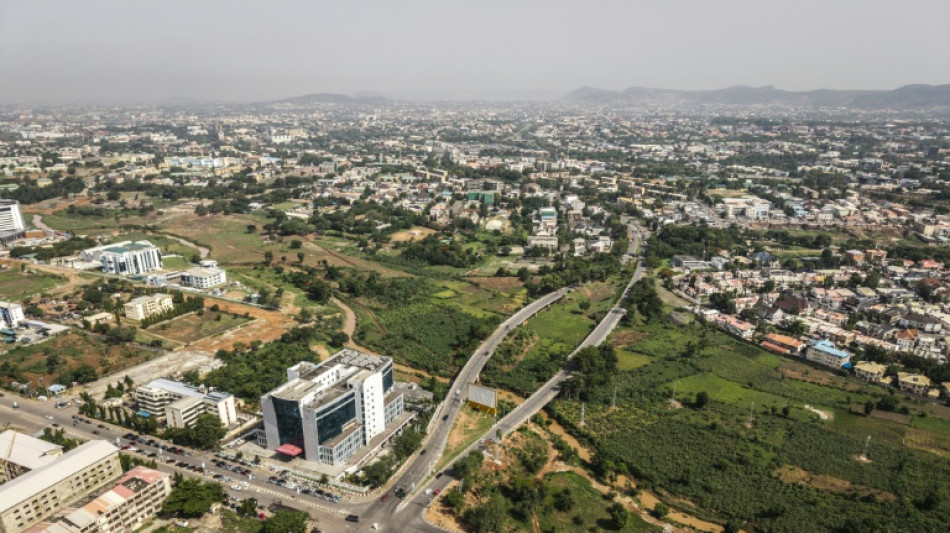
Nigerian farms battle traffic, developers in downtown Abuja / Photo: OLYMPIA DE MAISMONT - AFP

 Osaka channels NBA icon Iverson to reach US Open second round

 Fast-fashion giant Shein plunges 10% on Hong Kong debut

 South Korea hire former Spain boss Moreno as interim coach

 China-Taiwan friction clouds Pacific summit

 Two dead after stabbing in New York's Times Square

 Anthropic signs $35B computing deal with startup backed by Nvidia
 Drones in Ithaca: Azov's Odyssey turns Ukraine war into modern myth

 Boat builders keep Pakistan's fishing heritage afloat

 Australia axe Labuschagne for Zimbabwe, South Africa ODI series

 Heavy rain at Grand Canyon after flood kills 2, dozen missing

 Kushner blames soccer power struggle for World Cup plan collapse

 Buoyant Alcaraz shakes off nerves to advance at US Open

 US draws European pushback with Russia G20 finance invite

 Jury begins deliberations in Tupac Shakur murder trial

 US Supreme Court allows Trump ballroom project to proceed

 Trump says US reviewing position on Falkland Islands

 Saka strikes as flawless Arsenal punish troubled Villa

 Oil prices surge on renewed fighting in US-Iran war

 Cycling superstar Pogacar has surgery after Vuelta crash
 Man City agree deal for Everton's Ndiaye

 Apple CEO Tim Cook gives nod to founder Steve Jobs in final memo

 Russian finance minister makes unexpected appearance at G20

 Happy to be back in NY, Sabalenka advances

 Naomi Watts to receive lifetime award at top Spain film fest

 Jury hears closing arguments in Tupac Shakur murder trial

Under the din of traffic from the highway bridge that cuts over his fields, Bala Haruna inspects corn, cassava and okra on his family farm.
A pump pulls up water from a nearby stream and is diverted through trenches dug through cropland wedged between four-lane roads -- fields which were here long before the nearby hotel, the imposing national mosque or any of the high-rises that make up downtown Abuja were even dreamed up.
"There were no buildings here," Haruna, 42, told AFP, reminiscing over his childhood as birds chirped and frogs croaked.
The urban farms dotting Nigeria's capital show the limits of the top-down management the planned city is known for -- oases scattered around pockmarked downtown that has long expanded outward faster than it has filled in.
They owe much of their existence to the fact that they lie in hard-to-develop gulches along creek beds. Even roads built through them over the years tended to be elevated highway overpasses.
That fragile balancing act, however, is increasingly under threat, as developers fill in farmland despite regulations protecting these areas as rare green spaces in a city known for concrete sprawl.
On the other side of the overpass, the future has arrived: the vegetation abruptly stops and temperatures suddenly rise over flattened fields razed by construction crews.
Local farmers said the people who took the land three years ago provided no documentation and only gave the eight of them 300,000 naira to split -- a sum worth only $190 today after years of rampant inflation.
Much of the farmland in and around downtown is supposed to be a municipal green space, with neither farms nor buildings on it.
But enforcement of the decades-old Abuja master plan is ripe with abuse and lack of enforcement, said Ismail Nuhu, urban governance researcher who did his PhD on the capital's urban planning.
Adding to the sense of precarity is that the land, on paper, belongs to the government.
"Politicians still use it to grab lands, just to say, 'Oh, according to the master plan, this is not to be here'," no matter what the document actually says, he told AFP, adding that, technically, even the presidential villa is not located where it is supposed to be.
Nyesom Wike, the minister of the Federal Capital Territory, which includes Abuja, recently told reporters he would "enforce" the 70s-era master plan by building roads and compensating and evicting settlements that stand in the way.
FCT officials including Wike's spokesman did not respond to requests for comment.
- Urbanising country, not enough jobs -
The farms have provided steady employment -- a lifeline for some as the rapidly urbanising country fails to produce enough jobs. A recent opening for 10,000 government jobs saw 450,000 applicants, according to local media.
"Having a green space... in a very thick, populated city like Abuja does a lot of good," said retiree Malik Kuje Guni, who started farming three years ago to supplement his pension.
While tens of thousands of residents pass by the farms each day without second thought, Guni, when he was working as a civil servant, would often come down to visit, enjoying the shade and fresh air.
Now tilling a potato plot of his own, "I can come down, work, sweat," the 63-year-old said. "I have hope something will come out of it."
A few blocks over, squat, informal houses made of wood and sheet metal give way to a field of sugarcane, corn and banana trees. Glass-panelled highrises, half-finished construction and the imposing Bank of Industry tower above.
The crops give way to land cleared by developers a few months ago, some of whom pushed into Godwin Iwok's field and destroyed his banana trees.
Iwok, who quit his security job 22 years ago to make more money as a farmer, has had parts of his fields destroyed twice in the past two years, neither time with compensation.
To Guni, the farms represent the city's rural heritage. Despite decades of government promises to relocate Nigeria's capital from the crowded, congested mega-city of Lagos, the move only occurred in 1991.
But neither Iwok, 65, nor Haruna want their children to continue their increasingly precarious line of work.
"I wouldn't want my children to stand under the sun as I did," Iwok told AFP.
"I only use what I'm getting here... to make sure my children go to school."
E.Rodriguez--AT