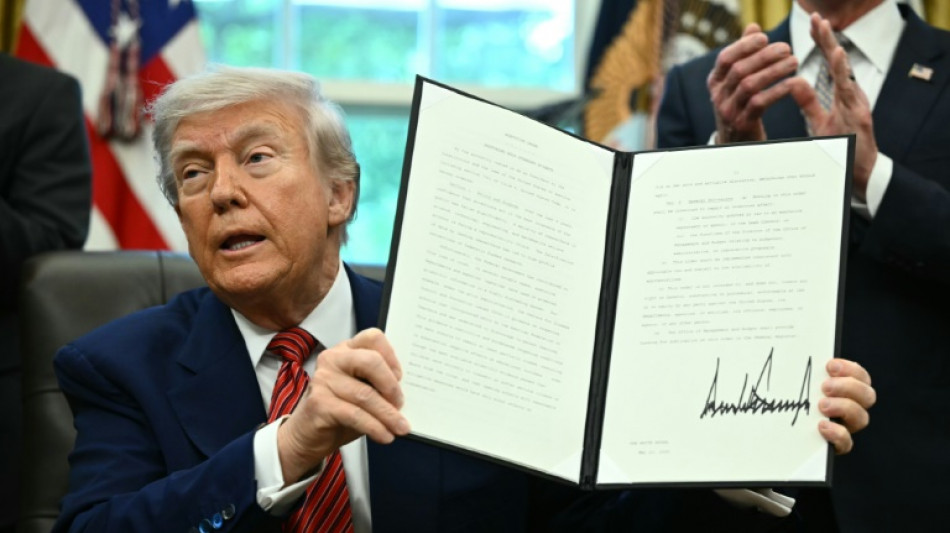
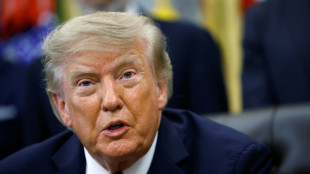
Trump signs orders to boost US nuclear energy / Photo: Mandel NGAN - AFP

 From Hollywood to big time tennis: teen makes US Open debut

 Man City secure Premier League record deal to sign Fernandez

 Kaepernick says NFL 'blackballing me' decade after protest

 Atletico loan David from Juve, send Lemar to Elche

 Chelsea 'keeper Sanchez makes deadline-day move to Como

 Kroenke to buy baseball's Los Angeles Angels: statement

 US defends Trump's Venezuela oil deal

 OpenAI to launch new model with 'stronger safeguards' after hack
 Fans mourn 'bittersweet' final Ariana Grande gig in London
 Norway's King Haakon VIII swears allegiance to constitution
 Syria site infrastructure 'consistent with nuclear reactor': IAEA

 Juventus sign Woltemade, Sarr on loan from Premier League

 US strikes Iran in latest tit-for-tat attacks
 China's Xi arrives in Egypt as US sanctions threat looms over Iran links
 Car bomb at Colombian police station kills one, injures 11
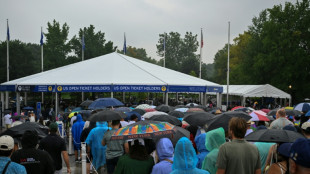 Rain delays start of play on US Open
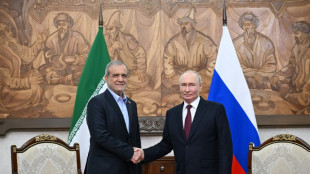
 Man City agree blockbuster deal to sign Chelsea star Fernandez: reports
 Alkemya Metacore Secures $50M via Tokenised Equity to Scale Nickel Energy and Security Tech

 Man City chase Fernandez, Arsenal sell Jesus on deadline day

 EU says Russian 'hybrid attacks' won't halt aid to Ukraine
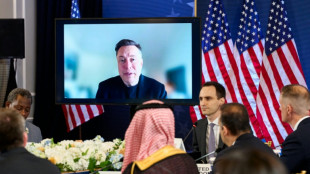
 Explosives used in sabotage attack on German power lines
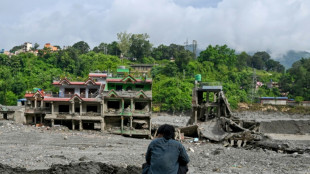
 Nepali families hold symbolic funerals for missing after floods
 Newcastle sign Lille forward Fernandez-Pardo

 Even at Elysee, phones are handed in, Macron tells French pupils
 Chelsea agree to sign Atalanta's Ahanor, with Palace loan for this season

President Donald Trump signed a series of executive orders Friday to boost nuclear energy in the United States, including by rolling back regulatory processes on a still divisive technology.
"We're signing tremendous executive orders today that really will make us the real power in this industry," Trump told reporters as he penned the four orders in the Oval Office.
Trump's orders aim to speed up the building of new reactors and to boost domestic mining and enriching of uranium, with the United States relying on imports for most of the crucial fuel.
The US president said the focus would be on building smaller reactors, such as those required by tech and artificial intelligence companies that have huge energy needs.
The orders will also overhaul the US nuclear watchdog so that it pushes through decisions on building new reactors within 18 months, amid reports that the White House found the regulator too risk averse.
Trump denied that speeding up the regulation process could compromise nuclear safety.
"We're going to get it very fast and very safe," Trump said. "It's time for nuclear and we're going to do it very big."
The move comes with growing interest in nuclear energy in the United States, despite being expensive to build and still politically sensitive in the wake of the 2011 Fukushima disaster.
"President Trump is taking truly historic action to usher in the American nuclear renaissance," Michael Kratsios, Director for the White House Office of Science and Technology Policy, told reporters earlier.
- 'Energy emergency' -
A senior White House official said the administration hopes to "test and deploy" new reactors before the end of Trump's second term in January 2029.
Trump's order "fundamentally rehauls" the Nuclear Regulatory Commission, which grants permission for new reactors, by "lowering regulatory burdens and shortening the licensing timeline."
Republican Trump declared an "energy emergency" on his first day back in office to expand drilling for oil and gas and to roll back Democratic predecessor Joe Biden's climate policies,
But he is now also looking at nuclear to meet growing demand.
Much of the demand is fueled by US tech giants, with some including Amazon, Microsoft and Google having recently signed deals for nuclear power as they seek carbon-free electricity sources.
Two US energy companies are also preparing to bring nuclear stations back online, including Three Mile Island -- the site in 1979 of the worst commercial nuclear power accident in US history.
Trump's drive to boost mining and enrichment also reflects the fact that the United States imports most of the uranium that is needed to fuel nuclear power stations.
The US imported most from Canada, Australia, Russia, Kazakhstan, and Uzbekistan in 2023 but in 2024 it banned uranium imports from Russia over Moscow's invasion of Ukraine.
Nuclear power has been undergoing a resurgence in recent years as countries look for carbon-free energy and confront rising prices, fueled by the war in Ukraine.
It suffered a major downturn after Fukushima when a huge tsunami caused a meltdown at a Japanese power station, with Germany in particular turning its back on nuclear.
G.P.Martin--AT