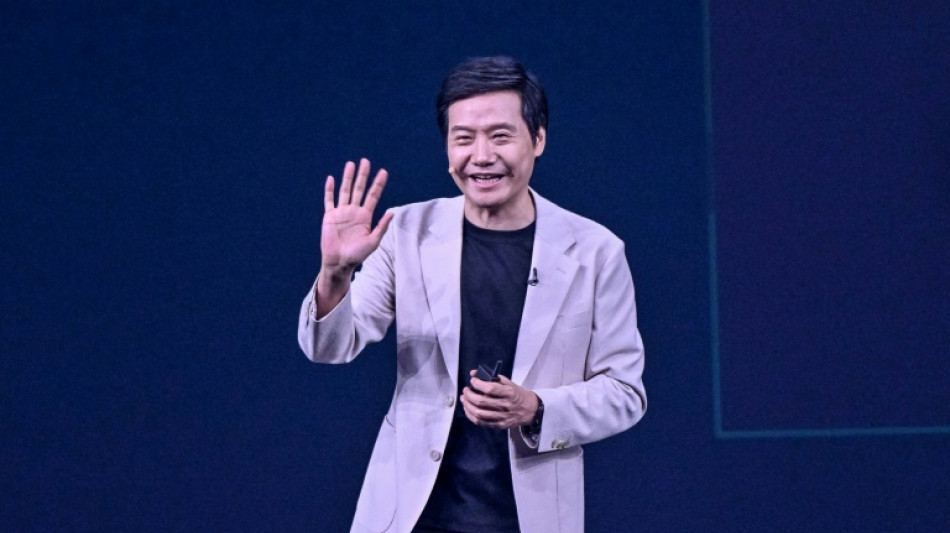
Xiaomi launches new advanced in-house mobile chip / Photo: ADEK BERRY - AFP

 Horoscope for October 30, 2026: communication and patience shape the day

 Amazon cloud business accelerates but shares drop on profit miss

 Wesley Fofana under scrutiny after Chelsea penalty miss in Carabao Cup

 Russell admits absence of rivalry because he cannot match Antonelli

 DR Congo says Rwanda flouting pact, US sanctions justified

 Brazil's Flavio Bolsonaro isolated, ridiculed after self-exile

 Asian equities diverge after mixed technology earnings and Fed rate decision

 Zverev 'on top of the world' after securing No. 1 ranking

 Clash of styles as Vikings, Lions prepare for NFL showdown

 After a long slog to the top, Zverev leaps to No. 1 ranking

 GCC legislative officials review ways to deepen regional cooperation

 Canada buying stake in AI firm Cohere to bolster tech sovereignty

 Utah files criminal charges against prediction market Kalshi

 Grieving Spain demands answers for latest rail disaster

 Judges to rule on Australian mushroom killer's appeal

 Qatar prime minister tours Cityscape Qatar 2026

 Bugatti CEO to stop leaving keys inside cars after Chiron theft

 Starc, Lyon leave South Africa reeling

 Arsenal lose appeal against Dowman red card in shock Fleetwood defeat

 French court rules Meta must negotiate over rights payments

 Spain demands answers as rail disaster toll rises

 Garcia bids for Ryder Cup return as he confirms LIV exit

 England outlast Sri Lanka despite Rathnayake's hundred in dead rubber

 Starc strikes twice as Australia push for victory

 Does White House ask AI to shape policy? Democrats want the receipts

Tech giant Xiaomi unveiled a new advanced in-house mobile chip on Thursday, a significant milestone for the company as Chinese firms shift resources towards home-grown technology against a bleak international trade backdrop.
Xiaomi, which sells goods from smartphones to vacuum cleaners and electric vehicles (EVs), is one of China's most prominent consumer electronics firms.
With the XRING O1, it becomes only the second smartphone brand globally after Apple to mass produce its own 3-nanometre chips, among the most advanced on the market.
This despite being a latecomer to the chip industry, Xiaomi founder Lei Jun said at a launch event on Thursday, joking that the feat had been "harder than ascending to heaven".
Xiaomi took early steps into semiconductors for smartphones with the launch of the firm's first in-house chip, the Surge S1, in 2017.
But the group was forced to halt production of the chip due to technical and financial obstacles.
Lei said the journey to developing the XRING O1 had taken over a decade.
"How much hardship, how much sweat, how much untold pain have been involved in these 11 years? How much courage and determination did it take to make this decision?" he said.
The XRING O1 will first be deployed in Xiaomi's new 15S Pro flagship smartphone and the Pad 7 Ultra tablet, which were also launched Thursday along with a preview of the firm's first electric SUV.
- 'Step to self-sufficiency' -
A number of Chinese firms are racing to develop their own chips with the aim of freeing themselves from reliance on foreign suppliers.
Xiaomi is only the fourth smartphone brand globally to have developed its own system-on-chip, with Huawei the only domestic competitor.
"This represents yet one more step toward China reaching self-sufficiency in this crucial industry –- as well as in broader ICT and electronics supply chains," Stephen Ezell from US-based think tank Information Technology and Innovation Foundation (ITIF) told AFP.
Over the past few years, Washington has sharply tightened export controls on advanced chip technology to China, citing national security concerns.
Chinese chip foundries are restricted from accessing foreign equipment needed for cutting-edge chip production -- meaning that firms have to rely on overseas foundries for 5nm-process and below.
Xiaomi has not confirmed which company is manufacturing the XRING O1, though Lei said it uses the same second generation 3nm-process technology as Apple's latest chips.
Apple contracts Taiwanese chipmaking titan TSMC for its fabrication.
The chip is a "significant" achievement for Xiaomi, and allows it to reduce "its reliance on external designers" such MediaTek and Qualcomm, Washington-based semiconductor and technology analyst Ray Wang told AFP.
"Longer term, owning its SoC (system-on-chip) roadmap will insulate Xiaomi's devices from the US–China geopolitical tensions and help mitigate global supply-chain disruptions," he said.
D.Lopez--AT