Gabon longs to cash in on sacred hallucinogenic remedy / Photo: Nao Mukadi - AFP

 Cricketers to get best rooms at Asian Games, says Japan chief

 Zverev out-lasts Sonego in wild five-setter to advance at US Open

 Amid war, Ukrainian soldiers celebrate love at ritual wedding

 Venice to roll out red carpet for Clooney on opening night
 Hong Kong democracy activist Wong pleads guilty to foreign collusion: AFP

 Stocks sink, yields at multi-decade highs and oil spikes on Mideast flare-up

 US defends Trump Venezuela oil deal as energy secretary lands in Caracas
 Jubilant Monfils celebrates birthday with US Open win
 The Japanese idealist behind the last deradicalisation NGO in Somalia

 Rybakina, Gauff advance as Zverev launches US Open campaign
 Macron in Britain to help unveil tapestry, hold Burnham talks
 China's Xi to hold talks with Sisi in rare visit to Egypt

 Confident Gauff reaches US Open 2nd round with straight-set win
 US postal whistleblower warns ballot system could disrupt midterms

 InterContinental Hotels Group PLC Announces Transaction in Own Shares - September 02

 G20 finance leaders close talks marked by US welcoming Russia

 From Hollywood to big time tennis: teen makes US Open debut

 Man City secure Premier League record deal to sign Fernandez

 Kaepernick says NFL 'blackballing me' decade after protest

 Atletico loan David from Juve, send Lemar to Elche

 Chelsea 'keeper Sanchez makes deadline-day move to Como
 Kroenke to buy baseball's Los Angeles Angels: statement

 US defends Trump's Venezuela oil deal

 OpenAI to launch new model with 'stronger safeguards' after hack

 Fans mourn 'bittersweet' final Ariana Grande gig in London

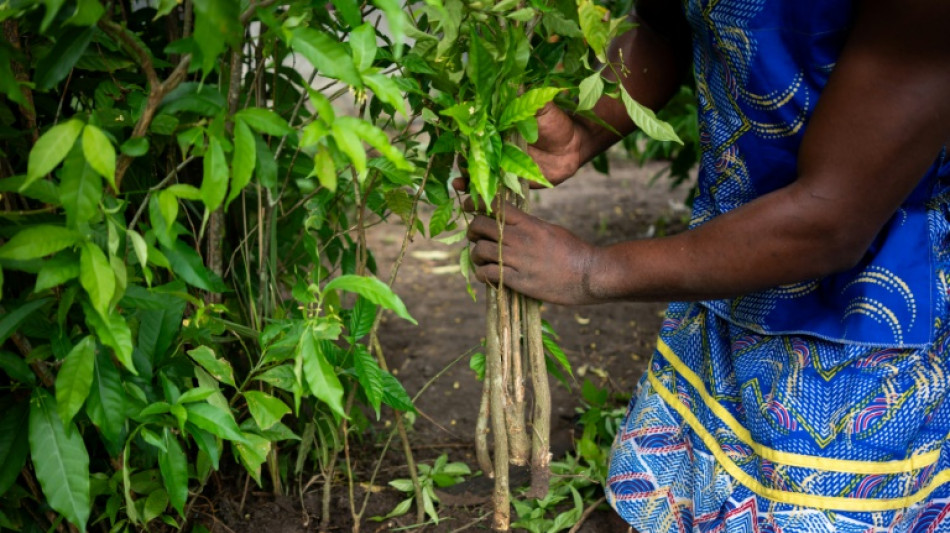
Beneath yellow fruit, hidden within the roots of the iboga plant in the forests of Gabon, lies a sacred treasure that the country is keen to make the most of.
For centuries, religious devotees have eaten it -- a psychotropic shrub that users say has addiction-fighting powers.
It fascinates foreign visitors, psychiatric patients and rich pharmaceutical companies that want to market it.
Now this central African country, where its use is enshrined in ancestral tradition, is scrambling to avoid missing out on the boom.
Teddy Van Bonda Ndong, 31, an initiate in the Bwiti spiritual tradition, calls it "sacred wood". He consumes it in small amounts daily, he said, for his "mental and physical health".
"It has a lot of power to help human beings," added Stephen Windsor-Clive, a 68-year-old retiree.
"It's untapped. A mysterious force lies within this plant."
He travelled to Gabon from Britain and consumed iboga -- in a powder ground from its roots -- during a 10-day Bwiti ceremony.
He tried it with a view to adopting it as a treatment for his daughter, who suffers from mental illness.
- Economic potential -
Given the interest, Gabon is seeking to channel the plant onto the international marketplace.
Exports of iboga products, including its active ingredient ibogaine, are few and strictly regulated in the country.
It grows mostly in the wild, but "more and more effort is being made to domesticate the plant", said Florence Minko, an official in the forestry ministry.
Potentially toxic in high doses, ibogaine can have effects similar to LSD, mescaline or amphetamines, and cause anxiety and hallucinations.
But users believe it can help drug addicts kick their habit and treat post-traumatic stress and neurological illnesses.
Yoan Mboussou, a local microbiologist and Bwiti initiate, hopes to gain an export licence for the 500-milligram ibogaine capsules he produces at his laboratory near the capital Libreville.
He sells them in Gabon as a food supplement, declaring them to have "anti-fatigue, antioxidant and anti-addictive" qualities.
Iboga, he believes, "is a potential lever to develop the economy and the whole country".
- Tradition and IP -
Countries such as the United States and France class iboga as a narcotic because of health risks identified in studies, especially heart issues. But it is used in treatment centres in countries including the Netherlands, Mexico and Portugal.
Numerous studies have examined its effects -- both helpful and harmful -- and scientists have taken out dozens of international patents for ibogaine therapeutic treatments.
"Most of those are based on studies of iboga use by Gabonese people, particularly by Bwiti practitioners," said Yann Guignon, from the Gabonese conservation group Blessings Of The Forest.
Despite the plant's "colossal therapeutic benefits", "Gabon is clearly missing out on the economic potential of iboga," he added.
"It did not position itself in this market in time by developing productive iboga plantations, a national processing laboratory and a proper industrial policy."
Overseas laboratories meanwhile have worked out how to make synthetic ibogaine and to extract it from other plants, such as Voacanga africana.
That flowering tree is available in greater quantities in Ghana and Mexico, which "can produce ibogaine at unbeatable prices", said Guignon.
And "Gabonese traditional knowledge is not protected by intellectual property regulations."
Currently only one company in Gabon has a licence to export iboga products -- though Minko, from the forestry ministry, said the country hopes this number will rise in the coming years.
She said companies were likely to produce more, spurred by revenue guarantees under the Nagoya Protocol, an international agreement on biological diversity and resource-sharing.
She wants the country to obtain a "made in Gabon" certificate of origin for iboga.
"This is a huge resource for Gabon. We have drawn up a national strategy for the conservation and sustainable use of the product," she said.
"Gatherings will soon be organised, bringing together all the groups concerned: NGOs, traditional practitioners and scientists."
- Soothing properties -
After harvesting iboga to the sound of traditional harps and consuming it in the initiation ceremony, Stephen Windsor-Clive was convinced by the benefits of iboga.
"I definitely want to bring my daughter here and have her have the experience," he said.
"This is my last attempt to find something which might be of assistance to her."
Another visitor, Tafara Kennedy Chinyere, travelled from Zimbabwe to discover Gabon and found, in the initiation, relief from anxiety and his "inner demons".
"I feel good in my body, in myself," he said, sitting under a tree after the ceremony.
"I feel like the iboga helped me to let go of things that you no longer need in your life."
F.Ramirez--AT