Wolf protection downgrade gets green light in EU / Photo: THOMAS KIENZLE - AFP/File

 Chase sparks Bangladesh collapse as West Indies on top in Mirpur

 BP net profit quadruples as Mideast war lifts oil prices

 Kulusevski says 'nervous system changes' behind Spurs return

 Marquez crashes, then tops second practice in Malaysia

 New home for orangutans rescued from Indonesia's burning forests

 Independent Russian newspaper Novaya Gazeta shuts under Kremlin pressure

 Thailand extends activist's jail term to more than 34 years

 China denies spying on Nvidia's Jensen Huang

 BP net profit quadruples on higher oil prices

 Kiss backs 'hungry' Beale to push for Wallabies game time

 World number one Rybakina withdraws in Tokyo with injury

 Malawi's fuel shortages, record prices deepen economic crisis

 Rubio hosts G20 ministers as Iran, Ukraine wars divide members

 From minerals to AI, EU and Canada to forge new alliance

 Fire pollution killed 3,560 people in Indonesia in September: report

 Ian Wright and Jamie Carragher split on Liverpool-Arsenal prediction

 The Duskbloods delayed as Nintendo Switch 2 release moves to 2027

 Russia turns to NATO countries for prosthetics amid war-related shortages

 Researchers on island encounter giant spider legs emerging from a burrow

 Britain's King Charles lands in ex-colony Guyana

 Arsenal assess Bukayo Saka fitness concerns before Liverpool meeting

 £10,000 garden project transforms a UK home into a miniature Greece

 Forest destruction tests Armenia-Azerbaijan peace push

 Deal still eludes nations on final day of UN nature talks

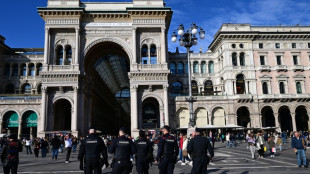 Teen rallies take to the streets across Italy

EU lawmakers on Thursday gave the green light to downgrading wolf protections in the bloc, which will allow hunting to resume under strict criteria.
Members of the Bern Convention, tasked with the protection of wildlife in Europe as well as some African countries, agreed in December to lower the wolf's status from "strictly protected" to "protected".
The downgrade came into force in March, and the European Commission moved immediately to revise related EU laws to reflect the change.
EU lawmakers approved the move by a majority of 371 to 162, with support from conservative, centrist and hard-right groups.
The law requires a formal rubber-stamp by EU member states -- which have already endorsed the text -- before entering into force, after which states will have 18 months to comply.
Green and left-wing parties voted against a change they denounce as politically motivated and lacking scientific basis, while the parliament's socialist grouping was split on the matter.
The European Union -- as a party to the Bern Convention -- was the driving force behind the push to lower protections, arguing that the increase in wolf numbers has led to more frequent contact with humans and livestock.
But activists fear the measure would upset the recovery made by the species over the past 10 years after it faced near extinction a century ago.
A trio of campaign groups -- Humane World for Animals Europe, Eurogroup for Animals and the International Fund for Animal Welfare (IFAW) -- denounced the vote as "a worrying precedent for European nature conservation."
"There is no data justifying a lower level of protection, but the EU institutions decided to ignore science," IFAW's Europe policy director Ilaria Di Silvestre said in a joint statement.
Echoing those concerns, Sebastian Everding of the Left group in parliament said the move "ignores effective coexistence tools".
"Downgrading wolf protection... panders to fear, not facts," he charged.
Grey wolves were virtually exterminated in Europe 100 years ago, but their numbers have surged to a current population of 20,300, mostly in the Balkans, Nordic countries, Italy and Spain.
- No 'licence to kill' -
Commission president Ursula von der Leyen welcomed the results of the vote on Thursday.
"With growing wolf concentrations in some areas, we should give authorities more flexibility to find balanced solutions between the aim to protect biodiversity and the livestock of local farmers," she wrote.
In late 2022, von der Leyen lost her beloved pony Dolly to a wolf that crept into its enclosure on her family's rural property in northern Germany -- leading some to suggest the matter had become personal.
In practice, the EU rule change makes it easier to hunt wolves in rural and mountainous regions where their proximity to livestock and sheepdogs is deemed too threatening.
Von der Leyen's European People's Party (EPP), which spearheaded the change, has stressed that member states will remain in charge of wolf management on their soil -- but with more flexibility than before.
To date, there have been no human casualties linked to rising wolf populations -- but some lawmakers backing the change warn that it may only be a question of time.
Spain's Esther Herranz Garcia, a member of the conservative EPP, cited figures showing that wolves attacked more than 60,000 farm animals in the bloc every year.
"The people who feed our country cannot be expected to work with this fear hanging over them," said France's Valerie Deloge, a livestock farmer and lawmaker with the hard-right Patriots group, where the rule change found support.
Socialist and centrist lawmakers -- while agreeing to back the changes under a fast-track procedure -- struck a more measured tone.
"This is not a licence to kill," Pascal Canfin, a French lawmaker with the centrist Renew group, told AFP. "We are providing more leeway for local exemptions -- wolves remain a protected species."
A.Taylor--AT