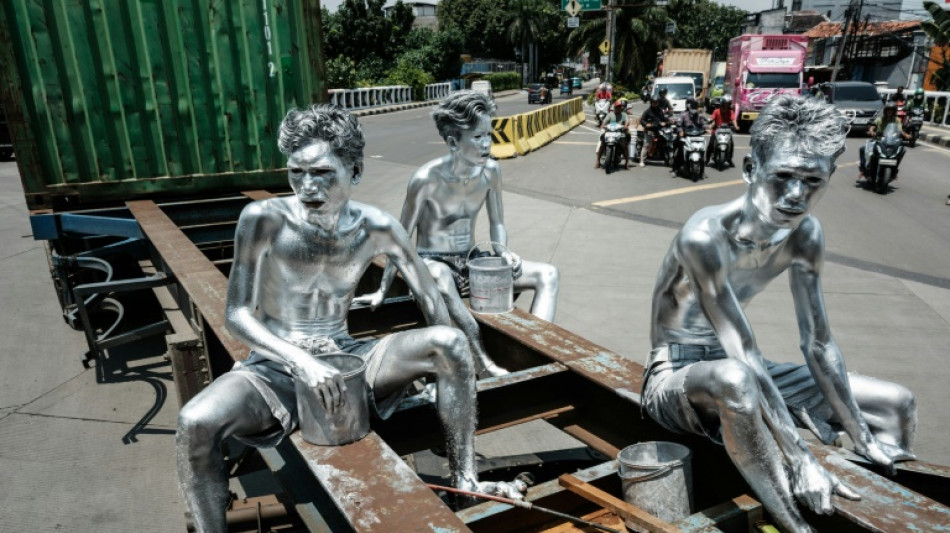
Indonesia's silvermen beg to make ends meet / Photo: Yasuyoshi CHIBA - AFP

 Australia defends Pacific climate meeting despite doubts on attendance
 Iran attacks US sites after American strikes, wedding deaths

 Stocks drop, yields at three-decade highs on Mideast flare-up

 EU summons Russian envoy, eyes sanctions after Germany drone 'attack'

 Stocks drop as yields and oil prices spike on Mideast flare-up
 Cricketers to get best rooms at Asian Games, says Japan chief

 Zverev out-lasts Sonego in wild five-setter to advance at US Open

 Amid war, Ukrainian soldiers celebrate love at ritual wedding

 Venice to roll out red carpet for Clooney on opening night
 Hong Kong democracy activist Wong pleads guilty to foreign collusion: AFP

 Stocks sink, yields at multi-decade highs and oil spikes on Mideast flare-up

 US defends Trump Venezuela oil deal as energy secretary lands in Caracas
 Jubilant Monfils celebrates birthday with US Open win
 The Japanese idealist behind the last deradicalisation NGO in Somalia

 Rybakina, Gauff advance as Zverev launches US Open campaign
 Macron in Britain to help unveil tapestry, hold Burnham talks
 China's Xi to hold talks with Sisi in rare visit to Egypt

 Confident Gauff reaches US Open 2nd round with straight-set win
 US postal whistleblower warns ballot system could disrupt midterms

 Independent Pharmacy Cooperative Acquires USave Pharmacy Group
 John Ternus takes over as Apple enters era of AI, foldable phones

 Second-ranked Rybakina eases into US Open 2nd round

 Man City sign Fernandez, Ndiaye as Premier League clubs set new spending record

 Alcaraz aims to step it up in round two of US Open title defense

 Honduran judge drops corruption charges against ex-leader Hernandez

On a rainy day in Indonesia's capital Jakarta, three men coated in metallic paint known as the "manusia silver", or silvermen, brave the elements at an intersection near a mall to ask drivers for change.
It is an arresting act that comes with health risks, one some young Indonesians feel is necessary to make ends meet as the cost of living worsens and jobs dwindle after the Covid pandemic.
"I'm ashamed to earn money like this. I want to find a real, more dignified job," said Ari Munandar, 25.
"But the embarrassment disappears when you remember that your daughter and your wife are at home."
Barefoot, dressed only in shorts and daubed head to toe by the irritating paint, Ari, his brother Keris and their friend Riyan Ahmad Fazriyansah each take a lane in the road.
When the cars come to a stop they strike robotic poses in front of the drivers.
"Good afternoon, have a nice drive," says Ari.
The poses have little meaning other than to attract cash.
"I do them because one day I saw a friend earn more by doing them," he said, moving between cars, holding out a bucket for donations.
On a good day they can pocket up to 200,000 rupiah ($12), but typically earn around 120,000.
That's much less than Jakarta's monthly minimum wage of five million rupiah and barely enough to cover daily expenses.
"I'm not going to eat lunch, just drink and smoke," said Ari.
Every penny counts in a country where prices have risen steadily in recent years.
A kilogram (two pounds) of rice, the archipelago's main staple, jumped by 27 percent between 2015 and 2025, according to statistics agency data.
And behind the paint, the friends are clearly undernourished.
None are taller than 172 centimetres (five feet eight inches) nor weigh more than 55 kilograms.
- 'Stings my eyes' -
A lack of employment opportunity is the main cause of young men and women taking to the streets, they say.
"Since I was made redundant in 2019 I've been begging," said Ari.
"Before that, I worked cleaning toilets."
According to government data, the number of people living below the poverty line in metropolitan Jakarta -- a megalopolis of 11 million people -- was up from 362,000 in 2019 to 449,000 as of September 2024.
"Many young people with few qualifications between the ages of 20 and 40 have found themselves unemployed," said Bhima Yudistira, executive director of the Center of Economic and Law Studies.
"Even though there is no national count, there has been a huge rise in begging in Jakarta after the pandemic of 2021."
After five hours at the intersection, the group returns home by hitchhiking a ride from a tuk-tuk.
The three pile into the back, counting their meagre earnings and lighting a cigarette to share.
Once dropped off, they walk by a polluted river and across a railway line to their Jakarta slum.
Far from the capital's high-rises, children play near the tracks to the rhythm of the trains as Ari makes his way back to remove the silver.
The paint, similar to that used for screen-printing on fabric, is not easy to remove.
Squatting in front of a well and buckets filled with water, he splashes his body before scrubbing fiercely, his one-year-old daughter Arisya watching.
"At first the paint burned and I had a blister on my neck, but now it only stings my eyes," he said.
The shower reveals a new, younger man.
Once dry, he heads home to play with Arisya.
"As soon as I'm here I forget all the fatigue and the hardship," he says, smiling.
"But I hope she never does what I do."
Th.Gonzalez--AT