Trump tariff promises get a reality check / Photo: Jim WATSON - AFP/File

 Third-ranked Pegula powers into US Open third round
 Uber says laying off 'about 10%' of workforce worldwide

 US judge rejects bid to break up Google's ad business
 Rupert Murdoch 'very happy' to be played by Guy Pearce in new film

 Wall Street stocks rise despite bond yields, oil rising

 Brennan claims third Vuelta victory in stage 11 sprint

 Nepal flood survivors cling to zipline to cross treacherous river

 US Treasury issues $1 coin with Trump's face on it

 Fernandez 'didn't hesitate' over record Man City move

 Dutch shift 86 tonnes of gold from US, Canada to UK
 Nepal floods should mobilise climate action: UN green fund chief
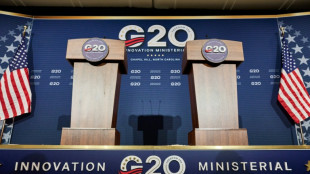 Nvidia boss presses G20 ministers to build AI infrastructure

 Liminal Launches Liminal Prime for Institutional OTC and Stablecoin Liquidity

 10 missing as cargo ship sinks after collision off Istanbul
 30 years on, 'Tomb Raider' reboot sees Lara Croft through a 'modern lens'

 King Charles, Macron to view Bayeux Tapestry as French leader starts UK visit

 George Clooney says US run by 'least qualified people'

 China's Xi urges against Mideast interference in rare Egypt visit
 Venice to roll out red carpet for 'lucky' Clooney on opening night
 'Humiliated' Aubameyang quits Gabon national team
 France sees limited economic hit from drought, heatwaves

 Bus crash in Egypt's Sinai kills 22, including 10 Jordanians
 UN says world must navigate 'reality' of 1.5C overshoot
 Taliban govt defends ban on protest, citing Islamic law

 10 missing as Turkish cargo ship sinks after collision off Istanbul

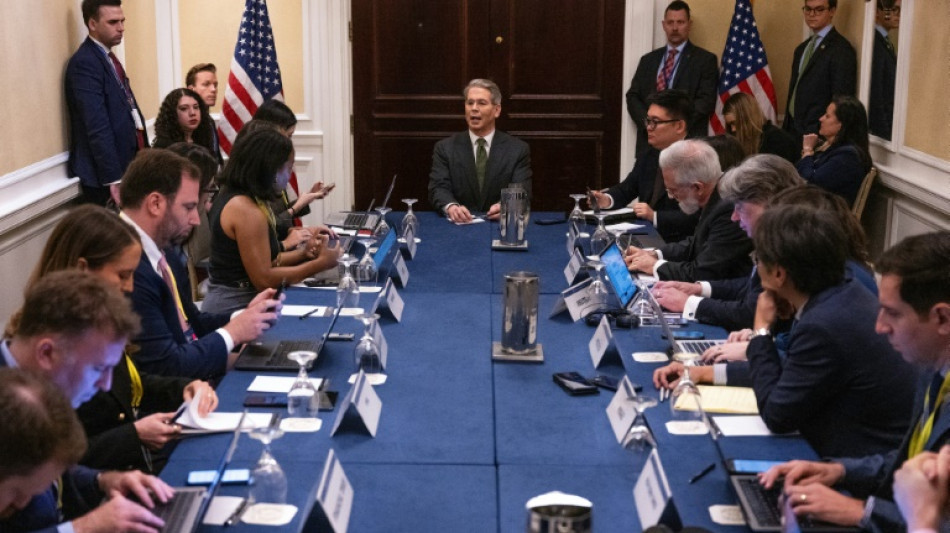
A gathering of global economic leaders in Washington wraps up Saturday with tariff talks between the United States and partners still unresolved -- and anxiety building over the state of the global economy.
The International Monetary Fund and World Bank's spring meetings provided an important opportunity for countries to discuss trade at the sidelines, speaking with President Donald Trump's new administration.
But despite US officials touting progress on tariff talks, analysts tell AFP that the hard work to reaching deals lies ahead.
Since returning to the presidency in January, Trump has slapped 10 percent tariffs on most US trading partners and a separate 145 percent levy on many products from China.
Dozens of countries face a 90-day deadline expiring in July to strike an agreement with Washington and avoid higher, country-specific rates.
But despite Trump saying that there are many deals on the table, details have been scant.
"Coming out, I think we have more confusion, not more clarity, in terms of what the administration wants for negotiations," said Josh Lipsky, international economics chair at the Atlantic Council.
Participants likely left the spring meetings with "a lot of anxiety about what these meetings will be like when they reconvene in six months, both for the state of the global economy and for individual countries," he told AFP.
- 'Notoriously tedious' -
"No deals have been announced but that's not surprising. Trade agreements take time to negotiate," said Wendy Cutler, vice president at the Asia Society Policy Institute and a former US trade negotiator.
While the uptick in negotiating activity is a "positive sign," she added, "holding meetings is a far step from announcing deals."
For now, Washington has prioritized discussions with key allies like Japan, South Korea and Switzerland -- in line with the Trump administration's comments that it would place more focus on about 15 important trading relationships.
Barath Harithas, a senior fellow at the Center for Strategic and International Studies (CSIS), said the emphasis on 15 or so partners is "likely pragmatic."
"Comprehensive tariff negotiations are notoriously tedious, typically spanning years rather than months, and cannot realistically be compressed into a 90-day ultimatum period," he added.
US officials have met with counterparts from countries like South Korea and Japan this week.
But negotiations with Thailand, although initially scheduled, have been postponed as Washington sought further review on crucial issues, Harithas said.
EU economy commissioner Valdis Dombrovskis told reporters Friday that there remains "a lot of work ahead" to reach a deal with Washington.
Underscoring the differences between both sides, Dombrovskis added that tariffs are not a solution to address underlying trade imbalances -- a goal of the Trump administration as it rolled out various levies.
Earlier Friday, Trump also cast doubt on a further tariff pause when speaking to reporters.
- 'Frustration' -
Lipsky of the Atlantic Council said it is seen as "unrealistic" for a series of deals to be struck by July, even if some discussions may bear fruit.
US Treasury Secretary Scott Bessent maintained Wednesday that Washington was close to a pact with India and making progress with other partners.
But he added: "A satisfactory arrangement does not necessarily mean the actual trade document, it means that we have reached agreement in principle."
With current economic worries sparked by Trump's policy decisions, Lipsky said there has been disappointment with current conditions.
"The frustration that I've heard this week is that this was unnecessary," Lipsky added.
And tensions between Washington and Beijing are "not headed towards any immediate resolution," he said.
While Trump said in a Time magazine interview that Xi has called him, Beijing previously disputed that tariff talks were ongoing.
Countries are now resigned to the idea that high US-China tariffs are here to stay, at least in the near future, he added.
A European official told AFP there have been two negotiation channels that are not always in agreement -- with Bessent on one hand and US Commerce Secretary Howard Lutnick on the other.
"The only thing I'm fairly sure of," the official said, "is that in the end, the decision is made by President Trump."
T.Wright--AT