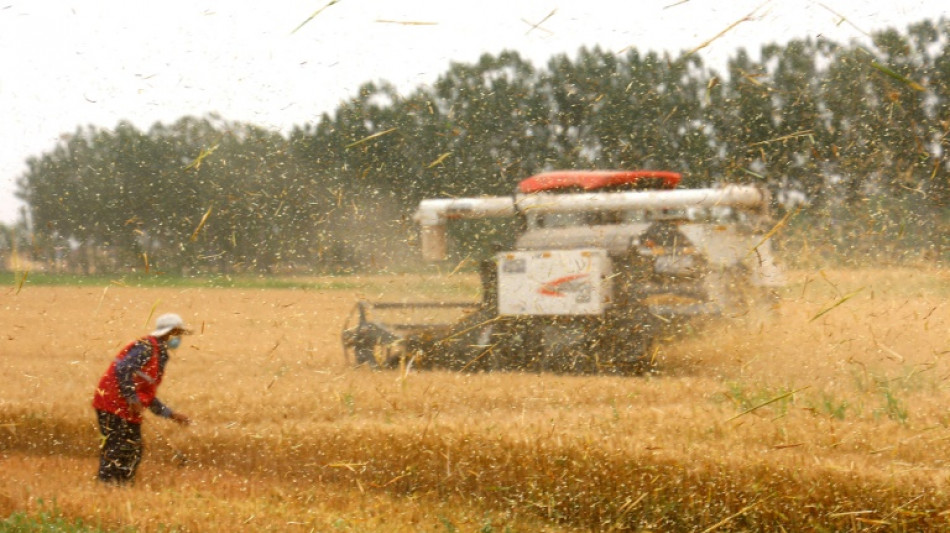
Keeping China fed as inflation surges brings risk for commodity prices / Photo: STR - AFP

 Stocks rise, yields ease as oil slips on Trump hint at short bombing campaign

 Brussels Diamond League finals Day 1 - five events to watch

 Thailand's 'Jurassic Park' shines light on dinosaur evolution

 'Role model' Stokes set to open for Adelaide Strikers

 Palau urges 'unified' Pacific response to China missile test

 Grinding away: in remote Appalachia, old mills fuel US clean food dreams

 Sabalenka races into US Open third round

 Chinese lucky loser stuns Jodar at US Open

 US Open under the influence: content creators spark debate

 NBA hammers Clippers over Leonard salary cap violations

 NBA strips five first-round draft picks from Clippers for Leonard salary cap violations

 Kane brace helps Bayern win German Cup opener

 Migrant plight, local anger divide Ceuta one month after influx

 Outrage as Maltese tycoon acquitted of reporter's murder

 Rare train of Pacific cyclones fueled by historic El Nino

 Macron, King Charles hail UK-France ties after viewing Bayeux Tapestry

 Fury hits out at 'coward' Joshua as 'Battle of Britain' talks go on

 Maltese tycoon acquitted of masterminding reporter's murder

 George Clooney: a Hollywood icon and campaigner

 Europe, US closer than they look on tech rules, says EU tech chief

 Clooney honoured as Hollywood-light Venice Film Festival kicks off

 Third-ranked Pegula, Medvedev power into US Open third round

 Davis-Woodhall a doubt for Ultimate Championship after car crash

 Third-ranked Pegula powers into US Open third round

 Uber says laying off 'about 10%' of workforce worldwide

Bedevilled by high fuel and fertiliser costs, along with a labour crisis driven by Covid-19 restrictions, China risks a smaller autumn harvest that could supercharge demand for commodities just as the world can afford it least.
Global food prices have spiked since Russia's February invasion of Ukraine, a major world producer of wheat, corn and sunflower oil, driving costs to record highs.
Moscow stands accused of pushing the globe to the brink of catastrophe by blockading Ukrainian ports and seizing commodity stocks, driving up prices and leaving the world's poorest nations facing hunger.
China is relatively self-reliant, producing more than 95 percent of its needs in rice, wheat and maize.
But relentless Covid disruptions -- caused by restrictions on the movement of goods and farm workers -- on top of higher fertiliser and fuel costs and issues with access to equipment, threaten the autumn harvest of key crops such as soybean and corn.
Experts caution even a small rise in demand from the world's most populous nation could drive global commodity costs up sharply.
"The last thing the global market needs right now is for China to become a more active buyer," said Even Pay, an agriculture analyst with consultancy Trivium China.
Corn prices hit a nine-year high in April, while soybean prices traded near a 10-year high this month.
China is the last major economy to adhere to a zero-Covid policy.
How that manifests itself in the next harvest is uncertain, but Pay said "last-mile logistics" have been complicated by virus restrictions in rural areas afraid of the spread of the disease.
"Villages have been very resistant to letting outsiders in during Covid-control periods," she added.
If China ends up going to the global market to fill any shortfall, there will be "a big impact" on prices, said Darin Friedrichs, co-founder of agriculture research firm Sitonia Consulting.
- Seeds of doubt -
For now, Beijing is keeping a close eye on the country's wheat harvest.
At a meeting last month, Premier Li Keqiang said a strong summer harvest with manageable prices depended in part on "unimpeded" access of workers and machines to wheat-growing provinces from eastern Anhui to northern Shanxi.
China has harvested about 80 percent of its winter wheat crop so far, according to state media, although Friedrichs cautioned that prices are 25 percent higher than last year, at about 3,000 yuan ($450) per tonne.
While a decent wheat harvest is good news to world markets, "Covid-related disruptions haven't gone away", according to Pay, who added that prices of fertilisers and fuels were riding high.
China has "massively ramped up its wheat, corn, barley purchases" in recent years, from below 20 million tonnes a year around four years ago to some 50 million tonnes now, according to Andrew Whitelaw, an analyst at Thomas Elder Markets.
But global inflation and uncertainty will make it expensive for China to import more.
Already, China has bought newly harvested wheat for its reserves at sky-high prices this month.
The political dimension of feeding China's vast population has not been lost on Beijing.
President Xi Jinping has said China should make "unrelenting efforts to ensure grain security", state media reported.
The issue has grown in importance since 2020, when the coronavirus spread worldwide, said Friedrichs.
"There were worries about global disruptions to supply chains, and now we have the global food crisis -- that's redoubled focus on food security," he said.
G.P.Martin--AT