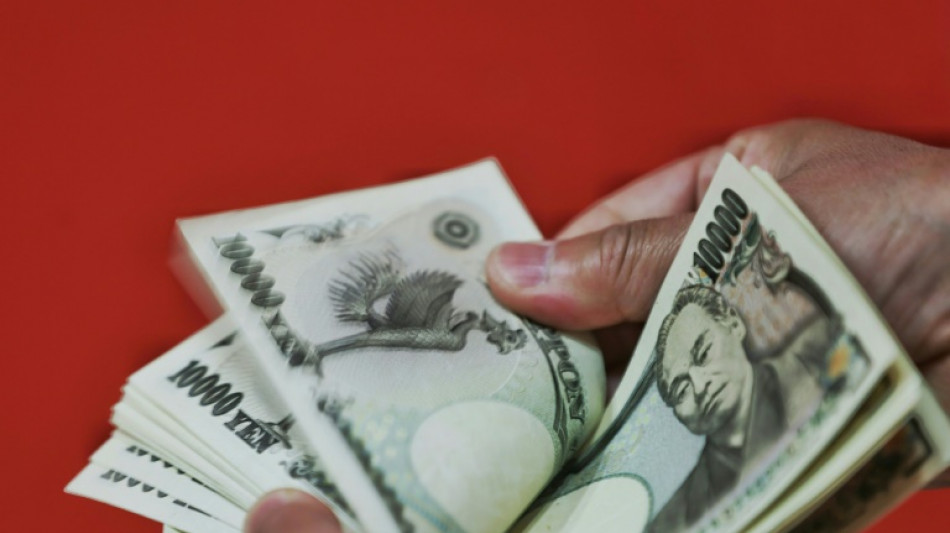
Yen slides to 24-year low against dollar / Photo: Behrouz MEHRI - AFP/File

 In Ghana, larger-than-life coffins tell the stories of the dead

 Menoncello, Reece headline Top 14 new-season signings

 Families descend on Nepal in search of missing tourists

 Far-right AfD eyes huge win in east German state vote

 Brazil-Japan to play World Cup rematch at Singapore tournament

 Defence chiefs back boosting US military presence in Australia

 Nepal seeks climate justice after Himalayan disaster

 Stocks rise, yields ease as oil slips on Trump hint at short bombing campaign

 Brussels Diamond League finals Day 1 - five events to watch

 Thailand's 'Jurassic Park' shines light on dinosaur evolution

 'Role model' Stokes set to open for Adelaide Strikers

 Palau urges 'unified' Pacific response to China missile test

 Grinding away: in remote Appalachia, old mills fuel US clean food dreams

 Sabalenka races into US Open third round

 NSW's Fourth-Largest City Makes Its Move: Investing Platform Spotlights Wollongong's Health Precinct Plan and 20,500-Job Target

 Hemogenyx Pharmaceuticals PLC Announces Exercise of Warrants and Issue of Equity

 Chinese lucky loser stuns Jodar at US Open

 US Open under the influence: content creators spark debate

 NBA hammers Clippers over Leonard salary cap violations

 NBA strips five first-round draft picks from Clippers for Leonard salary cap violations

 Kane brace helps Bayern win German Cup opener

 Migrant plight, local anger divide Ceuta one month after influx

 Outrage as Maltese tycoon acquitted of reporter's murder

 Rare train of Pacific cyclones fueled by historic El Nino

 Macron, King Charles hail UK-France ties after viewing Bayeux Tapestry

The yen plunged to its lowest level against the dollar since 1998 on Monday as sky-high US inflation fuels a widening monetary policy gap between Japan and the world's largest economy.
Japan's currency has been weakening for months, accelerated by the US Federal Reserve's aggressive monetary tightening to tackle soaring inflation caused by the war in Ukraine and other factors.
But unlike the Fed, the Bank of Japan has said it will stick with its long-standing monetary easing programme which it hopes will lead to stable growth.
The increasingly polar policies have strengthened the greenback, and on Monday one dollar bought 135.19 yen.
It's a level not seen since October 1998 during the Asian currency crisis, and marks a dramatic drop from January rates of around 115 yen per dollar.
"The ongoing backdrop to the yen's fall is the growing gap between long-term interest rates in Japan and the United States," Takahide Kinouchi, executive economist at Nomura Research Institute, said in a recent commentary.
And as higher oil prices fuel US inflation, "expectations are growing stronger that aggressive US monetary tightening will continue for the time being, causing US yields to rise further."
US consumer prices for May hit a new four-decade high, rising 8.6 percent and topping what economists thought was the peak in March.
In Japan however, inflation has only just hit the central bank's long-term target of two percent.
And while the figure represents a seven-year high, the BoJ sees current inflationary pressures as temporary, and believes its monetary policy is necessary to produce more long-lasting growth.
- Benefits for tourism, exporters -
As the war in Ukraine pressures global fuel and food prices, household brands from Uniqlo to 7-Eleven have anounced price hikes, with budget sushi chain Sushiro causing shock when it said it would no longer offer plates for 100 yen ($0.75).
But BoJ governor Haruhiko Kuroda said last week that "monetary tightening is not at all a suitable measure" for Japan, whose economy is still recovering from the pandemic, according to Kyodo News.
He also pointed to the benefits of a weaker yen for Japanese exporters, whose overseas profits are inflated when they are repatriated and have seen their stock prices rise in recent months.
The weaker yen could also be a boon for the tourism sector, with Japan cautiously reopening to foreign visitors now allowed in on group tours.
"The weak yen helps to support Japan's export sector directly, and a weaker exchange rate also contributes to looser monetary conditions domestically," said Alvin Tan, head of Asia forex strategy at RBC Capital Markets in Singapore.
"These will help drive the economic recovery further," he told AFP.
Although "higher import prices will negatively affect consumers" and the weaker yen will contribute to inflation, particularly given Japan's reliance on energy imports, this could also be "seen as a positive", he said.
"It could help to deepen more persistent inflation expectations in a country that has suffered under deflation for so many years."
The yen's trajectory may depend on how the US Fed acts in its September meeting, with worse-than-expected inflation figures for May raising expectations of further rate hikes.
But "there is still a lot of time left until then," said Kinouchi, and other factors may also be at play including energy prices rising further after a European Union ban on most Russian oil imports.
F.Wilson--AT