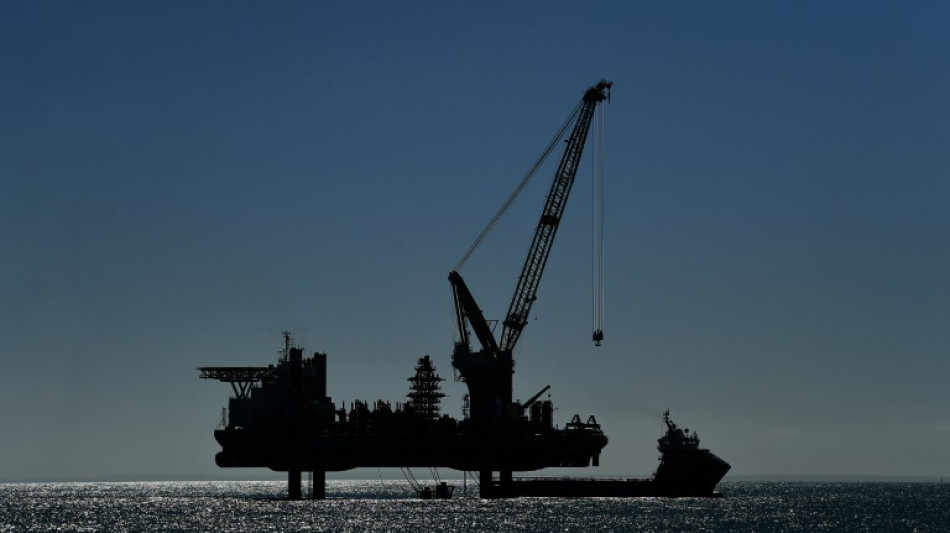
Climate: offshore methane gas leak spotted from space / Photo: FRED TANNEAU - AFP/File

 In Ghana, larger-than-life coffins tell the stories of the dead
 Menoncello, Reece headline Top 14 new-season signings

 Families descend on Nepal in search of missing tourists

 Far-right AfD eyes huge win in east German state vote

 Brazil-Japan to play World Cup rematch at Singapore tournament

 Defence chiefs back boosting US military presence in Australia

 Nepal seeks climate justice after Himalayan disaster

 Stocks rise, yields ease as oil slips on Trump hint at short bombing campaign

 Brussels Diamond League finals Day 1 - five events to watch

 Thailand's 'Jurassic Park' shines light on dinosaur evolution
 'Role model' Stokes set to open for Adelaide Strikers

 Palau urges 'unified' Pacific response to China missile test

 Grinding away: in remote Appalachia, old mills fuel US clean food dreams

 Sabalenka races into US Open third round

 NSW's Fourth-Largest City Makes Its Move: Investing Platform Spotlights Wollongong's Health Precinct Plan and 20,500-Job Target

 Hemogenyx Pharmaceuticals PLC Announces Exercise of Warrants and Issue of Equity

 Chinese lucky loser stuns Jodar at US Open

 US Open under the influence: content creators spark debate

 NBA hammers Clippers over Leonard salary cap violations

 NBA strips five first-round draft picks from Clippers for Leonard salary cap violations

 Kane brace helps Bayern win German Cup opener

 Migrant plight, local anger divide Ceuta one month after influx

 Outrage as Maltese tycoon acquitted of reporter's murder

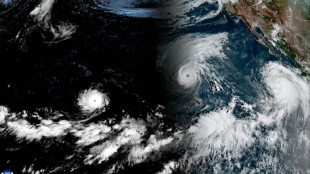 Rare train of Pacific cyclones fueled by historic El Nino

 Macron, King Charles hail UK-France ties after viewing Bayeux Tapestry

Scientists have for the first time used satellite data to detect a major offshore leak of the potent greenhouse gas methane, according to peer-reviewed research.
The findings add a crucial tool to an expanding space-based arsenal for pinpointing previously invisible methane plumes from the oil and gas industry.
Fossil fuel operations globally emitted about 120 million tonnes of the planet-warming gas in 2020, nearly one-third of all methane emissions from human activity, according to the International Energy Agency (IEA).
The new study in the journal Environmental Science and Technology Letters identified a plume from an oil and gas production platform in the Gulf of Mexico that spewed some 40,000 tonnes over a 17-day period in December.
The platform, near Campeche in southern Mexico, is in one of the country's biggest oil producing fields.
"Our results demonstrate how satellites can detect methane plumes from offshore infrastructure," senior author Luis Guanter, a professor at Valencia Polytechnic University, said in a statement.
"It opens the door to systematic monitoring of industrial emissions from individual offshore platforms."
Satellite-based methods for spotting methane leaks over land have developed rapidly in the last few years, training an uncomfortable spotlight on regulators and industry.
But equivalent techniques have been lacking for leaks from offshore oil and gas operations, which account for about 30 percent of global production.
- Huge short-term potential -
Up to now, ocean water's capacity to absorb short-wave infrared radiation has limited the amount of reflected light reaching space-based sensors.
Guanter and colleagues overcame this problem with a new method for measuring solar radiation bouncing off the water's surface, called Sun-glint observation mode.
Methane is responsible for roughly 30 percent of the global rise in temperatures to date.
While far less abundant in the atmosphere than CO2, it is about 28 times more powerful as a greenhouse gas on a century-long timescale. Over a 20-year time frame, it is 80 times more potent.
Methane lingers in the atmosphere for only a decade, compared to hundreds or thousands of years for CO2.
This means a sharp reduction in emissions could shave several tenths of a degree Celsius off of projected global warming by mid-century, helping keep alive the Paris Agreement goal of capping Earth's average temperature increase to 1.5C, according to the UN Environment Programme (UNEP).
Last year saw a record jump in the atmospheric concentration of methane, US government scientists reported in April.
Methane is generated by the production, transport and use of fossil fuels, but also from the decay of organic matter in wetlands, and as a by-product of livestock digestion in agriculture.
At last year's COP26 climate summit in Glasgow, more than 100 nations agreed under the Global Methane Pledge to reduce emissions 30 percent by 2030. But several major methane emitters -- including China, Russia, Iran and India -- failed to sign.
O.Ortiz--AT