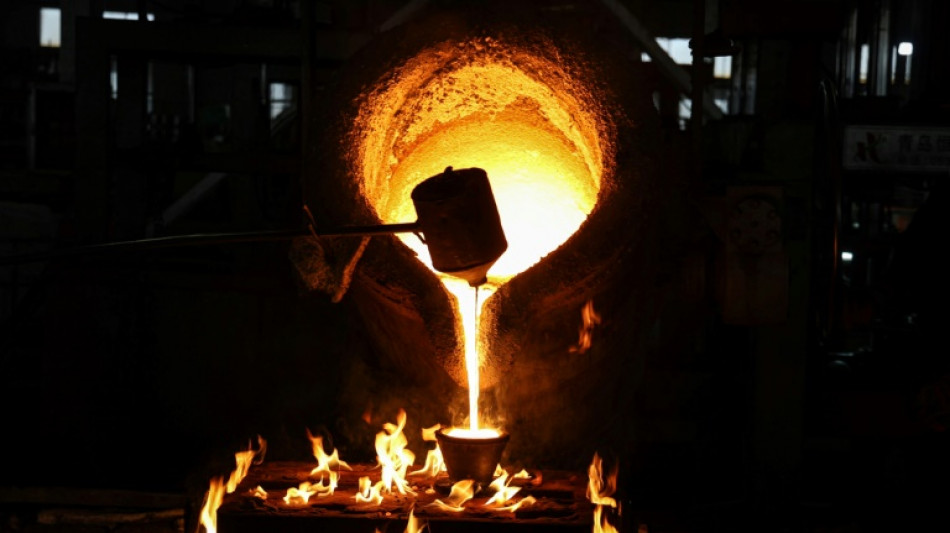
Trump tariffs threaten Latin American steel industry / Photo: STR - AFP

 France recorded 'hottest summer ever': environment minister

 'No plans to retire', says 'acting god' Malkovich

 Nigerian opposition lobbyist tapped for White House-linked role, firm says

 China emissions fell in Q2 as Iran war pared oil use: analysis

 France sells bonds at highest rate since 2008 amid deficit worries

 Vast aid challenge after 'Himalayan tsunami' devastates Nepal

 Bosnia captain Dzeko to retire from international football
 Grief on Chinese internet as wait for Tibet flood news drags on

 Heavy rain puts a dampener on Taiwan 'extreme heat' drill
 Juve's Khephren Thuram out until 2027 with knee injury

 Delivering aid to Nepal flood survivors 'very, very difficult': UN

 German growth prospects brighten as economy defies Mideast turmoil

 Outrage mounts in Malta after acquittal over journalist's murder

 Malaysia starts cloud seeding to help clear toxic haze

 El Nino could be strongest in decades, UN warns

 Kenya steps up crocodile hunt as rising lakes fuel conflict
 Argentine Groups Seek Court Halt to Sea Lion Oil Project Near Falklands

 China’s Oil Use Drops 9 Percent as Transport Electrification Accelerates

 Fifth-Generation Mitsubishi Pajero Returns With Ladder Frame and Seven Seats
 Philadelphia Roundup: Museum Closure, Phishing Warning and Gun Violence Data
 Philadelphia Natural History Museum Prepares to Close After Two Centuries

 Indonesia protesters targeted by coordinated disinfo

 Oil sinks, bond yields ease and stocks boosted after Trump Iran hint
 American jazz singer Cassandra Wilson dies at 70
 Rare trio of Pacific hurricanes fueled by historic El Nino

Chile's largest steel plant shut down last year, yielding to cheaper production in China.
Now, six months later, the tariffs that President Donald Trump has imposed on US imports of the metal threaten the livelihood of 1.4 million workers in Latin America.
As he did during his first term in office from 2017 to 2021, Trump is trying to protect American producers by making steel imports costlier with a 25 percent tariff that kicked in on March 12.
The United States imports 25 million tons of steel each year, and Canada is it main supplier, followed by Brazil and Mexico, each with products tailored to other industries like car manufacturing and construction.
The United States relies on Latin America for specialized steel products, said Ezequiel Tavernelli, head of the Latin American Steel Association, Alacero.
With the world awash steel production overcapacity, and China the main offender, the Trump tariffs will distort the market.
"The only thing they will bring is a flood of steel" that had been headed to the United States and is now rerouted to regions that are less protected and have less ability to defend themselves, like Latin America, said Tavernelli.
To explain the threat he gives these figures: in 2000 China exported less than 100,000 tons of steel a year to Latin America, but today it is more than 14 million tons. The growth is exponential.
Steel production in Latin America has been falling for three years. And the Chinese share of what is consumed is getting bigger and bigger .
And now, due to the Trump tariffs Latin American producers will not only lose market share in the United States but also miss out in some markets of their own region due to Chinese competition.
- When it rains it pours-
The numbers are jarring. China accounts for more than 45 percent of the world's steel production capacity and produces 140 million tons it does not need.
It dumps this excess cheaply on the international market, says Alacero, which says China produces 23 percent of the world's excess steel.
"The main problem of our region, and that of the United States, is world steel overcapacity," Tavernelli told AFP.
And China behaves disloyally, he argued, by selling steel below cost thanks to government subsidies.
In September of last year Chile endured what Tavernelli is talking about. Its Huachipato steelworks, the country's largest, shut down its blast furnaces for good.
With the smoke that drifted out of its chimneys went nearly 75 years of company history. Chinese steel was 40 percent cheaper and Huachipato simply could not compete.
Alacero argues that regionalization of supply chains -- for instance, US steel producers, car makers and construction companies buy Latin American steel -- "is the best way to defend against disloyal business by China and countries of Southeast Asia."
As Brazil's vice president Geraldo Alckmin, who is also the minister of development and industry, put it, the region's goal should be to achieve "economic complementarity."
Brazil and Mexico are negotiating with the United States to try to win exemptions from the US tariffs, and managed to pull this off during Trump's first term in power.
In the same vein, Mexico's iron and steel producers association, Canacero, said last month there is a high level of production integration between the US and Mexican steel industries and regional benefits should be the priority in the face of the threat of excess capacity of China and Southeast Asia.
So there is the risk that more long-standing firms like Huachipato will have to shut down, said Tavernelli, who insisted the countries of Latin America have to work together.
M.White--AT