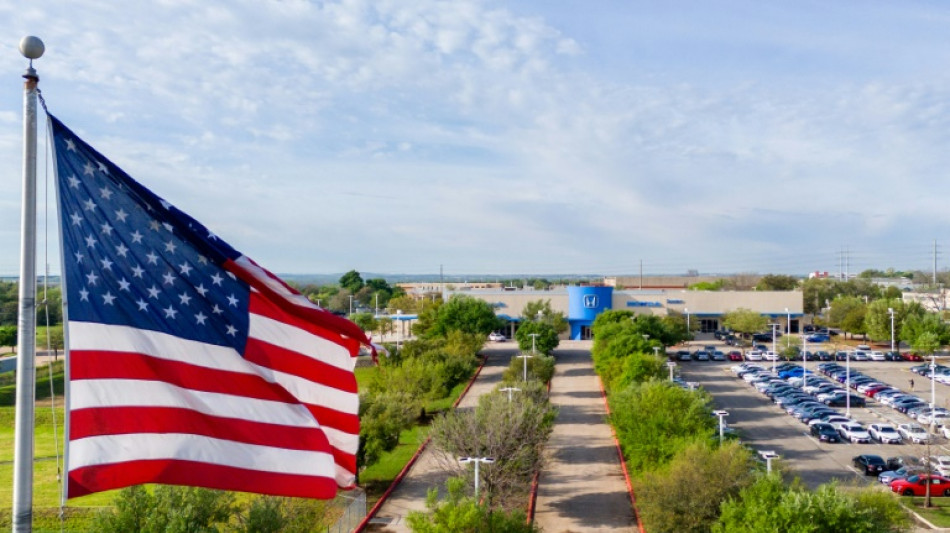
US auto industry stunned by tariffs meant to save it / Photo: Brandon Bell - GETTY IMAGES NORTH AMERICA/AFP/File

 Antonelli will obey Mercedes orders to help 'tow' teammate Russell

 UK fintech Revolut gains conditional US banking licence

 Mara sisters channel childhood energy for twins performance at Venice

 UN's Sudan probe says foreign fighters fuelling conflict
 Violence erupts at S.Africa anti-migrant protest

 Nothing left: Nepal flood survivors face loss and uncertainty

 Tesla to launch self-driving 'Cybercab' in Texas

 Europe struggles to respond as Russia escalates shadow warfare
 Malta PM urges 'caution' after acquittal in journalist's murder

 Spanish PM says no 'solid proof' Morocco planned Ceuta migrant rush

 Venezuela's Maduro seek immunity from US drug charges

 Tazapay Now Live on the Borderless.xyz Network For Seamless Money Movement to Asia Pacific and Latin America
 DWF Labs Expands Global Regulatory Footprint with BVI Virtual Asset Service Provider Approval

 Just the beginning of the journey, Broeders-Bol says of 800m adventure
 US trade gap in July hits biggest in over a year on AI buildout

 Study shows plug-in hybrids polluting far more than expected
 Lost tool disrupted Airbus jet deliveries for months

 MEXC Concludes 0808 Stock Season with Over 86,000 Participants and More Than $1M Saved Through 0 Fee Trading
 US feminist icon Gloria Steinem dies at 92: foundation
 All Blacks drop veteran hooker Taylor for third Springboks Test
 British, French leaders hold talks on migrants, EU relations

 Oil prices jump as Iran strikes US targets

 Putin denies plan for new Russia military call up
 Caruana Galizia: 'one-woman WikiLeaks' who exposed Malta's shady side

 Kuwait's Iranians under pressure since start of war

The 25 percent tariffs on automobiles announced by President Donald Trump are meant to revitalize American industry, but Detroit's giants were stunned Thursday by their scale and faced a beating on Wall Street.
While the implementation of the tariffs had been anticipated for weeks, their details surprised manufacturers and experts as the levies will not only apply to imports of finished vehicles but parts as well.
That will be particularly painful because the sector relies on a complex global supply chain, sometimes involving multiple border crossings, with assembly in one country of parts manufactured in others.
The levies kick in April 3 at 04:01 GMT, according to the decree signed by the Republican president on Wednesday.
The manufacturing process at Ford and General Motors depends largely on a highly complex back-and-forth between the United States, Mexico, and Canada -- the three countries linked by the USMCA, a free trade agreement signed by Trump during his first term.
However, Trump's decree doesn't provide exemptions for imports under USMCA, dashing industry hopes that car parts would be spared.
The tariffs include "crucial parts" -- engines, transmissions, powertrains, and electrical components are on the list that could be expanded.
Parts not originally manufactured in the United States will face 25 percent tariffs just like finished foreign vehicles.
The White House noted that of the 16 million new vehicles sold in the United States last year, half were assembled in the country but contained only 40-50 percent American-made components.
It also said the trade deficit for automotive parts was $93.5 billion.
Stock Market Decline
Manufacturers faced a drubbing in the stock market Thursday.
General Motors plummeted 7.3 percent, while Ford closed down 3.8 percent and Stellantis 1.2 percent.
US listed shares of Toyota and Honda fell by 2.8 percent and 2.7 percent, respectively.
According to JPMorgan analysts, 82 percent of vehicles sold by Ford are produced in the United States, ahead of Stellantis (71 percent), Honda (68 percent), Toyota (57 percent), and General Motors (53 percent).
Trump's decree demands that manufacturers determine the percentage between US parts and foreign parts in components or finished vehicles entering the United States, with the 25 percent tariff imposed only on foreign-made parts.
This presents a real challenge for manufacturers -- who will be penalized for incorrect allocations -- but also for the authorities to track them.
An implementation delay has therefore been granted, allowing the Commerce Department time to figure out how to proceed.
According to JPMorgan, once tariffs are collected across the entire intended scope, they would generate $82 billion annually.
Trump claimed Wednesday that they would bring in "more than $100 billion."
JPMorgan estimated that the largest tariff bill would be paid by GM ($13 billion) while Ford should pay around $4.5 billion.
Experts have no doubt that there will be a price increase for new vehicles in the United States, which will subsequently affect a weakened used car market as owners keep their vehicles longer.
The president's goal is to increase manufacturing in the United States, but relocating factories or reconfiguring a supply chain cannot happen overnight.
Foreign nations have also threatened retaliatory measures which could further impact the sector.
In the meantime, manufacturers will have to decide between fully passing on the additional cost to the end consumer, cutting into their margins, or a mix of both.
The cost of an affected new vehicle could increase by 9-12 percent, or $4,000 to $5,300, JPMorgan anticipates.
"With added cost pressures, automakers may pull back on incentives, which could make it more difficult for some consumers to find affordable options," said Jessica Caldwell from Edmunds.
According to Caldwell, insurance premiums should also increase due to inflation in spare parts costs.
O.Brown--AT