Tajikistan launches crackdown on 'witchcraft' and fortune-telling / Photo: STRINGER - AFP

 Trump envoys arrive in Kyiv for first Ukraine visit
 Indonesia's main airport suspends operations after volcanic eruption

 US aircraft carrier departs Thailand after port call

 Haze emergency grips Malaysian Borneo town
 Messi creates both Miami goals in 2-2 draw with Atlanta
 Rybakina books US Open fourth-round berth, inches closer to No. 1

 Sobering reality: Curbs on alcohol in northeast Syria cause discontent

 Wobbly Osaka 'shocked' to battle past Mertens and reach last 16

 Indian Oscar-nominated filmmaker turns camera on his cancer
 Argentina 'let off hook' by Australia as Kiss's winning run ends

 Argentina threatens to sanction oil projects around Falklands
 Gauff into round four at US Open after straight-set win
 Bordeaux hammer Racing in Top 14 start as Bielle-Biarrey extends deal

 Zheng, Potapova pull off upsets to reach US Open last 16
 Swiatek into US Open fourth round in tight two-setter
 Werro wins in Brussels, as Russell and Dos Santos shine

 Kolbe breaks jaw and shoulder injury sidelines Savea

 US military strikes oil tankers as Iran vows tougher reprisals

 Zheng rallies to stun Keys, Anisimova out in US Open third round

 Bayern held to draw by stubborn Schalke

 Lens lose again ahead of Champions League date

 Olympic champion Zheng storms home to reach US Open last 16

 Big-spending Spurs must make better attacking decisions, says De Zerbi

 South Africa dominate New Zealand in second half to lead series

 Kiefer Sutherland still in action, but ibuprofen lending helping hand

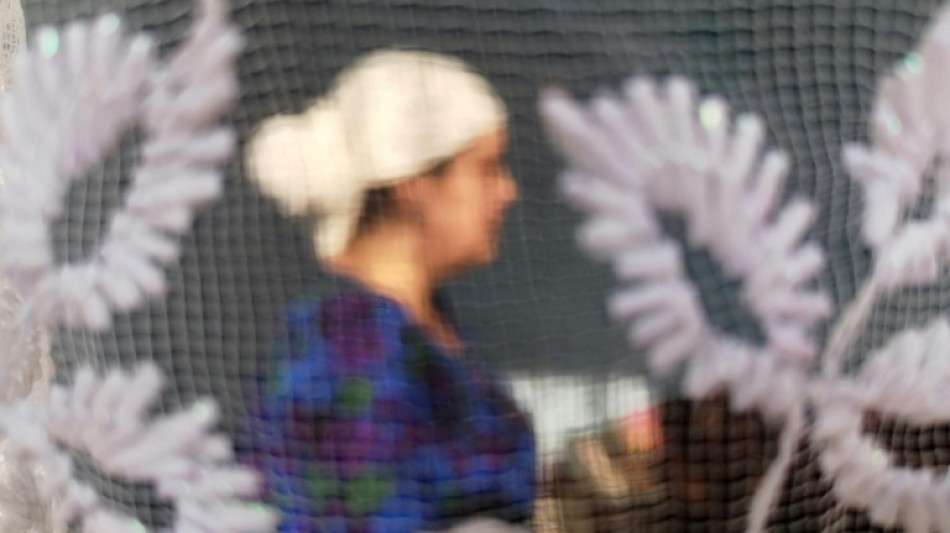
In a block of flats in Tajikistan's capital Dushanbe, a turbaned woman cautiously opened the door of her apartment a chink, letting out a waft of incense.
"I'm not taking on new clients. It could be a set-up," she says, as she closes the door again and locks it.
"I risk a heavy fine. I do not want people outside on my landing," speaking through the door.
A majority Muslim country in Central Asia, mountainous and impoverished Tajikistan has recently launched a crackdown against fortune tellers, clairvoyants, mediums and "witches".
Practitioners of the occult are keeping a low profile to avoid arrest and public shaming because of a government-led campaign against them.
Tajik police have stepped up raids against what they call "parasites engaged in some of the most detestable activities imaginable -- divination and witchcraft".
Other countries in Central Asia are also cracking down on what have become widespread practices with roots in pre-Islamic traditions.
- Thousands of arrests -
The fight against occult practices is part of wider strict controls imposed in the authoritarian country, which is seeking to curb both radical Islam and ancestral beliefs.
"Illegal religious teaching leads to scams, divination and witchcraft. Tajiks! The Prophet categorically forbade going to diviners and sorcerers," President Emomali Rakhmon, who has ruled the country since 1992, said last year.
Rakhmon also last year announced the arrest of 1,500 people "engaged in witchcraft and divination" as well as "more than 5,000 mullahs" who promised healing through prayer.
A repeat offence is now punishable by two years' imprisonment and a fine of 12,800 euros ($13,300) -- the equivalent of six years' average salary for a Tajik.
Witches and fortune tellers have adapted to avoid police raids.
"I no longer receive people in my home. I go to them," Adalat, a 56-year-old fortune teller, said during a session on the outskirts of Dushanbe.
She swung a string of pearls over some instructions scribbled on a piece of paper, mumbling a few words after asking her client some questions.
She said she is particularly skilled at reconciling fighting couples and seeing their future.
"Even as a child, I was tormented by nightmares which made me want to help people. But I only show my gift to people close to me," she said.
The price of consultations can range from a few euros to gold jewels depending on the client requests but Adalat said she "cannot live" off her fortune telling and relies on money sent to her by her son who works in Russia.
- 'Social inequality' -
One of her clients, Gulbakhor, said she had "turned to fortune tellers and healers mainly because of health problems".
"It's cheaper than conventional medicine, which is very expensive," the 42-year-old housewife told AFP.
Since the fall of the Soviet Union and a civil war in the early 1990s, Tajikistan has been plunged into poverty.
According to Mehrigiul Ablezova, a professor of sociology at the American University of Central Asia, "the attraction of witchcraft and fortune-telling may be linked to social inequality and a lack of access to public services".
"In countries where health or welfare systems are limited, people may seek alternative sources of treatment and support," she told AFP.
She said repression alone would not be enough to counteract these "deeply rooted traditions and beliefs in Central Asia that predate the introduction of Islam".
N.Mitchell--AT