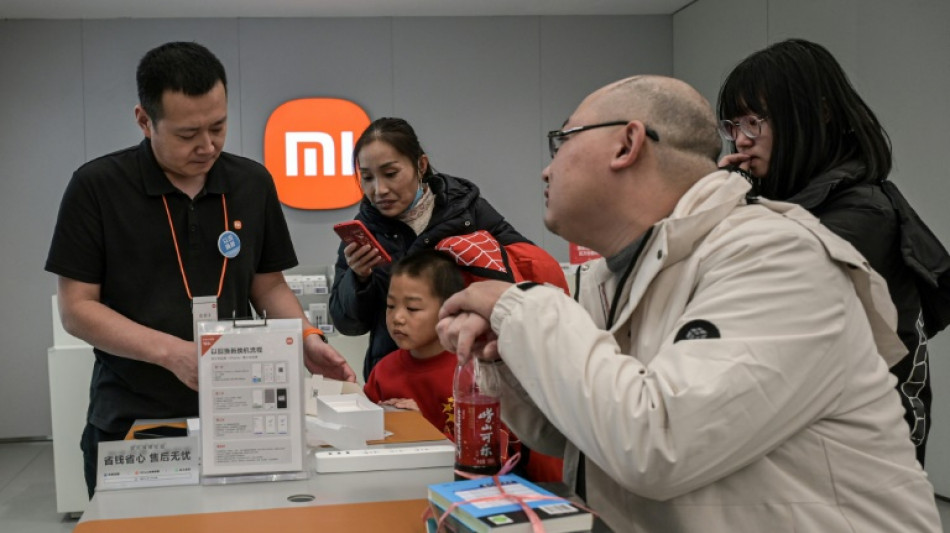
Chinese give guarded welcome to spending subsidies / Photo: Jade GAO - AFP

 With joy and grief, Palestinian football marks return

 Iran threatens greater force if US launches more attacks

 Vandals uproot Berlin tree commemorating Pride attack victims

 Trump envoys arrive in Kyiv for first Ukraine visit
 Indonesia's main airport suspends operations after volcanic eruption

 US aircraft carrier departs Thailand after port call

 Haze emergency grips Malaysian Borneo town

 Messi creates both Miami goals in 2-2 draw with Atlanta

 Rybakina books US Open fourth-round berth, inches closer to No. 1

 Sobering reality: Curbs on alcohol in northeast Syria cause discontent

 Wobbly Osaka 'shocked' to battle past Mertens and reach last 16

 Indian Oscar-nominated filmmaker turns camera on his cancer

 Argentina 'let off hook' by Australia as Kiss's winning run ends

 Argentina threatens to sanction oil projects around Falklands

 Gauff into round four at US Open after straight-set win

 Bordeaux hammer Racing in Top 14 start as Bielle-Biarrey extends deal

 Zheng, Potapova pull off upsets to reach US Open last 16

 Swiatek into US Open fourth round in tight two-setter

 Werro wins in Brussels, as Russell and Dos Santos shine

 Kolbe breaks jaw and shoulder injury sidelines Savea

 US military strikes oil tankers as Iran vows tougher reprisals

 Zheng rallies to stun Keys, Anisimova out in US Open third round

 Bayern held to draw by stubborn Schalke

 Lens lose again ahead of Champions League date

 Olympic champion Zheng storms home to reach US Open last 16

Beijing is hoping subsidies for rice cookers, microwave ovens and smartphones can boost sluggish spending and help the country weather an economic storm from incoming US president Donald Trump.
Policymakers have struggled to get China's billion-strong army of consumers to inject cash into the economy as a prolonged real estate crisis weighs on confidence.
And last week, they expanded a subsidy scheme for common household items, from water purifiers and refrigerators to laptops and electric vehicles.
Outside a bustling shopping centre in Sanlitun, one of the capital's most popular commercial districts, 25-year-old Li Ling told AFP the policy could work as an "incentive".
"If someone's budget is not very abundant, such policies can support them in their consideration about buying things," she said.
"I think the policy can just be regarded as an incentive," she said.
Beijing is nervously looking to the second administration of Donald Trump, who has vowed brutal tariffs on Chinese goods in retaliation for Beijing's allegedly unfair trade practices -- fuelling fears of another trade war.
And experts say the country may need to shift towards a growth model driven largely by domestic consumption as those pressures mount.
Under the broadened subsidy scheme, people can get 20 percent off microwave ovens, water purifiers, dishwashers and rice cookers, among other things -- with the state covering the discount of up to 2,000 yuan ($275).
Gadgets such as smartphones, tablets and smartwatches also now receive subsidies of up to 15 percent.
- 'Saving is meaningless' -
Shopper Yang Boyun told AFP that he recently took advantage of the new deal.
"I bought three Xiaomi air conditioners," he said, referring to one of China's leading consumer goods brands. "They all only cost 8,000-9,000 yuan. Normally each one would cost more than 4,000 yuan," he said.
But Yang, a worker in the crisis-hit property sector, said much stronger action was needed for the country to reverse its economic malaise.
"Only after some changes to the macroeconomic regulation of the country will individuals feel the effects," he said.
Beijing is set to release a tranche of economic data Friday and analysts expect the country to report its weakest growth in decades.
In bustling Sanlitun, student Wang Jiaxin said she was prioritising spending on things she enjoyed.
"If it's on food and drinks and buying more beautiful clothes then I'll spend a bit more," she said.
Next year Wang said she planned to enter China's job market -- beset in recent years with high youth unemployment -- rather than continue studying.
But she expressed cautious optimism about her chances.
"I can definitely find a job. But what kind of job it is really depends," she said. "I'm not sure I'll be able to find a good one, but I'll definitely be able to support myself."
Meanwhile, Yang told AFP his thinking on personal spending had shifted.
"In the past I may have saved some money, but now I feel that one small thing may cause debt -- like if you get sick, you will be in debt," he said.
"But money is something that should be used to enjoy the present," he added. "Saving money is meaningless. The most important thing for us now is to be happy."
M.O.Allen--AT