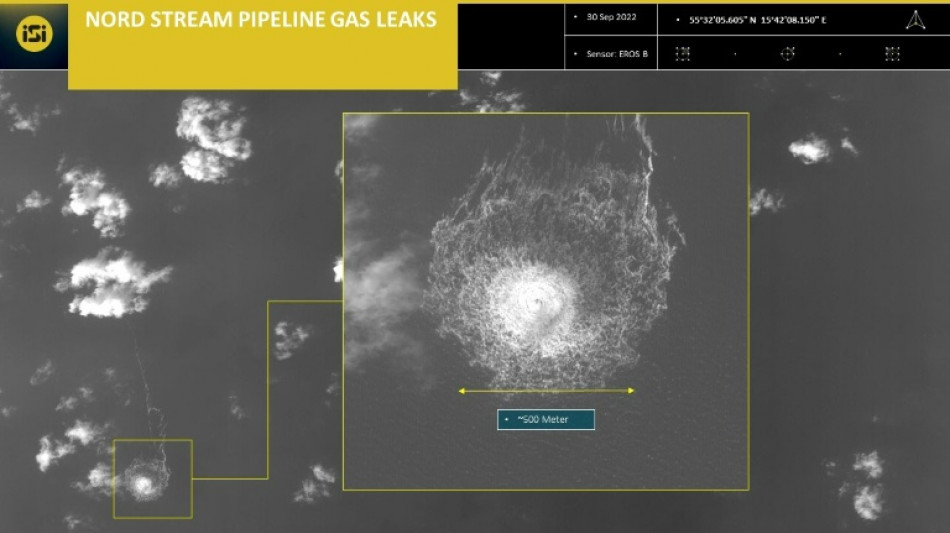
Methane leaks from Nord Stream pipeline blasts revised up: studies / Photo: - - ImageSat International (ISI)/AFP

 Championship leader Antonelli wins Italian Grand Prix

 Vardy signs for Championship strugglers Burnley
 FIFA confirms Infantino will run in presidential election

 With joy and grief, Palestinian football marks return

 Iran threatens greater force if US launches more attacks
 Vandals uproot Berlin tree commemorating Pride attack victims

 Trump envoys arrive in Kyiv for first Ukraine visit
 Indonesia's main airport suspends operations after volcanic eruption

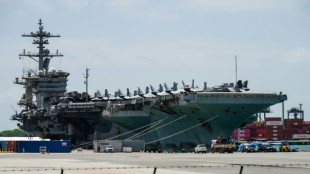 US aircraft carrier departs Thailand after port call

 Haze emergency grips Malaysian Borneo town

 Messi creates both Miami goals in 2-2 draw with Atlanta

 Rybakina books US Open fourth-round berth, inches closer to No. 1

 Sobering reality: Curbs on alcohol in northeast Syria cause discontent

 Wobbly Osaka 'shocked' to battle past Mertens and reach last 16

 Indian Oscar-nominated filmmaker turns camera on his cancer

 Argentina 'let off hook' by Australia as Kiss's winning run ends

 Argentina threatens to sanction oil projects around Falklands

 Gauff into round four at US Open after straight-set win

 Bordeaux hammer Racing in Top 14 start as Bielle-Biarrey extends deal

 Zheng, Potapova pull off upsets to reach US Open last 16

 Swiatek into US Open fourth round in tight two-setter
 Werro wins in Brussels, as Russell and Dos Santos shine

 Kolbe breaks jaw and shoulder injury sidelines Savea

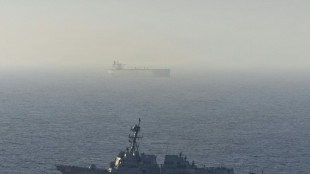 US military strikes oil tankers as Iran vows tougher reprisals

 Zheng rallies to stun Keys, Anisimova out in US Open third round

A series of underwater explosions that ruptured the Nord Stream gas pipelines in 2022 caused the largest known methane leak on record from a single incident, according to new research published on Wednesday.
Scientists estimate the rupture of the major pipeline for transporting Russian gas to Europe released approximately 465,000 tonnes of methane into the atmosphere -- well above earlier estimates, but just a fraction of total global emissions.
The exact cause of the blasts in September 2022, just months after Russia's invasion of Ukraine, is still unknown, though Moscow and Kyiv have traded blame over this and other damage of energy infrastructure.
In three new studies on the Nord Stream leak -- one in Nature and two in a separate journal Nature Communications -- researchers said its potential impact on the environment and climate remained unclear.
But the leak "represents the largest recorded amount of methane released from a single transient event", wrote Stephen Harris and others in Nature.
Though significant, this was equivalent that year to 0.1 percent of human-caused emissions of methane, a powerful greenhouse gas many times more effective at trapping heat in the short term than carbon dioxide.
Methane is emitted naturally from wetlands and rivers but also cows, rice fields and landfills.
A leading source of human-caused emissions is oil and gas projects, and fixing leaky pipelines and other infrastructure is considered a particularly cost-effective way to quickly slow global warming.
"While extraordinary in its magnitude, the Nord Stream explosions remind us of the immediate climate opportunity represented by reducing methane emissions across the oil and gas industry," said Manfredi Caltagirone, head of the UN Environment Programme's International Methane Emissions Observatory (IMEO), which supported the research.
- Unclear impact -
After the explosions beneath the Baltic Sea damaged the Nord Stream pipelines, gas began bubbling up at four rupture points, creating enormous foamy patches on the surface.
There was an "immediate desire" among scientists to determine the size of such a clearly significant leak, said Harris from IMEO.
This was challenging because it was difficult to know how much methane was absorbed in the ocean and how much leaked into the atmosphere.
Early estimates for the Nord Stream leak ranged from 70,000 tonnes to 300,000 tonnes.
For the research in Nature, scientists used atmospheric data, satellite images, marine observations and aerial measurements to model how much methane might have escaped the ocean.
It "far exceeds" any other leak of its kind and was equivalent to 30 percent of Germany's annual methane emissions, wrote Friedemann Reum from the German Aerospace Centre in Nature Communications.
Another paper in the same journal looked at the impact of the leaks on protected marine areas in the Baltic.
Martin Mohrmann from Sweden's Voice of the Ocean Foundation and colleagues suggested 14 percent of the region experienced methane concentrations five times average levels.
More than 150 countries have signed a pledge to slash methane emissions, but atmospheric concentrations of this potent greenhouse gas still hit record highs in 2024.
The International Energy Agency has noted that normal oil and gas operations around the world release the same amount of methane as the Nord Stream explosion every single day.
O.Gutierrez--AT