Tajikistan bets on giant dam to solve electricity crisis / Photo: STRINGER - AFP

 Sabalenka surges past Townsend to reach US Open quarter-finals

 Smiling face of Germany's far-right AfD: Ulrich Siegmund

 Lebanon president calls for US help as Israeli strikes kill 7

 Yamal hits double as perfect Barca thrash Valencia

 Venice festival turns gaze on war reporters, media industry

 Sensational Antonelli wins Italian GP from back of grid

 Susan Sarandon says still losing roles over Gaza stance

 US envoys hold 'important' talks in first trip to Kyiv

 Championship leader Antonelli wins Italian Grand Prix

 Vardy signs for Championship strugglers Burnley
 FIFA confirms Infantino will run in presidential election

 With joy and grief, Palestinian football marks return

 Iran threatens greater force if US launches more attacks
 Vandals uproot Berlin tree commemorating Pride attack victims

 Trump envoys arrive in Kyiv for first Ukraine visit
 Indonesia's main airport suspends operations after volcanic eruption

 US aircraft carrier departs Thailand after port call

 Haze emergency grips Malaysian Borneo town

 Messi creates both Miami goals in 2-2 draw with Atlanta

 Rybakina books US Open fourth-round berth, inches closer to No. 1

 Sobering reality: Curbs on alcohol in northeast Syria cause discontent

 Wobbly Osaka 'shocked' to battle past Mertens and reach last 16

 Indian Oscar-nominated filmmaker turns camera on his cancer

 Argentina 'let off hook' by Australia as Kiss's winning run ends

 Argentina threatens to sanction oil projects around Falklands

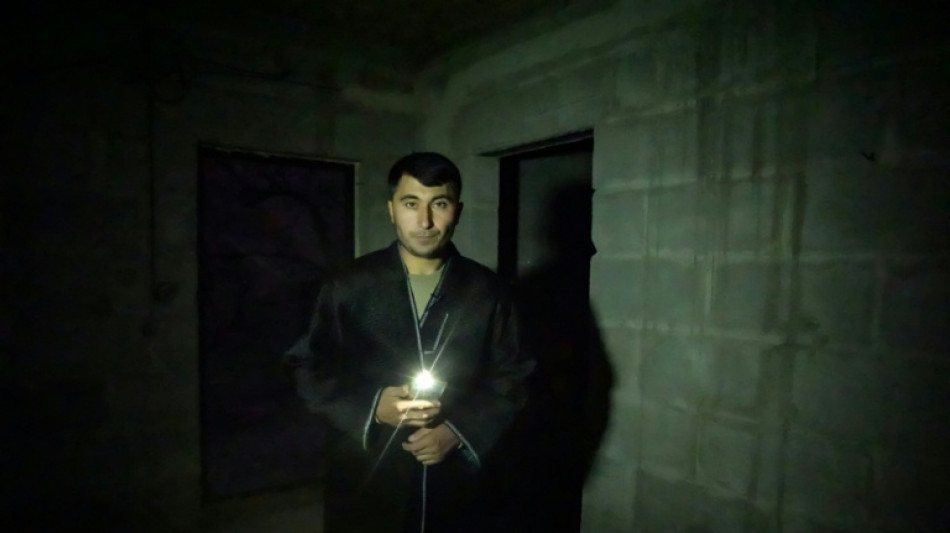
In a remote village in Tajikistan's soaring mountains, Muslikhiddin Makhmudzoda relies on a mobile phone to light his modest home as his family spends another winter without electricity.
Makhmudzoda's three children and wife were sitting huddled together to share the phone's flashlight in their modest brick home.
A shortage of water needed to fuel hydroelectric plants has led to serious power outages in Tajikistan, a poor former Soviet republic nestled in the Central Asian mountains and surrounded by Afghanistan, China, and fellow ex-Soviet states Uzbekistan and Kyrgyzstan.
The power crisis is only set to worsen, as Central Asia is hard-hit by climate change.
Amid chronic shortages, Tajikistan has promised it will end the power outages and has revived a Soviet-era mega-project to build the world's highest dam.
Makhmudzoda's family spend much of their day without power.
"We have electricity from 5:00 am to 8:00 am and then from 5:00 pm until 11:00 pm", the 28-year-old said.
To cope with intermittent power supplies, the family resorts to using a charcoal stove for heating -- a risky choice, since many Tajiks die from carbon monoxide poisoning each year caused by such appliances.
Every year, the impoverished country's state electricity company Barqi Tojik restricts power supplies starting in September to prevent the system's collapse during the coldest months.
It says this is an "inevitable measure" as demand has skyrocketed.
Since the fall of the Soviet Union in 1991, the small country's population has doubled to 10 million, with economic growth steady at around eight percent after decades of stagnation.
- 'Every centimetre counts' -
The rationing is also due to falling water levels in reservoirs used to drive turbines in hydroelectric power plants, which provide 95 percent of Tajikistan's electricity.
Authorities say "feeble rainfall" means that water levels in the country's biggest river -- the Vakhsh -- are low.
"Every centimetre of water counts," Barqi Tojik has warned, urging Tajiks to pay their bills to renovate ageing infrastructure.
The average salary in Tajikistan hovers around $190 (180 euros) a month.
But the government is now promising that all these inconveniences will soon be a thing of the past thanks to the construction of a massive dam and plant.
Tajikistan has placed its bets on Rogun, planned to become the most powerful hydropower plant in Central Asia. It is set to have the highest dam in the world at 335 metres (1,100 feet).
When completed, the plant is intended to produce some 3,600 megawatts -- the equivalent of three nuclear power stations.
- 'Palace of light' -
Tajikistan is reviving the colossal project, first planned by the Soviet authorities in 1976, before being abandoned due to the end of communist rule and then the Tajik civil war.
At the site, dozens of bulldozers go up and down the mountains and dozens of kilometres of underground tunnels are equipped with giant turbines.
Some 17,000 people are working on the site which lies west of the capital Dushanbe, in the foothills of the Pamir Mountains.
The site is already partially functioning but it is not known when construction will be finished.
Giant banners showing President Emomali Rahmon -- in power for 32 years -- hang over the construction site.
Rahmon has stressed the importance of the dam, calling it a "palace of light", the "pride of the Tajik nation" and the "construction project of the century".
- 'Altitude 1,100 metres' -
Surrounded by giant machinery, engineer Zafar Buriyev said he was certain the dam would end power cuts.
"Once the construction at Rogun is finished, Tajikistan will completely come out of its electricity crisis," he told AFP.
He stood in what he called "the heart of the dam" in between giant peaks.
"By next summer, this area will be submerged and the water will reach an altitude of 1,100 metres and then eventually 1,300."
Authorities have said the plant will not only generate enough electricity to use domestically, but could supply other Central Asian countries -- and even nearby Afghanistan and Pakistan.
Water resources have long been a source of tension between Central Asian countries as they suffer shortages.
The plant's technical director Murod Sadulloyev told AFP it will help "reinforce the unified energy system" in Central Asia -- a concept dating back to the USSR that enables the former Soviet republics to exchange water and electricity.
Tajikistan's neighbours are also working to revive Soviet-era energy projects.
Kyrgyzstan and Uzbekistan have pledged to build the Kambar-Ata hydroelectric power plant jointly in a mountainous area of Kyrgyzstan.
Tajikistan's Rogun project has been criticised for its constantly rising cost -- currently more than $6 billion -- and its environmental impact, while information on Kambar-Ata has been classified as secret.
The Central Asian power plants are being built in the context of dire climatic realities.
According to the UN, Central Asia is "warming more rapidly than the global average".
P.A.Mendoza--AT