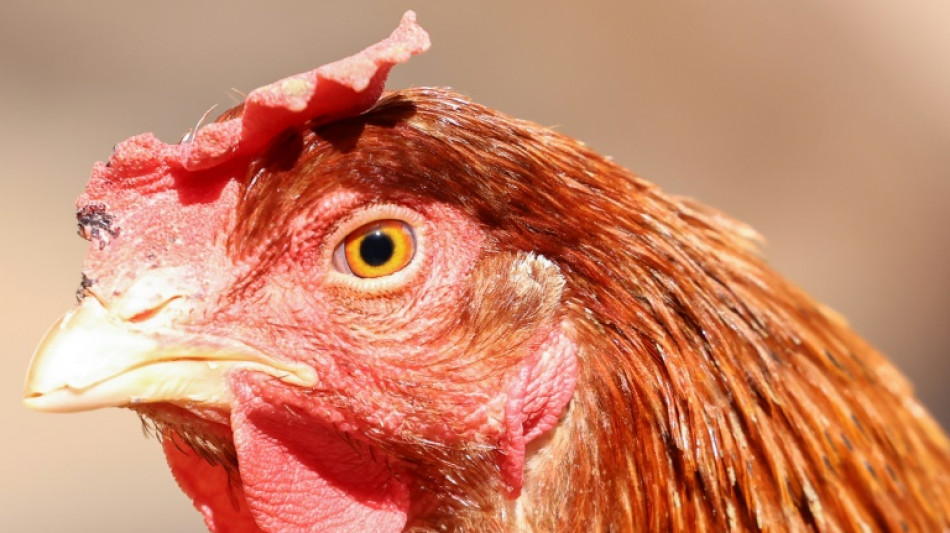
US urged to do more to fight bird flu after first death / Photo: MARIO TAMA - GETTY IMAGES NORTH AMERICA/AFP/File

 Alonso urges Chelsea to learn from painful defeat at Arsenal

 Defending champion Sabalenka reaches US Open quarter-finals

 Minnows Augsburg sink Frankfurt to top Bundesliga table

 Yamal hits double as 'nearly perfect' Barca thrash Valencia
 Antonelli living 'a dream' after astonishing home win

 Impressive Daryz keeps Arc double dream alive
 Strasbourg hit Troyes for six as Amo-Ameyaw sparkles

 German far-right AfD landslide winner in eastern state vote

 Carrick defends Man Utd start despite defensive concerns

 More than 140 killed in latest Yemen clashes: military sources

 Van Aert claims shortened Vuelta stage 15 win in high heat

 Everton shrug off transfer window woes to hold Man Utd

 'Nothing has changed': FIFA confirms Infantino to run for re-election

 UN's Nepal chief makes emotional plea for flood-ravaged country
 Italian GP red-flagged after massive Leclerc crash

 US envoys hold talks with Zelensky on first Kyiv visit

 'Truly scared': Blazes outpace firefighters in Indonesian Borneo
 German director Wenders clarifies views on film and politics

 Nepali rescuers buoyed by miracle finds but tough conditions persist

 At last: Straight sets win over Tabilo puts Zverev in US Open last 16

 Jovic 'loses sanity five times over' to oust friend Eala in US Open epic
 China's memories of Mao fade to nostalgia 50 years after his death

 US envoys discuss with Putin 'substantive' plans for steps to end Ukraine war

 Zheng stuns Keys as US Open upsets dim American hopes

 Jovic 'loses sanity five times over' to oust Eala and book Gauff clash

The first human death from bird flu in the United States has intensified calls for the government to ramp up efforts to stave off the threat of another pandemic -- particularly ahead of Donald Trump's return to the White House.
Health experts around the world have for months been urging US authorities to increase surveillance and share more information about its bird flu outbreak after the virus started spreading among dairy cows for the first time.
On Monday, Louisiana health authorities reported that a patient aged over 60 was the country's first person to die from bird flu.
The patient, who contracted avian influenza after being exposed to infected birds, had underlying medical conditions, US health authorities said.
The World Health Organization has maintained that bird flu's risk to the general population is low, and there is no evidence that it has been transmitted between people.
However health experts have been sounding the alarm about the potential pandemic threat of bird flu, particularly as it has shown signs of mutating in mammals into a form that could spread more easily among humans.
- 'This is how it could start' -
The avian influenza variant H5N1 was first detected in 1996, but a record global outbreak since 2020 has resulted in hundreds of millions of poultry birds being culled -- and killed an unknown but massive number of wild birds.
In March, the virus started transmitting between dairy cows in the United States.
Since the start of last year, 66 bird flu cases have been recorded in humans in the United States, many of them among farm workers, according to the Centers for Disease Control and Prevention.
The US cases had been relatively mild until the Louisiana patient, though a Canadian teenager become severely ill. Nearly half of the 954 human cases of H5N1 recorded since 2003 have been fatal, according to the WHO.
Marion Koopmans, a virologist at the Erasmus University Medical Center in the Netherlands, emphasised that the public should not be unduly worried about another pandemic.
"The problem is that this is how it could start," she added.
Koopmans criticised that "there is not really an effort to contain" the bird flu outbreak among cattle in the United States.
Tom Peacock, a virologist at the Imperial College London, said he thought "the biggest error the US has made is its slow and weak response to the cattle outbreak".
The reason bird flu was affecting US cattle seemed to be a combination of this weak early response, poor biosecurity, "and the intensification of US dairy farming (which involves far more movement of animals than any European system)," he told AFP.
Peacock was a co-author of a preprint study released on Monday, which has not been peer-reviewed, describing how the mutations of H5N1 in cattle enhance its ability to infect other mammals -- including humans.
Rebecca Christofferson, a scientist at Louisiana State University, said there were signs that the deceased patient's virus mutated while they were infected -- but it was not transmitted to anyone else.
"The worry is, the more you let this sort of run wild... the more chances you have for this sort of mutation to not only occur, but to then get out and infect someone else, then you start a chain reaction," she told AFP.
WHO spokeswoman Margaret Harris said the United States "are doing a lot of surveillance" on bird flu. "That's why we're hearing about it," she added.
Last week, the US government awarded an additional $306 million to bolster H5N1 surveillance programs and research.
Peacock said that monitoring has increased for US cattle but warned "big gaps" remain.
- What should the US do? -
Rick Bright, a former top US health official, has been among those calling for the department of agriculture to release more information about bird flu infections among animals.
"There are still just reams of data from this current administration that haven't been released," he told the Washington Post on Monday.
The United States has a stockpile of millions of H5N1 vaccine doses, which Bright said should be offered to at-risk people such as farm workers.
The Biden government has also been urged to encourage companies to develop rapid home tests as well as monitor wastewater for bird flu.
Several of the experts called on Biden to act quickly, before president-elect Trump replaces him in less than two weeks.
There are particular concerns about Trump's pick for health secretary, Robert F. Kennedy Jr.
Kennedy is a sceptic of vaccines, which would be among the most powerful weapons to fend off a potential new pandemic. He is also a known fan of raw milk, which has repeatedly been found to be contaminated with bird flu from infected dairy cows.
People at home have been advised to avoid infected animals -- and raw milk -- and to get a seasonal flu vaccine.
Christofferson said her "biggest worry" was that if someone was infected with both seasonal flu and H5N1, they could mix to become "something that's either more transmissible and or more dangerous to people".
T.Perez--AT