-
 US envoys have 'more effective proposals': Ukraine official
-
Gatti salvages Juve draw with AC Milan in Serie A
-
 Defending champion Alcaraz powers into US Open quarter-finals
-
Sinayoko stars as unbeaten Paris FC down Marseille
-
 Amazon cargo plane overshoots Miami runway, hits vehicles, catches fire
-
Still on top: 'Spider-Man' dominates North American box office

-
 Toll from Yemen clashes passes 300 as civilians flee homes
-
Zelensky in fresh talks with US envoys: Ukraine official
-
 Sabalenka books US Open quarter-final clash with Noskova
-
Noskova edges Kostyuk to reach US Open quarter-finals
-
 German AfD supporters jubilant at far right's thumping win
-
Alonso urges Chelsea to learn from painful defeat at Arsenal

-
 Zelensky warns war likely to continue into winter after US talks
-
Defending champion Sabalenka reaches US Open quarter-finals
-
 Arsenal deliver statement fightback to end Chelsea's flying start
-
Minnows Augsburg sink Frankfurt to top Bundesliga table

-
 Leclerc accepts blame as Hamilton laments Ferrari approach
-
Yamal hits double as 'nearly perfect' Barca thrash Valencia

-
 Sabalenka surges past Townsend to reach US Open quarter-finals
-
Antonelli living 'a dream' after astonishing home win
-
 Smiling face of Germany's far-right AfD: Ulrich Siegmund
-
Impressive Daryz keeps Arc double dream alive
-
 Lebanon president calls for US help as Israeli strikes kill 7
-
Strasbourg hit Troyes for six as Amo-Ameyaw sparkles
-
 Yamal hits double as perfect Barca thrash Valencia
-
German far-right AfD landslide winner in eastern state vote
-
 Venice festival turns gaze on war reporters, media industry
-
Carrick defends Man Utd start despite defensive concerns

-
 Sensational Antonelli wins Italian GP from back of grid
-
More than 140 killed in latest Yemen clashes: military sources

-
 Susan Sarandon says still losing roles over Gaza stance
-
Van Aert claims shortened Vuelta stage 15 win in high heat
-
 US envoys hold 'important' talks in first trip to Kyiv
-
Everton shrug off transfer window woes to hold Man Utd

-
 Championship leader Antonelli wins Italian Grand Prix
-
'Nothing has changed': FIFA confirms Infantino to run for re-election
-
 Vardy signs for Championship strugglers Burnley
-
UN's Nepal chief makes emotional plea for flood-ravaged country
-
 FIFA confirms Infantino will run in presidential election
-
Italian GP red-flagged after massive Leclerc crash
-
 With joy and grief, Palestinian football marks return
-
US envoys hold talks with Zelensky on first Kyiv visit
-
 Iran threatens greater force if US launches more attacks
-
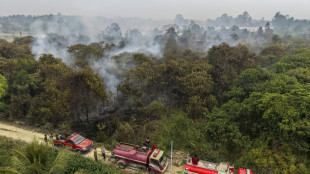
'Truly scared': Blazes outpace firefighters in Indonesian Borneo
-
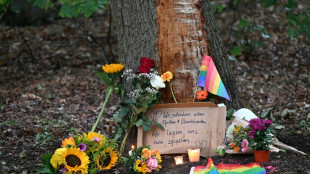 Vandals uproot Berlin tree commemorating Pride attack victims
-
German director Wenders clarifies views on film and politics
-
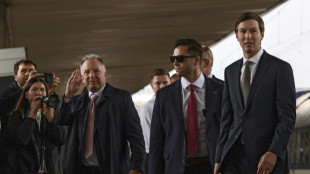 Trump envoys arrive in Kyiv for first Ukraine visit
-
Nepali rescuers buoyed by miracle finds but tough conditions persist
-
 Indonesia's main airport suspends operations after volcanic eruption
-
At last: Straight sets win over Tabilo puts Zverev in US Open last 16
Osaka Expo 'Grand Ring' a symbol of unity: architect
A towering wooden "Grand Ring" built for Expo 2025 in Osaka pays homage to Japan's architectural history and is a symbol of unity despite criticism over costs, its creator says.
The two-kilometre (1.2-mile) circumference of Sou Fujimoto's striking structure will surround dozens of national pavilions at the six-month-long event from April.
World Expo, held every five years in different locations, allows participating countries to show off their technological and cultural strengths.
Organisers have struggled to rouse enthusiasm for the 2025 event, facing slow ticket sales and public concern over the ballooning construction budget.
But Fujimoto, one of Japan's top architects, told AFP there is a deeper value to the 34.4 billion yen ($220 million) Grand Ring than just its price tag.
The Expo is a "really beautiful, precious opportunity where so many different cultures... and countries come together in one place to create diversity and unity", the 53-year-old said under the Ring's imposing latticed beams.
Such an event facilitates international exchange, even as conflicts rage in Ukraine, Gaza and elsewhere, and to illustrate this concept "the simplest shape is a circle."
Traditional techniques for joining wooden pillars inspired by the famous raised platform at Kiyomizu Temple in nearby Kyoto were used to construct the Grand Ring.
So the Expo is also a "wonderful occasion to show that Japan has a long history" of wooden buildings, Fujimoto said.
- Skywalk -
Japanese cedar and hinoki wood, as well as stronger European red cedar, were reinforced with metal to make them quake-resistant.
The wooden beams hold up a sloping roof, 20 metres (65 feet) tall at its highest point, to protect visitors from the elements as they wander through at ground level.
The roof doubles as a "skywalk" with views of the surrounding area.
Despite that, only 7.4 million tickets had been sold by December -- half the organisers' target.
Inflation and labour shortages have meanwhile driven the total construction budget up 27 percent from 2020 estimates to hit 235 billion yen ($1.5 billion).
Fujimoto has argued that the budget increase was partly because of rising prices linked to the Ukraine war, "which no one could have predicted".
"The Ring was created with ingenuity, to have the maximum impact within a limited budget by consolidating various functions," he wrote on social media platform X.
Fujimoto told AFP that using wood for the Grand Ring was a sustainable choice, referring to the "beautiful cycle" of trees absorbing carbon dioxide.
However, how renewable the Ring really is has been questioned.
Japan's Yomiuri Shimbun daily reported in December that just 12.5 percent of the temporary structure will be reused after the Expo -- down from the original plan of 25 percent.
- 'Beyond your imagination' -
Fujimoto's previous work includes "L'Arbre Blanc", a multipurpose tower in France's Montpellier, and a spindly white lattice for the 2013 Serpentine Pavilion in London.
As a child in northern Hokkaido where he used to play in the forest, Fujimoto realised the importance of "the wonderful relationship between nature, architecture and people".
He enjoyed making things, influenced by his doctor father who used to paint and make sculptures.
But he discovered architecture aged 14 when he read the only book on the topic at his home, about Spain's Antonio Gaudi.
"At that time, Gaudi seemed too extreme to me. So I couldn't imagine I could be something like that," he laughed.
The young Fujimoto, who admired Albert Einstein, first studied physics at the prestigious University of Tokyo.
But he "couldn't understand anything" and so switched to architecture, setting up his own company in 2000, six years after graduation.
Fujimoto said he does not know where his passion for architecture comes from but, when a design like the Grand Ring comes to life, it is "beyond your imagination".
"And that is amazing."
A.Clark--AT