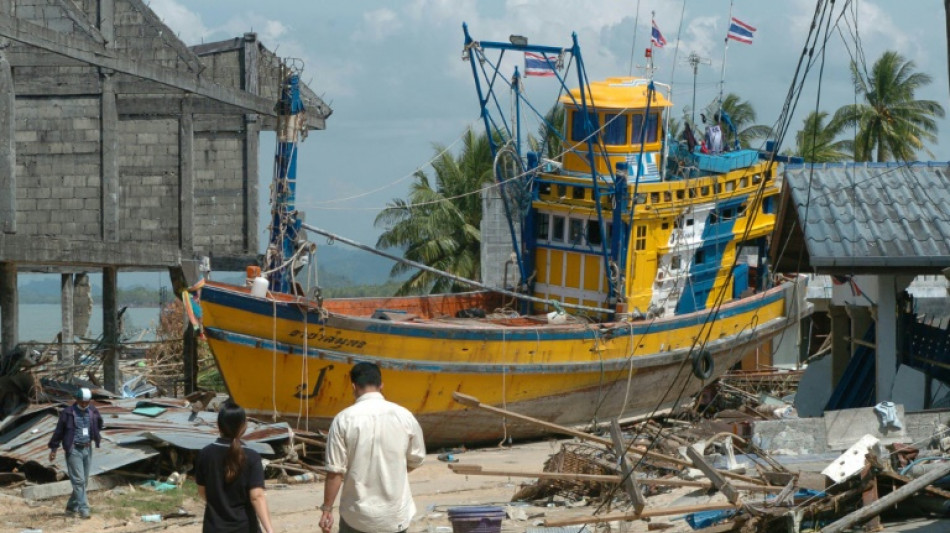
2004 Indian Ocean tsunami: what to know 20 years on / Photo: ROMEO GACAD - AFP

 US envoys have 'more effective proposals': Ukraine official

 Defending champion Alcaraz powers into US Open quarter-finals

 Amazon cargo plane overshoots Miami runway, hits vehicles, catches fire

 Toll from Yemen clashes passes 300 as civilians flee homes

 Sabalenka books US Open quarter-final clash with Noskova

 German AfD supporters jubilant at far right's thumping win

 Zelensky warns war likely to continue into winter after US talks

 Arsenal deliver statement fightback to end Chelsea's flying start

 Leclerc accepts blame as Hamilton laments Ferrari approach

 Sabalenka surges past Townsend to reach US Open quarter-finals

 Smiling face of Germany's far-right AfD: Ulrich Siegmund

 Lebanon president calls for US help as Israeli strikes kill 7

 Yamal hits double as perfect Barca thrash Valencia

 Venice festival turns gaze on war reporters, media industry

 Sensational Antonelli wins Italian GP from back of grid

 Susan Sarandon says still losing roles over Gaza stance

 US envoys hold 'important' talks in first trip to Kyiv

 Championship leader Antonelli wins Italian Grand Prix

 Vardy signs for Championship strugglers Burnley
 FIFA confirms Infantino will run in presidential election

 With joy and grief, Palestinian football marks return

 Iran threatens greater force if US launches more attacks
 Vandals uproot Berlin tree commemorating Pride attack victims

 Trump envoys arrive in Kyiv for first Ukraine visit
 Indonesia's main airport suspends operations after volcanic eruption

Survivors and victims' relatives will next week mark the 20th anniversary of the 2004 Indian Ocean earthquake and tsunami, which killed more than 220,000 people across more than a dozen countries.
A 9.1-magnitude earthquake off the western coast of Indonesia's Sumatra island triggered huge waves that swept into coastal areas of Indonesia, Sri Lanka, India, Thailand and nine other nations around the Indian Ocean basin.
Here is a look back at the impact of the deadliest tsunami in history.
- Faultline rupture -
The tsunami was triggered by the longest faultline rupture from an earthquake ever observed, seconds before 7:59 am on December 26, 2004.
The ocean floor opened at least 1,200 kilometres (750 miles) in length between the India plate and Burma microplate.
It created waves more than 30 metres (100 feet) high, releasing energy equivalent to 23,000 Hiroshima atomic bombs and causing widespread destruction.
The magnitude was initially recorded at 8.8, before the United States Geological Survey gave its official magnitude of 9.1 and depth as 30 kilometres (18.6 miles).
The epicentre was located 150 miles from Sumatra's coast.
Indonesia is a vast archipelago nation on the Pacific "Ring of Fire", an arc of intense seismic activity stretching from Japan through Southeast Asia and across the Pacific basin.
- Huge death toll -
A total of 226,408 people died as a result of the tsunami, according to EM-DAT, a recognised global disaster database.
The worst affected area was northern Sumatra, where more than 120,000 people were killed out of a total of 165,708 dead in Indonesia.
The huge waves travelled around the Indian Ocean, hitting Sri Lanka, India and Thailand hours later.
At their fastest the waves travelled at over 800 kilometres an hour (500 mph), more than twice the speed of a bullet train.
More than 35,000 were killed in Sri Lanka, with 16,389 killed in India and 8,345 in Thailand, according to EM-DAT.
Nearly 300 were killed in Somalia, more than 100 in the Maldives, as well as dozens in Malaysia and Myanmar.
- Displaced, reconstruction -
The tsunami displaced more than 1.5 million people and sparked disaster relief of around $14 billion pledged from the international community, according to the United Nations.
Hundreds of thousands of buildings were destroyed, leaving in some cases entire communities homeless.
A splurge in reconstruction has transformed the worst-hit city Banda Aceh.
More than 100,000 houses were rebuilt in the westernmost Indonesian province of Aceh alone, according to the Indonesian government.
- Warning systems -
The tsunami also forced a reckoning about the preparedness of coastal communities around the Indian Ocean basin.
At the time of the earthquake, there was no warning system in place in the Indian Ocean.
But now, 1,400 stations globally cut warning times to just minutes after a tsunami wave forms.
Experts said the lack of a properly coordinated warning system in 2004 had made the disaster's impact worse.
Ocean scientists say we are more prepared than ever thanks to millions of dollars being invested into tsunami warning systems, but warn that the impact of a catastrophic tsunami can never be completely prevented.
D.Johnson--AT