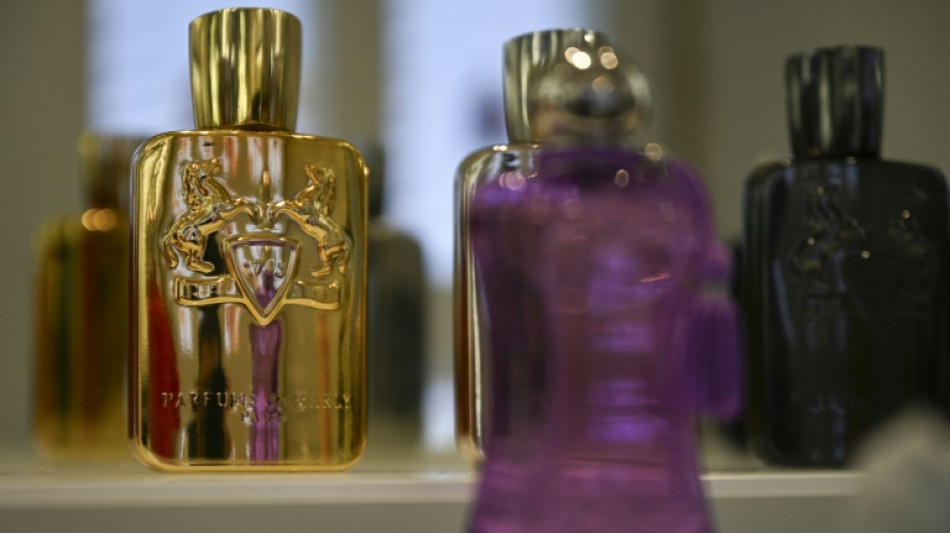
Sweet smell of success for niche perfumes / Photo: Grégoire CAMPIONE - AFP

 Trump Signals Willingness to Work With Democrats After Midterm Defeat

 Qatar media bodies discuss support for humanitarian initiatives

 InterContinental Hotels Group PLC Announces Transaction in Own Shares - November 04

 No. 22 UCLA defeats No. 5 Arizona 84-75 despite Kharchenkov's 38 points

 Vessel operator seeks witnesses after Vancouver grounding

 US Air Force deploys F-16 fighters to remote Aleutian base for readiness drill

 Bezos grant helps Seattle nonprofit move thousands of families toward housing

 Shrini Srivastava joins crew of Varanasi-Delhi Vande Bharat Sleeper service

 Nearly Half of Australian Workers Overqualified, Survey Finds

 RBI eases export-declaration compliance for individual service exporters

 India proposes more import entry points for drugs and medical devices

 Derek Tierney Outlines Ten-Year Strategy for National Digital Health System

 NBC’s Steve Kornacki Reveals Tech Habits Ahead of Midterm Elections

 India and Israel oppose UN draft on regional conventional arms control

 BLS Polymers shares open 65.3% above IPO price

 Capital-markets shares rally as Motilal Oswal and Angel One lead gains

 Latino Voters Defy ICE Fears, Turn Out in Record Numbers for Midterms

 ITC shares rise as analysts anticipate gradual cigarette-business recovery

 Reliance rally puts historical one-year return pattern in focus

 Kuwait edges Oman 1-0 in veterans Gulf Cup in Doha

 Saudi Aramco quarterly profit climbs 34.6% amid elevated oil prices
They don't advertise and they are largely unknown to the general public but niche perfumes are able to command prices of hundreds of dollars from men and women seeking to stand out.
Produced in small batches with high-quality, natural or rare ingredients, niche perfumes are becoming big business even while retaining their exclusive nature.
"We've had absolutely incredible growth," said Julien Sausset, director of Parfums de Marly, a France-based niche fragrance producer.
The company posted more than 50 percent sales growth in 2023 and expects more than 40 percent growth this year to $600 million in sales.
"People don't want to smell like others anymore. They want to free themselves, affirm their identity," Sausset told AFP.
Producers use high concentrations of unconventional ingredients to give their perfumes unique and complex scents, such as amber, bergamot, cedarwood, pink peppercorn, or rhubarb.
Niche perfumes account for 10 to 12 percent of the overall market, according to Sausset.
It will likely continue to expand as it is growing at 13 percent per year while mass market perfumes are growing between three and five percent.
- Something different -
Present in more than 80 countries, Parfums de Marly does most of its business in the United States, where a small bottle will set you back at least $250.
It plans to open a boutique in Paris near the Champs-Elysees in a neighbourhood known as the Golden Triangle for its high concentration of luxury shops.
"What is important is to have a place where you can have your own salespeople do some storytelling and present the products," Sausset said.
The brand was created in 2009 by Julien Sprecher, an aficionado of the 18th century, when modern perfumery was created.
The name comes from the Chateau de Marly, located near Versailles, where Louis XV was known to throw lavish parties.
Niche perfumes tap into that sense of luxury.
Julie El Ghouzzi, who wrote a book on the luxury industry, said the sector developed in reaction to the popularisation of perfumes in the 1990s, when many brands seemed to resemble one another.
Some perfumers wanted to do something different, to "blow up the notion of masculine and feminine and developed perfumes around high-end ingredients, using the names of these ingredients and not brands," she said.
- 'Bottle code' -
These independent perfumers "didn't have the money to order custom bottles, so they used rectangular ones for all their perfumes. And it worked," said El Ghouzzi.
Their success drove luxury houses like Dior and Cartier to imitate them with simple bottles to signal the product was niche, she added.
This "bottle code" has changed somewhat, with some perfumers now adopting more creative bottles, but beauty products giant L'Oreal still uses it for its niche perfumes.
But while the bottle signals to consumers a difference, it is what's inside that sets them apart.
"When a consumer pays 400 euros for a bottle of orange blossom perfume, it is in our interest to use top-quality orange blossoms in high concentrations," said Karine Lebret, L'Oreal's global vice-president for scent science and fragrance design.
"There isn't a top brand without its niche perfume today," said Eric Briones, who wrote a book about luxury and Generation Z (people born between the late 1990s and early 2010s).
He said the Chinese market and Gen Z particularly like niche perfumes in contrast to other luxury goods.
Then there is the ultra niche of bespoke perfumes.
Sylvaine Delacourte, who previously created perfumes for Guerlain, now has her own line of perfumes but also offers to create made-to-order fragrances.
A two-hour meeting is set up with customers to take a "trip in their olfactory memory".
After that, a unique fragrance is created over several months. The price: 20,000 euros ($21,000) for two litres.
K.Hill--AT