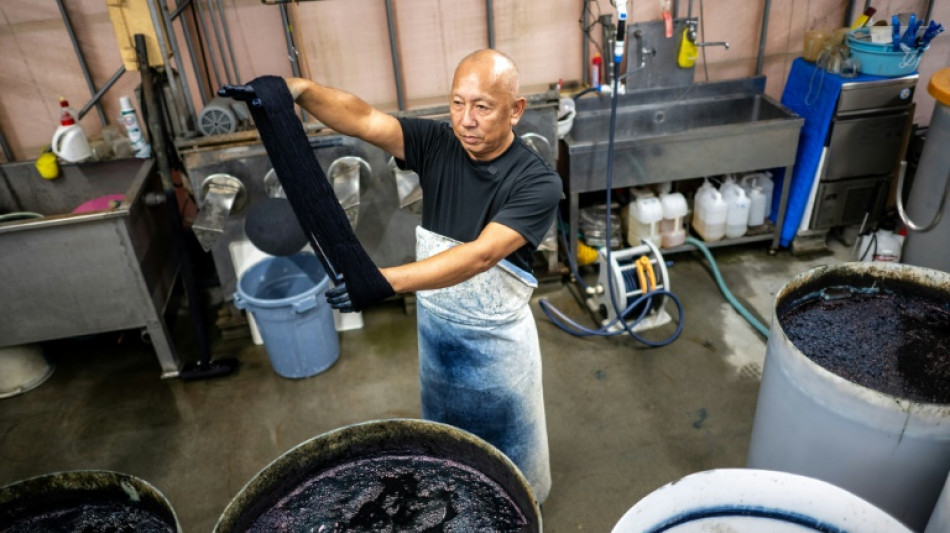
True blue tradition: how Japan's coveted jeans are made / Photo: Philip FONG - AFP

 'Trumpapalooza' tests Republican bet on unpopular US president

 Pegula tops Cirstea to reach US Open quarter-finals

 Australians could opt out of social media algorithms under new law

 Tiafoe tops Medvedev in straight sets at US Open

 Zverev seeks US Open last eight as Osaka faces Rybakina

 Alcaraz turns up heat to reach US Open quarters

 Gatti salvages Juve draw with AC Milan in Serie A

 Sinayoko stars as unbeaten Paris FC down Marseille

 Still on top: 'Spider-Man' dominates North American box office

 Zelensky in fresh talks with US envoys: Ukraine official

 Noskova edges Kostyuk to reach US Open quarter-finals

 Alonso urges Chelsea to learn from painful defeat at Arsenal

 Defending champion Sabalenka reaches US Open quarter-finals

 Minnows Augsburg sink Frankfurt to top Bundesliga table

 Yamal hits double as 'nearly perfect' Barca thrash Valencia

 Antonelli living 'a dream' after astonishing home win

 Impressive Daryz keeps Arc double dream alive

 Strasbourg hit Troyes for six as Amo-Ameyaw sparkles

 German far-right AfD landslide winner in eastern state vote

 Carrick defends Man Utd start despite defensive concerns

 More than 140 killed in latest Yemen clashes: military sources

 Van Aert claims shortened Vuelta stage 15 win in high heat

 Everton shrug off transfer window woes to hold Man Utd

 'Nothing has changed': FIFA confirms Infantino to run for re-election

 UN's Nepal chief makes emotional plea for flood-ravaged country

Call it an antidote to fast fashion: Japanese jeans hand-dyed with natural indigo and weaved on a clackety vintage loom, then sold at a premium to global denim connoisseurs.
Unlike their mass-produced cousins, the tough garments crafted at the small Momotaro Jeans factory in southwest Japan are designed to be worn for decades, and come with a lifetime repair warranty.
On site, Yoshiharu Okamoto gently dips cotton strings into a tub of deep blue liquid, which stains his hands and nails as he repeats the process.
The cotton is imported from Zimbabwe, but the natural indigo they use is harvested in Japan -- its colour far richer than synthetic imitations, according to Okamoto.
He calls it a "time-consuming and costly" method, commonly used to dye kimonos in the 17th-19th century Edo period.
Momotaro Jeans was established in 2006 by Japan Blue, one of a few dozen denim producers in the seaside town of Kojima, renowned for their artisan quality.
"We're very strict about all aspects of manufacturing," Japan Blue's president Masataka Suzuki told AFP.
That includes "whether the sewing is done properly, and whether the dye is beautiful," making local craftspeople with traditional manufacturing skills indispensable.
Their efforts do not come cheap, however. A standard pair of Momotaro Jeans retails for around 30,000 yen ($200) while a silk-blend pair costs 60,000 yen.
The brand's most expensive offering, woven by hand on a wooden machine converted from a luxury kimono loom, has a price tag of over 200,000 yen.
Following in the footsteps of popular high-end Japanese denim brands such as Osaka-based Evisu and Sugar Cane in Tokyo, interest in Japan Blue is growing among overseas shoppers.
They now account for 40 percent of retail sales, and the company recently opened its sixth Kyoto store targeting deep-pocketed tourists.
- 'Niche' reputation -
Denim-making flourished from the 1960s in Kojima, which has a long history of cotton-growing and textile-making.
In the Edo period, the town produced woven cords for samurai to bind sword handles. It then switched to producing split-toe "tabi" socks and, later, school uniforms.
Now denim from Kojima is used by international luxury fashion brands.
The market for Japanese jeans "has grown in the last 10 to 15 years", said Michael Pendlebury, a tailor operating a repair shop in Britain called The Denim Doctor.
Although revered by denim aficionados in Western countries, they remain "not quite affordable for most" with something of a "niche" reputation, Pendlebury said.
"Mass-produced denim brands like Levis, Diesel and Wrangler are the largest, and more worn, but the highest quality is still Japanese in my opinion," he said, adding that the weak yen and a tourism boom could boost sales of made-in-Japan jeans.
Momotaro Jeans is named after a folklore hero in Okayama, where Kojima is located. It's part of the wider denim-producing Sanbi area, which also includes Hiroshima.
Another factor that makes brands like Momotaro Jeans idiosyncratic -- and expensive -- is the use of very noisy old shuttle-weaving machines, which have only a quarter of the output of the latest factory looms.
They often break down, but the only people who know how to repair the machines are in their 70s or older, according to Shigeru Uchida, a weaving craftsman at Momotaro.
The brand uses a handful of shuttle looms made in the 1980s by a company owned by Toyota.
"There are only a few of them in Japan now" because they are no longer made, the 78-year-old Uchida said, walking back and forth between the machines to detect unusual sounds that could signal a breakdown.
Despite the complexities, he says their fabric makes it worth it.
"The texture is very smooth to the touch... and when made into jeans, it lasts quite a long time," Uchida said.
Suzuki says Momotaro Jeans is a "sustainable" choice because "no matter when you bring it to us, we will take responsibility for fixing it".
"When people spend a lot of time in their jeans, the path of their life is left on the clothes," depending on how they wear or wash them and even where they live, Suzuki said.
"We want to preserve such a mark as long as possible."
A.Clark--AT