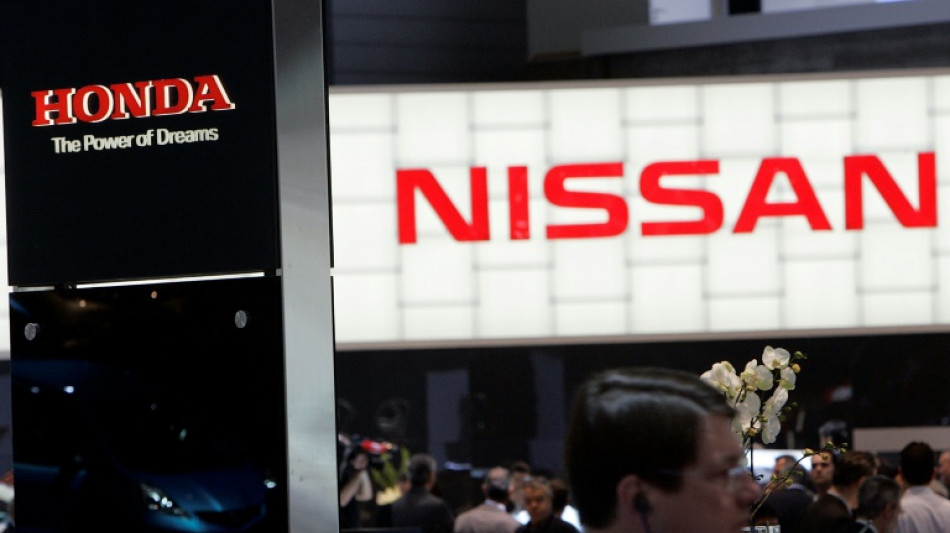
Japan's Honda and Nissan in preliminary merger talks: reports / Photo: NICHOLAS RATZENBOECK - AFP/File

 Trump Signals Willingness to Work With Democrats After Midterm Defeat

 Qatar media bodies discuss support for humanitarian initiatives

 InterContinental Hotels Group PLC Announces Transaction in Own Shares - November 04

 No. 22 UCLA defeats No. 5 Arizona 84-75 despite Kharchenkov's 38 points

 Vessel operator seeks witnesses after Vancouver grounding

 US Air Force deploys F-16 fighters to remote Aleutian base for readiness drill

 Bezos grant helps Seattle nonprofit move thousands of families toward housing

 Shrini Srivastava joins crew of Varanasi-Delhi Vande Bharat Sleeper service

 Nearly Half of Australian Workers Overqualified, Survey Finds

 RBI eases export-declaration compliance for individual service exporters

 India proposes more import entry points for drugs and medical devices

 Derek Tierney Outlines Ten-Year Strategy for National Digital Health System

 NBC’s Steve Kornacki Reveals Tech Habits Ahead of Midterm Elections

 India and Israel oppose UN draft on regional conventional arms control

 BLS Polymers shares open 65.3% above IPO price

 Capital-markets shares rally as Motilal Oswal and Angel One lead gains

 Latino Voters Defy ICE Fears, Turn Out in Record Numbers for Midterms

 ITC shares rise as analysts anticipate gradual cigarette-business recovery

 Reliance rally puts historical one-year return pattern in focus

 Kuwait edges Oman 1-0 in veterans Gulf Cup in Doha

 Saudi Aramco quarterly profit climbs 34.6% amid elevated oil prices
Japanese auto giants Honda and Nissan are in preliminary merger talks, media reports said Wednesday.
A tie-up would help them better compete against Tesla and other electric vehicle makers, the Nikkei, the Financial Times and others said.
The two firms agreed in March to explore a strategic partnership on electric vehicles, a move analysts said was aimed at catching up with Chinese competitors.
A Honda spokesman said Wednesday that a potential merger was already among the possibilities being discussed.
"We are discussing possibilities for cooperation between Honda and Nissan in the future, in a wide range of fields and in various areas, and those possibilities include the latest reports, but there is nothing decided," the spokesman told AFP.
Nissan said: "The content of the report is not something that has been announced by either companies. As announced in March of this year, Honda and Nissan are exploring various possibilities for future collaboration, leveraging each other's strengths.
"If there are any updates, we will inform our stakeholders at the appropriate time."
Nissan in particular has been struggling, announcing 9,000 job cuts last month and slashing its annual sales forecast.
Nissan shares rose more than 20 percent in early trade while Honda was off more than one percent. Mitsubishi Motors -- of which Nissan is the top shareholder -- gained 14 percent.
Honda and Nissan are looking to operate under a single holding company and will soon sign a memorandum of understanding for the new entity, the Nikkei and other outlets said, citing people familiar with the matter.
They said the firms would consider bringing Mitsubishi Motors under the holding company to create one of the world's largest auto groups.
Honda and Nissan earlier issued almost identical statements in response, saying the details in the report had not been announced by either side.
Their statements said they were "exploring various possibilities for future collaboration, leveraging each other's strengths", as previously announced.
Honda is Japan's number two automaker and Nissan is number three, with their rival Toyota in pole position.
China overtook Japan as the world's biggest vehicle exporter in 2023, helped by its dominance in EVs, a sector where Japanese firms have lost ground by focusing on hybrid vehicles.
Honda announced plans in May to double investment in electric vehicles to $65 billion by 2030, part of its ambitious target set three years ago of achieving 100 percent EV sales by 2040.
Nissan has signalled similar ambitions.
It said in March that 16 of the 30 new models it plans to launch over the next three years would be "electrified".
The world's auto giants are increasingly prioritising electric and hybrid vehicles, with demand growing for less polluting models as concern about climate change grows.
At the same time, however, there has been a slowdown in the EV market on the back of consumer concern about high prices, reliability, range and a lack of charging points.
Hybrids that combine battery power and internal combustion engines have proved enduringly popular in Japan, accounting for 40 percent of sales in 2022.
Just 1.7 percent of cars sold in Japan in 2022 were electric -- compared with 15 percent in western Europe and 5.3 percent in the United States.
burs-kh-stu/kaf/dan
E.Rodriguez--AT