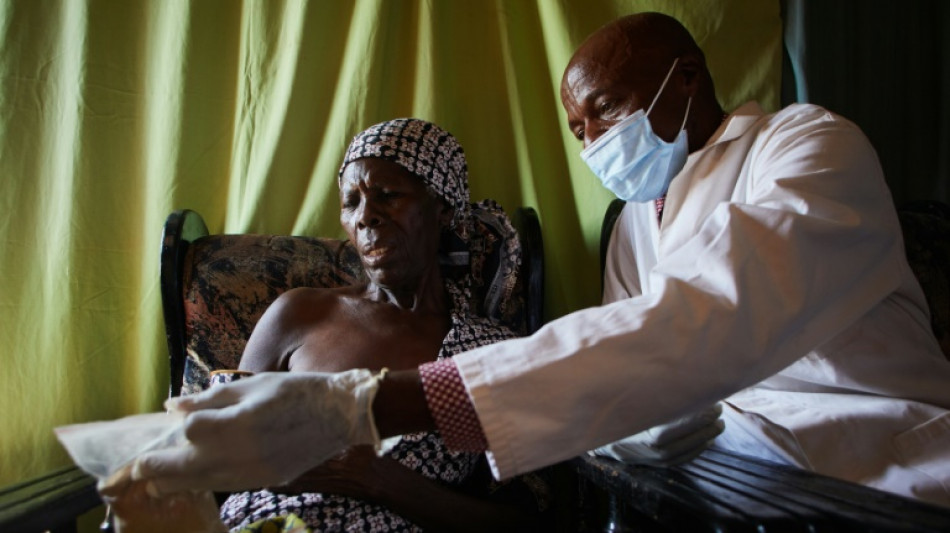
Zimbabwe's sick turn to herbalists over ailing health system / Photo: Jekesai NJIKIZANA - AFP

 Philippine sensation Eala looks forward to Asian Games 'fun'
 Jakarta airport extends closure after volcano eruption

 Lonely woman director in Venice sees industry backsliding on gender
 Tech firms rally on mixed day for Asian markets, with eyes on US inflation

 World number one An sends Asian Games warning with China hat-trick

 PSG go for three in a row as Champions League returns

 "Super-human' Alcaraz books US Open quarter-final clash with Shelton

 ECB set to hike interest rates as Iran war flares anew

 AI data centers are less thirsty now, tech giants say

 North Korea vows nuclear-armed navy as US ally drills open

 Under-fire Labuschagne named in Australia Test squad for South Africa

 Enjoying the moment: Alcaraz steps it up to reach US Open quarter-finals

 Five dead, five injured after Amazon cargo plane overshoots Miami runway

 La Rochelle half-backs lead fightback against Toulouse

 US envoys have 'more effective proposals': Ukraine official

 Defending champion Alcaraz powers into US Open quarter-finals

 Amazon cargo plane overshoots Miami runway, hits vehicles, catches fire

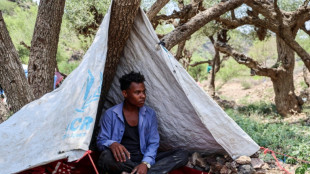 Toll from Yemen clashes passes 300 as civilians flee homes

 Sabalenka books US Open quarter-final clash with Noskova

 German AfD supporters jubilant at far right's thumping win

 Zelensky warns war likely to continue into winter after US talks

 Arsenal deliver statement fightback to end Chelsea's flying start

 Leclerc accepts blame as Hamilton laments Ferrari approach

 Sabalenka surges past Townsend to reach US Open quarter-finals

 Smiling face of Germany's far-right AfD: Ulrich Siegmund

When Agnes Kativhu could not get treatment for breast cancer from Harare's main public hospital, she checked in to one of the many self-styled herbal clinics opening up across Zimbabwe's capital.
"I was a moving grave but am now well," Kativhu claimed in an interview at the centre, where she spent around a month.
"I never want to go back to the hospital because it broke my heart that they failed to give me a single tablet," the 67-year-old told AFP.
Unaccredited, unregulated and with unproven results, herbalists are in growing demand among Zimbabweans who feel let down by a public health system in ruins.
The country's largest public hospital, Parirenyatwa, has not had a functioning mammogram machine for 15 years.
It does, however, have the only operating radiotherapy cancer treatment machine available to the general public in the entire country of nearly 17 million people.
"We recognise that one machine is insufficient," said Nothando Mutizira, head of oncology at Parirenyatwa.
"However, we are managing to provide radiotherapy services with this single unit."
Like other public hospitals struggling through Zimbabwe's deep and enduring economic crisis, Parirenyatwa lacks medicines, equipment and even staff as doctors and nurses quit for better salaries and conditions abroad.
- 'No drugs' -
Some hospitals solicit donations of medicines and essential items such as gloves and syringes.
"There are no drugs," said Simbarashe James Tafirenyika, president of Zimbabwe Municipalities Nurses and Allied Workers Union.
Even when a hospital does have equipment, regular power outages put the machines out of service, he said.
Public hospitals are losing their staff to the growing private sector and countries like Britain -- where qualified nurses can earn more money as carers -- or even closer to home in the less well-off region.
"Some are migrating to South Africa, some are migrating to Zambia, some are actually migrating to Mozambique," Tafirenyika said.
The corridors at Parirenyatwa are jammed with patients and their families navigating paint-chipped walls under cracked ceilings. The waiting lists are long.
Those who can afford it, travel to neighbouring South Africa for treatment. Others go to herbalists.
- Faith based on 'fear' -
There is some misguided faith in the benefits of herbs and the risks of hospital treatment, said Lovemore Makurirofa, from the Cancer Association of Zimbabwe.
"Many people fear both the disease and its treatments, avoiding chemotherapy, radiotherapy and surgery," he said.
The emerging herbal clinics -- which advertise for business on street corners via loudspeakers -- frustrate the hospitals.
"When you ask patients why it has taken them that long to come and seek medical attention, usually they will tell you that they've been using herbal medicines for quite a long time," Mutizira said.
"When patients eventually come, they come either with stage three or stage four cancer which is more difficult to treat, more expensive to treat and also the outcomes are much poorer," she said.
The herbalist who runs the Harare centre where Kativhu sought help for her breast cancer is confident of his abilities.
"I can treat any type of cancer," said Never Chirimo, 66. Herbs also enable him to diagnose cancer, he claimed.
But he would like to work more closely with the hospitals.
"What I want is an open dialogue with doctors. Ultimately, we should work together, as many cancer patients prefer herbal remedies over conventional medicine."
Another of his patients, 58-year-old Wilfred Manatsa said he spent $25,000 on treatment at a private hospital for prostate cancer and kaposi sarcoma.
Surgery would have cost another $7,000 that he did not have. He put his faith in the herbs.
"I put aside my prescribed medications and now rely solely on herbs," Manatsa said.
G.P.Martin--AT