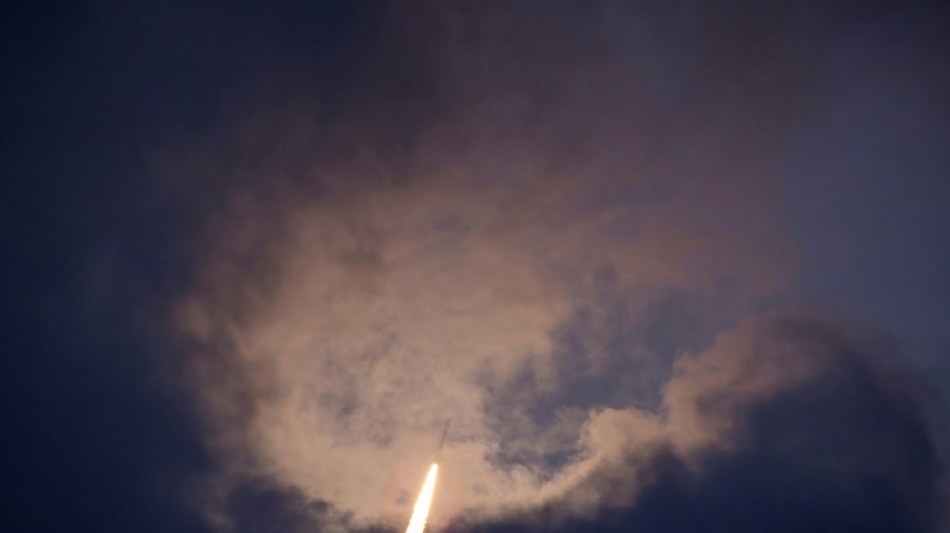
Europe's Vega-C rocket launches satellite into orbit after delays / Photo: Ronan LIETAR - AFP

 Philippine sensation Eala looks forward to Asian Games 'fun'
 Jakarta airport extends closure after volcano eruption

 Lonely woman director in Venice sees industry backsliding on gender

 Tech firms rally on mixed day for Asian markets, with eyes on US inflation

 World number one An sends Asian Games warning with China hat-trick
 PSG go for three in a row as Champions League returns
 "Super-human' Alcaraz books US Open quarter-final clash with Shelton

 ECB set to hike interest rates as Iran war flares anew

 AI data centers are less thirsty now, tech giants say

 North Korea vows nuclear-armed navy as US ally drills open

 Under-fire Labuschagne named in Australia Test squad for South Africa

 Enjoying the moment: Alcaraz steps it up to reach US Open quarter-finals

 Five dead, five injured after Amazon cargo plane overshoots Miami runway

 La Rochelle half-backs lead fightback against Toulouse

 US envoys have 'more effective proposals': Ukraine official

 Defending champion Alcaraz powers into US Open quarter-finals

 Amazon cargo plane overshoots Miami runway, hits vehicles, catches fire

 Toll from Yemen clashes passes 300 as civilians flee homes

 Sabalenka books US Open quarter-final clash with Noskova

 German AfD supporters jubilant at far right's thumping win

 Zelensky warns war likely to continue into winter after US talks

 Arsenal deliver statement fightback to end Chelsea's flying start

 Leclerc accepts blame as Hamilton laments Ferrari approach

 Sabalenka surges past Townsend to reach US Open quarter-finals

 Smiling face of Germany's far-right AfD: Ulrich Siegmund

Europe's new Vega-C rocket launched Thursday from French Guiana and put a satellite into orbit in its first takeoff since a failed flight two years ago.
After two days of delays, the rocket -- crucial to Europe's autonomy in reaching space -- took off without problems, carrying the Sentinel-1C satellite for the European Union's Copernicus Earth observation programme.
The satellite, which provides data and services for observing the planet in order to understand climate change impacts, was put into orbit at an altitude of around 700 kilometres (435 miles), 1 hour and 43 minutes after lift-off, to thunderous applause from the Jupiter control centre.
"With the insertion of Sentinel-1C into orbit, ESA continues a legacy of steadfast Sentinels protecting the Earth and exemplifies why Europe needs secured flights: because what we send to space provides benefits to Earth, and it all starts with a launch," Josef Aschbacher, director general of the European Space Agency, said in a statement.
The ESA added that the satellite will deliver "high-resolution radar imagery to monitor Earth's changing environment", and offers "new capabilities for detecting and monitoring maritime traffic".
It is the first launch for the lightweight rocket since December 2022, when it failed to reach orbit in its maiden commercial flight and lost two satellites, delivering a fresh blow to a continent already struggling to blast its missions into space.
The rocket was grounded for two years while the nozzle of the Zefiro 40 rocket motor -- which caused the failure -- was redesigned.
- Flight delays -
Vega-C's return flight was initially scheduled for Tuesday from Europe's spaceport in Kourou, French Guiana.
That launch was postponed by one day to allow for "additional checks on electrical connections in the upper stage" of the rocket, said the ESA's space transportation director, Toni Tolker-Nielsen.
But hours before the launch, it was delayed another 24 hours.
This time it was "due to a mechanical problem preventing the removal of the Vega-C mobile gantry", French space agency CNES said in a statement on Wednesday.
A gantry is a movable frame that supports the rocket on the launch pad.
In its latest try, the Vega-C took off as scheduled at 6:20 pm local time (2120 GMT).
Earlier on Thursday, the ESA's Proba-3 mission to probe the Sun's outer atmosphere successfully launched on an Indian rocket.
Europe has struggled to find a way to independently launch missions since Russia withdrew its rockets in 2022 over the war in Ukraine.
Four years of delays to Europe's new Ariane 6 rocket compounded the issue, forcing the continent to turn to rivals such as Elon Musk's SpaceX.
However, the heavy-lift Ariane 6 had a successful first flight in July, offering some relief to European space efforts.
The lighter Vega-C was designed to send small satellites into low-Earth orbit.
Its predecessor Vega had its last launch in September, placing more importance on Vega-C returning to active duty.
Four launches using Vega-C are planned for next year, followed by five more in 2026, Tolker-Nielsen said.
The Sentinel-1C satellite will use radar to monitor Earth's environment as part of the EU's Copernicus programme to provide climate and other data to governments and businesses.
H.Gonzales--AT