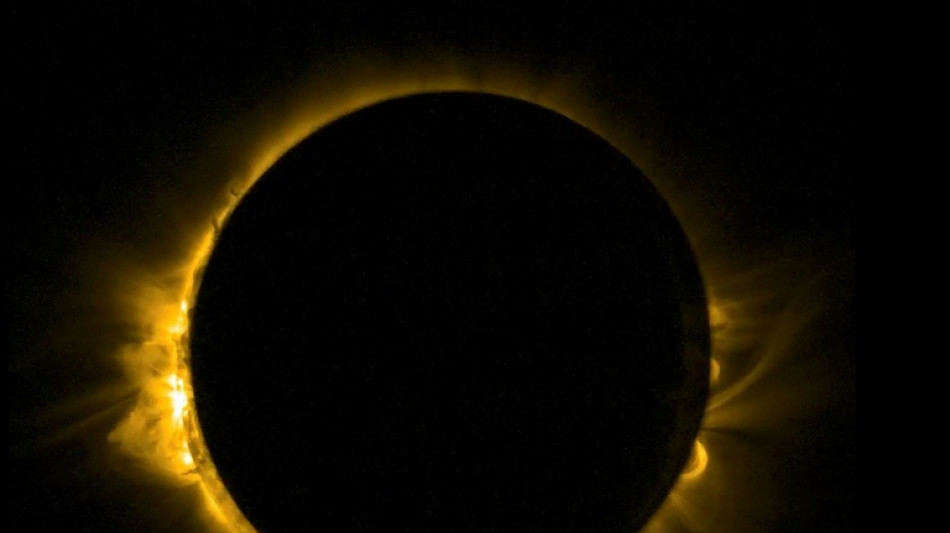
European mission to imitate solar eclipse launches from India / Photo: Proba-2 minisatellite - ESA/AFP/File

 Trump Signals Willingness to Work With Democrats After Midterm Defeat

 Qatar media bodies discuss support for humanitarian initiatives

 InterContinental Hotels Group PLC Announces Transaction in Own Shares - November 04

 No. 22 UCLA defeats No. 5 Arizona 84-75 despite Kharchenkov's 38 points

 Vessel operator seeks witnesses after Vancouver grounding

 US Air Force deploys F-16 fighters to remote Aleutian base for readiness drill

 Bezos grant helps Seattle nonprofit move thousands of families toward housing

 Shrini Srivastava joins crew of Varanasi-Delhi Vande Bharat Sleeper service

 Nearly Half of Australian Workers Overqualified, Survey Finds

 RBI eases export-declaration compliance for individual service exporters

 India proposes more import entry points for drugs and medical devices

 Derek Tierney Outlines Ten-Year Strategy for National Digital Health System

 NBC’s Steve Kornacki Reveals Tech Habits Ahead of Midterm Elections

 India and Israel oppose UN draft on regional conventional arms control

 BLS Polymers shares open 65.3% above IPO price

 Capital-markets shares rally as Motilal Oswal and Angel One lead gains

 Latino Voters Defy ICE Fears, Turn Out in Record Numbers for Midterms

 ITC shares rise as analysts anticipate gradual cigarette-business recovery

 Reliance rally puts historical one-year return pattern in focus

 Kuwait edges Oman 1-0 in veterans Gulf Cup in Doha

 Saudi Aramco quarterly profit climbs 34.6% amid elevated oil prices
A European mission launched from India on Thursday, aiming to catch a rare glimpse of the Sun's mysterious atmosphere by imitating a solar eclipse using two satellites flying with millimetre-level precision.
The European Space Agency's Proba-3 mission blasted off on an Indian rocket from a launchpad on the island of Sriharikota at around 4:04 pm (1034 GMT), an online broadcast showed.
The separation of the rocket's third stage was met with applause at mission control, according to the ESA broadcast.
The Indian Space Research Organisation wrote on X that the PSLV-C59 rocket had "successfully soared into the skies", hailing the "proud moment" for India's space efforts.
The mission's aim is to find out more about the Sun's corona, the outermost part of its atmosphere, which is not visible on Earth except during a total solar eclipse when the Moon blocks out the light.
The half-ton spacecraft, which soon will enter Earth's orbit, holds two satellites that will separate from each other early next year.
They will then line up around 150 metres (500 feet) apart, so that one casts its shadow on the other.
In tandem, and without guidance from the ground, the solar-powered satellites will embark on an extremely elliptical 19-hour orbit, swinging out towards the Sun around 60,000 kilometres (37,000 miles) from Earth.
One satellite has a 1.4-metre shield that will play the role of the Moon in blocking the Sun's light.
The other satellite will then be able to observe and measure the Sun's corona from the shadow.
While total eclipses on Earth last just minutes and only occur around 60 times a century, it is hoped that Proba-3 will manage to secure 10 to 12 hours of observations a week over two years, the ESA has said.
To achieve this feat, the two satellites will need to fly in formation at a level of precision never before seen in such a mission, according to the ESA.
"We are aiming for precision on the order of a millimetre," ESA's Proba-3 project manager Damien Galano told a recent press conference.
The launch of the 200-million-euro ($210-million) mission had originally been planned for Wednesday, but was postponed by one day due to a technical issue, the ESA said.
A.Ruiz--AT