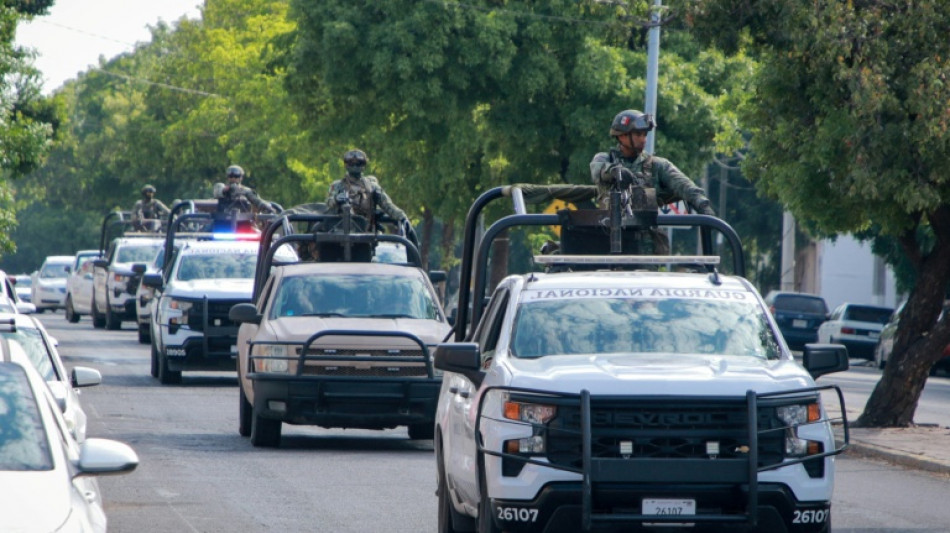
Life has 'disappeared': Mexican city reeling from cartel infighting / Photo: Ivan MEDINA - AFP

 Nepal holds day of mourning as families pray missing still alive
 African players in Europe: Mbeumo fires solo goal as United draw

 Malaysia cancels haze emergency, but warns problems remain
 Philippine sensation Eala looks forward to Asian Games 'fun'
 Jakarta airport extends closure after volcano eruption

 Lonely woman director in Venice sees industry backsliding on gender
 Tech firms rally on mixed day for Asian markets, with eyes on US inflation
 World number one An sends Asian Games warning with China hat-trick

 PSG go for three in a row as Champions League returns

 "Super-human' Alcaraz books US Open quarter-final clash with Shelton

 ECB set to hike interest rates as Iran war flares anew

 AI data centers are less thirsty now, tech giants say
 North Korea vows nuclear-armed navy as US ally drills open
 Under-fire Labuschagne named in Australia Test squad for South Africa

 Best Way to Protect A 401(k) in 2026: Guide Released by Experts

 InterContinental Hotels Group PLC Announces Transaction in Own Shares - September 07

 Tiafoe tops Medvedev in straight sets at US Open
 Zverev seeks US Open last eight as Osaka faces Rybakina

 Alcaraz turns up heat to reach US Open quarters
 Gatti salvages Juve draw with AC Milan in Serie A

 Sinayoko stars as unbeaten Paris FC down Marseille
 Still on top: 'Spider-Man' dominates North American box office
 Zelensky in fresh talks with US envoys: Ukraine official
 Noskova edges Kostyuk to reach US Open quarter-finals

 Alonso urges Chelsea to learn from painful defeat at Arsenal

An eerie silence pervades the historic center of Culiacan, capital of the Mexican state of Sinaloa, where infighting among one of the world's biggest drug cartels has left hundreds of people dead since September.
As night falls on Paseo del Angel, the city's entertainment quarter, a popular restaurant offering Japanese-Mexican fusion cuisine that was booked out nightly just a few months ago is virtually empty.
A nail salon and a pastry shop on the same street have "for sale" signs in the window.
"Life in Culiacan has almost disappeared," Miguel Taniyama, owner of the Clan Taniyama restaurant, lamented.
Years of relative quiet in Sinaloa, a predominantly agricultural state home to the notorious cartel of the same name, were shattered in September when two rival factions of the drug gang went to war.
- Allegations of double-crossing -
Since then, each week has brought a grim litany of shootouts, abductions, bodies dumped in the street and vehicles and businesses set alight, sending Culiacan's 800,000 residents scrambling for cover.
The bloodletting began on September 9 after details emerged of how the son of the cartel's jailed founder Joaquin "El Chapo" Guzman reportedly double-crossed the cartel's other co-founder, Ismael "El Mayo" Zambada.
Zambada was arrested on US soil on July 25 after allegedly being kidnapped in Mexico and delivered to US authorities against his will.
Zambada claimed he was ambushed by Joaquin Guzman Lopez, one of "El Chapol"'s sons, who he said lured him onto a plane that was headed for the United States, where "El Chapo" himself is serving a life sentence.
The ensuing war between the cartel's "Mayos" and "Chapitos" has left more than 400 people dead and hundreds missing, according to the state prosecutor's office.
The local Noroeste newspaper said 519 people had been killed in an explosion of violence that shows no signs of abating.
At least 10 people were killed on Monday, the state prosecutor's office said.
Last week, five bodies were found outside the Autonomous University of Sinaloa, which promptly suspended classes and switched to remote learning.
- Feeding US fentanyl addiction -
The Sinaloa Cartel, one of Mexico's biggest drug trafficking organizations, was built on cocaine smuggling but over the past decade has changed focus to feeding the US opioid addiction.
The US Drug Enforcement Administration in June said the gang was "largely responsible for the massive influx of fentanyl" into the country over the past eight years.
The cartel's stranglehold on Culiacan was evident in 2019, when Mexico's security forces attempted to arrest another of El Chapo's sons, Ovidio Guzman Lopez.
The operation ended in humiliation for the government, which was forced to free the drug lord after the cartel launched a massive assault on the city.
While Culiacan recovered quickly from that episode -- and Ovidio was later recaptured -- the succession war now raging within the cartel has brought the local economy to the brink of collapse.
At least 30,000 people have lost their jobs, representing about a third of all social welfare recipients, according to the city's chamber of commerce.
The violence has affected all aspects of daily life.
With many people fearing going out into the street, some companies have reinstated pandemic-era remote working.
The second-division Dorados de Sinaloa football club, which had late Argentine legend Diego Maradona for a coach in 2018-2019, has temporarily relocated from Culiacan to Tijuana, some 1,500 kilometers (932 miles) away.
- 'Scared out of our wits' -
Around 11,000 soldiers backed with armored vehicles and planes have been deployed to Culiacan to try to quell the violence.
In October, the army said it had killed 19 suspected cartel members and arrested one local leader in its bloodiest clashes with narco-traffickers in years.
More than 450,000 people have been murdered in Mexico since the state launched a war on drugs in 2006.
Over 100,000 people are missing.
To try lure people back onto the streets, Taniyama, the chef, organized a giant festival on November 21, with live music and lashings of Sinaloa's signature dish, aguachile, a shrimp ceviche.
"We've been locked up for 70 days and scared out of our wits...Today we're starting to live again!" he told the gathering.
But there was no respite from the suffering for the families of those caught up in the violence.
Rosa Lidia Felix, 56, has not heard from her 28-year-old son Jose Tomas since he went missing on November 1.
"Please, I want my son back," she wept.
A.Taylor--AT