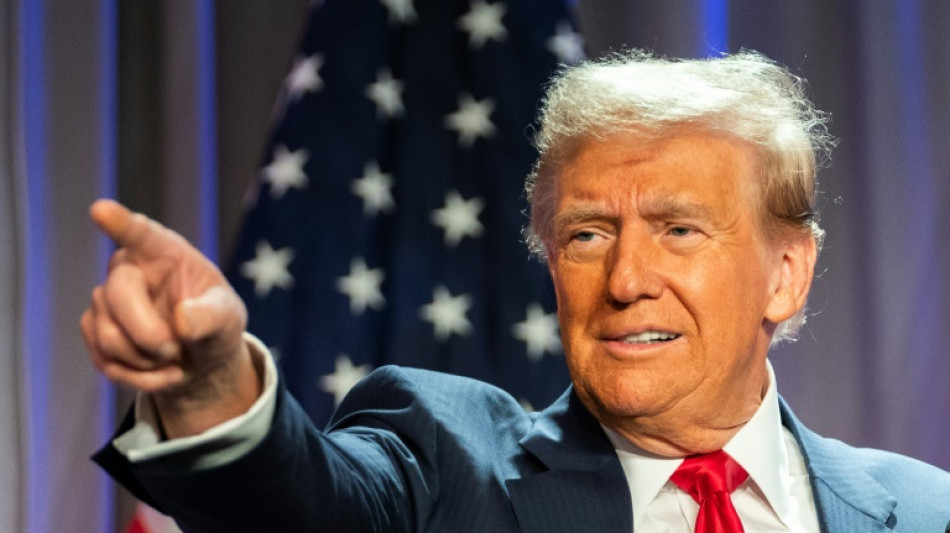
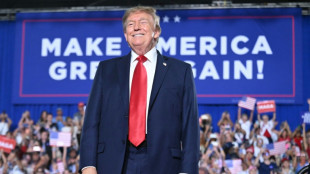
Trump vows to defend US dollar hegemony, but is it under threat? / Photo: ALLISON ROBBERT - POOL/AFP/File

 Nepal holds day of mourning as families pray missing still alive

 African players in Europe: Mbeumo fires solo goal as United draw

 Malaysia cancels haze emergency, but warns problems remain
 Philippine sensation Eala looks forward to Asian Games 'fun'
 Jakarta airport extends closure after volcano eruption
 Lonely woman director in Venice sees industry backsliding on gender
 Tech firms rally on mixed day for Asian markets, with eyes on US inflation
 World number one An sends Asian Games warning with China hat-trick

 PSG go for three in a row as Champions League returns

 "Super-human' Alcaraz books US Open quarter-final clash with Shelton

 ECB set to hike interest rates as Iran war flares anew
 AI data centers are less thirsty now, tech giants say
 North Korea vows nuclear-armed navy as US ally drills open

 Under-fire Labuschagne named in Australia Test squad for South Africa
 Best Way to Protect A 401(k) in 2026: Guide Released by Experts

 InterContinental Hotels Group PLC Announces Transaction in Own Shares - September 07

 Tiafoe tops Medvedev in straight sets at US Open
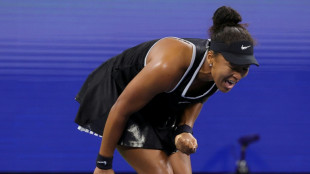 Zverev seeks US Open last eight as Osaka faces Rybakina

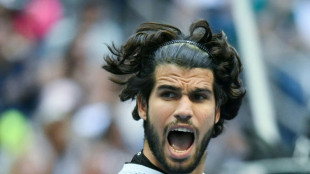 Alcaraz turns up heat to reach US Open quarters
 Gatti salvages Juve draw with AC Milan in Serie A

 Sinayoko stars as unbeaten Paris FC down Marseille
 Still on top: 'Spider-Man' dominates North American box office
 Zelensky in fresh talks with US envoys: Ukraine official
 Noskova edges Kostyuk to reach US Open quarter-finals
 Alonso urges Chelsea to learn from painful defeat at Arsenal
US President-elect Donald Trump has threatened retaliation against governments that challenge the US dollar, vowing "100 percent tariffs" on countries that undercut the US currency.
The Republican vowed the action on states that "create a new BRICS Currency" or otherwise "replace the mighty US dollar," according to a post on Truth Social on Monday.
BRICS refers to a grouping that includes Brazil, Russia, India, China and South Africa, and has expanded in recent years to include Iran, Egypt, Ethiopia and the United Arab Emirates.
Trump's statement, however, comes at a time when the greenback's hegemony does not appear to be facing an immediate threat, having been the world's reserve currency for decades.
- Is the dollar's influence diminishing? -
The US dollar currently comprises 58 percent of foreign exchange reserves held worldwide, according to the International Monetary Fund (IMF), down from 67 percent in 2000.
But the greenback accounts for 74 percent of export invoices in the Asia-Pacific region, which is the most active in terms of international trade, the IMF says.
The dollar has maintained its unique position globally since the 1944 Bretton Woods accords, the international agreement that established the IMF and required signatories to peg their currencies to the US currency.
The system has evolved since that time and several countries have stopped indexing their currencies to the dollar, but without challenging its status as the global reserve currency.
The United States' massive role in monetary policy also reflects the country's position as the world's largest consumer of goods and services and the source of more than $8 trillion in government debt held by foreign investors.
The dominance of the US currency has not been affected by the huge scale of its debt, nor by the shakiness of its financial system during the 2008 global financial crisis.
"The US dollar remains as dominant as ever as a global funding currency, a payment currency for international transactions, and a reserve currency," said Eswar Prasad, a professor of international trade policy at Cornell University in New York state.
"Without the dollar as the dominant international currency, the multilateral trading system would effectively cease to exist –- making the global economy much less efficient," said Benn Steil, a senior fellow at the US-based Council on Foreign Relations.
- Is the dollar being threatened? -
Trump's comments came on the heels of a BRICS summit in October in Kazan, Russia, where members discussed boosting non-dollar transactions and strengthening local currencies.
"The BRICS today might be where Europe was in the 1970s and that's optimistic in terms of integrating," said Adam Button, chief currency analyst at ForexLive.
Recent years have seen an uptick in transactions involving local currencies, especially between China and Russia, in light of international sanctions on Moscow following its invasion of Ukraine in 2022.
There has not, however, been an official effort to employ a currency throughout the group, or at forming an official monetary union.
"I don't know if there (are) any of those countries (that) would give up monetary sovereignty," Button said. "So it's a wholly fringe idea, and I'm not even sure why Trump decided to validate it."
While China and India are by far the world's two most populous states, their currencies are not widely used outside of their borders.
Trump's broadside did not mention the euro, which plays a key role in facilitating commerce within the eurozone but has not been envisioned as having global aspirations.
- Will Trump's comments impact the dollar? -
The influence of the dollar means many countries can see their fortunes affected by the fluctuations of the US currency.
When the dollar is strong -- such as currently -- other countries face pressure to raise their interest rates to counter the risk of capital flight.
"The US has wielded the dollar's dominance as a weapon against its rivals through financial sanctions and even freezing of dollar reserves," Prasad said.
Jonathan Kirshner, a political scientist at Boston College who has written extensively on currencies and international relations, sees Trump's comments as largely "irrelevant for real-world international politics."
"Despite Trump's bluster, you can't force people to use the dollar -- an international currency thrives because people *want* to hold it -- and thus such coercion will only backfire," he said in an email to AFP.
M.White--AT