Dressing the Church: one of Rome's last clergyman tailors / Photo: Tiziana FABI - AFP

 Trump Signals Willingness to Work With Democrats After Midterm Defeat

 Qatar media bodies discuss support for humanitarian initiatives

 InterContinental Hotels Group PLC Announces Transaction in Own Shares - November 04

 No. 22 UCLA defeats No. 5 Arizona 84-75 despite Kharchenkov's 38 points

 Vessel operator seeks witnesses after Vancouver grounding

 US Air Force deploys F-16 fighters to remote Aleutian base for readiness drill

 Bezos grant helps Seattle nonprofit move thousands of families toward housing

 Shrini Srivastava joins crew of Varanasi-Delhi Vande Bharat Sleeper service

 Nearly Half of Australian Workers Overqualified, Survey Finds

 RBI eases export-declaration compliance for individual service exporters

 India proposes more import entry points for drugs and medical devices

 Derek Tierney Outlines Ten-Year Strategy for National Digital Health System

 NBC’s Steve Kornacki Reveals Tech Habits Ahead of Midterm Elections

 India and Israel oppose UN draft on regional conventional arms control
 BLS Polymers shares open 65.3% above IPO price

 Capital-markets shares rally as Motilal Oswal and Angel One lead gains

 Latino Voters Defy ICE Fears, Turn Out in Record Numbers for Midterms

 ITC shares rise as analysts anticipate gradual cigarette-business recovery

 Reliance rally puts historical one-year return pattern in focus
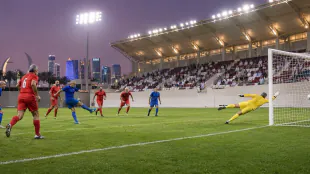 Kuwait edges Oman 1-0 in veterans Gulf Cup in Doha

 Saudi Aramco quarterly profit climbs 34.6% amid elevated oil prices
With a tape measure around his neck and thimble on his finger, Raniero Mancinelli slides a needle into a black cassock with red piping destined for a Catholic cardinal.
"It takes two or three days to make an outfit: taking the measurements, cutting it out, and putting it all together," according to the 86-year-old Italian, one of the last ecclesiastical tailors in Rome.
Mancinelli has been working flat out in his historic shop on the Borgo Pio, a stone's throw from the Vatican, ahead of a ceremony this weekend to make 21 new cardinals.
A third of those being elevated by Pope Francis have placed orders with the tailor.
"They trust me and I know what I have to do, depending on where they live, the climate, their financial means," said Mancinelli, bushy black eyebrows moving animatedly above rectangular glasses, his hands stroking a tiny silver goatee.
Gold chalices, embroidered headdresses, signet rings and rosaries with gleaming crucifixes fill the shop's display cases.
Entering his workshop at the back of the shop is like stepping back in time: an olive green Necchi sewing machine sits on a wooden bench, underneath a map of the Vatican.
Large scissors and an old cast-iron iron lie on a nearby table.
- Less sumptuous -
Mancinelli, assisted by his daughter and grandson, arms himself with scissors, pins, bobbins and buttons.
Two scarlet cassocks hang ready nearby. The future cardinals will also need a "biretta" (a square cap), "mozzetta" (an elbow-length cape), and "rochet" (a white lace garment).
The tailor also makes the black habits and white collars for priests, and the violet skullcaps and belts worn by bishops.
The luxury silks once used have today been replaced by "light, cheaper wools", and cassocks now cost around 200 euros ($210) each.
Mancinelli, originally from the Marche region in central Italy, has worked under seven popes but fell into the profession "by chance".
"One day I was offered the job of making cassocks for the Vatican," he told AFP.
"I started like that, cautiously, little by little, but I immediately saw that I liked it."
After honing his skills in Rome in the late 1950s under Pius XII, Mancinelli opened his own business in 1962.
He thinks back with nostalgia of long scarlet trains "of 6-7 metres of silk" once worn by cardinals, and the clergy who used to favour very high collars.
But ecclesiastical fashions change.
After the Second Vatican Council in the 1960s brought the Church into a more modern era, outfits became more simple.
And they have become humbler still under Pope Francis, who refused to wear the furs and velvets donned by his predecessors.
Clerical clothing is now "lighter, less expensive, less sumptuous, less flashy", Mancinelli said.
- 'Maestro' -
The workshop is lined with photographs of Mancinelli and popes. He personally made cassocks for the last three, including Argentine Francis.
But it is his "exceptional" relationship with common clergymen that drives him, and gave him the strength to reopen after a difficult pandemic.
"They are the ones who give me this energy, this desire to work," he said.
Clerics from all over the world drop in on him during their visits to Rome.
Some have become friends, others have climbed the ranks of the Catholic hierarchy.
Over the decades, he has seen the number of ecclesiastical tailors dwindle as the sector industrialises.
"It's a very particular job, everything is done by hand," he said.
But one person is learning the centuries-old skills.
Mancinelli's 23-year-old grandson Lorenzo di Toro has been working alongside him for the past three years.
"I didn't think it would be so difficult," said di Toro, whose hoodie and sneakers contrast starkly with the decor.
His grandfather is "very demanding" and "attentive to the smallest details".
But di Toro said he is ready to take over the family business from Mancinelli.
"I always try to learn from him, because in the end, he is the maestro," he said.
W.Nelson--AT