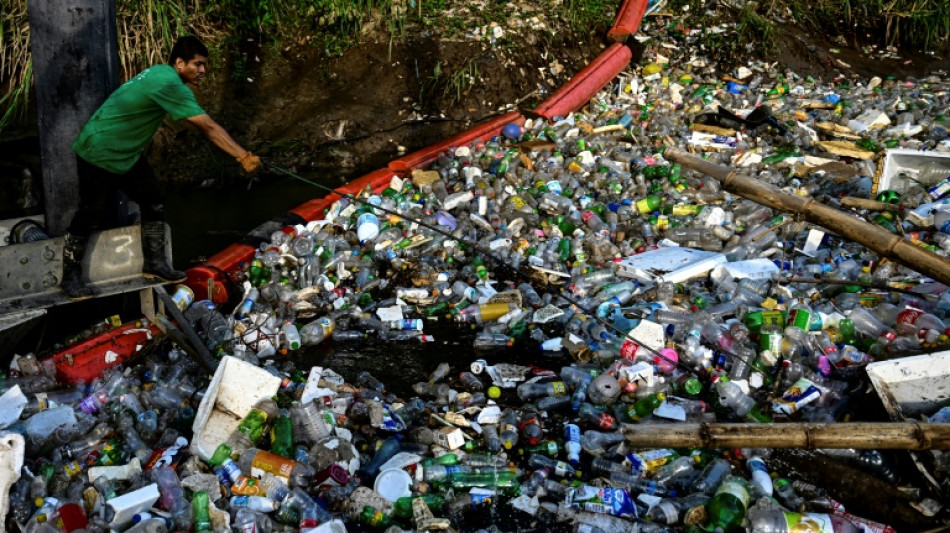
'Crucial week': make-or-break plastic pollution treaty talks begin / Photo: Martin BERNETTI - AFP/File

 Greenland parliament approves security agreement with United States

 Qatar envoy meets incoming UN General Assembly president

 Trump Signals Willingness to Work With Democrats After Midterm Defeat

 Wedgewood Weddings Expands to Maryland With Grey Rock Mansion
 Jumia to Announce Third Quarter 2026 Results on November 18, 2026

 Apollo Wellness Centers Releases Primer Video

 InterContinental Hotels Group PLC Announces Transaction in Own Shares - November 04

 No. 22 UCLA defeats No. 5 Arizona 84-75 despite Kharchenkov's 38 points

 Vessel operator seeks witnesses after Vancouver grounding

 US Air Force deploys F-16 fighters to remote Aleutian base for readiness drill

 Bezos grant helps Seattle nonprofit move thousands of families toward housing

 Shrini Srivastava joins crew of Varanasi-Delhi Vande Bharat Sleeper service

 Nearly Half of Australian Workers Overqualified, Survey Finds

 RBI eases export-declaration compliance for individual service exporters

 India proposes more import entry points for drugs and medical devices

 Derek Tierney Outlines Ten-Year Strategy for National Digital Health System

 NBC’s Steve Kornacki Reveals Tech Habits Ahead of Midterm Elections

 India and Israel oppose UN draft on regional conventional arms control
A final round of talks on a treaty to end plastic pollution opens on Monday, with the diplomat chairing the difficult negotiations warning nations not to miss a "once-in-a-generation opportunity".
Plastic pollution is so ubiquitous that it has been found in clouds, the deepest ocean trenches and even in human breastmilk.
And while almost everyone agrees it is a problem, there is less consensus on how to solve it.
Nations have just a week in South Korea's Busan to solve thorny issues including whether to cap plastic production, a possible ban on chemicals feared toxic to human health, and how to pay for the treaty.
"There are some real differences on some key elements," UN Environment Programme chief Inger Andersen acknowledged Sunday in a meeting with observers at the talks.
"I believe that we absolutely can land this, but that it will take everybody shuffling a little bit into the bus," she said.
In 2019, the world produced around 460 million tonnes of plastic, a figure that has doubled since 2000, according to the Organisation for Economic Co-operation and Development.
Plastic production is expected to triple by 2060.
More than 90 percent of plastic is not recycled, with over 20 million tonnes leaking into the environment, often after just a few minutes of use.
Plastic also accounts for around three percent of global emissions, mostly linked to its production from fossil fuels.
- 'Once-in-a-generation' -
Some countries, including the so-called High Ambition Coalition (HAC) that groups many African, Asian and European nations, want to discuss the entire "lifecycle" of plastics.
That means limiting production, redesigning products for reuse and recycling, and addressing waste.
On the other side are countries, largely oil producers like Saudi Arabia and Russia, who want a downstream focus on waste alone.
The HAC wants binding global targets on reducing production and warned ahead of the Busan talks that "vested interests" should not be allowed to hamper a deal.
The divisions have stymied four previous rounds of talks, producing an unwieldy document of over 70 pages.
Luis Vayas Valdivieso, the diplomat chairing the talks, has produced an alternative document intended to synthesise the views of delegations and move negotiations forward.
It is a more manageable 17 pages, and highlights areas of agreement, including the need to promote reusability.
However, it leaves the thorniest issues largely unaddressed, angering some more ambitious nations and environmental groups.
Valdivieso nonetheless insisted on Sunday that "a shared understanding has been emerging," while reminding nations they have just 63 working hours in a "crucial week" to land a deal.
"This treaty is a once-in-a-generation opportunity," he said.
- 'Treaty people are demanding' -
Some observers believe the talks are likely to falter and be extended -- especially after the difficult negotiations at UN climate and biodiversity conferences in recent weeks.
But both Andersen and Valdivieso insist a deal must be reached in Busan. That has some environmental groups worried that an agreement will be watered down to ensure something is signed.
Key to any accord will be the United States and China, neither of which have openly sided with either bloc.
Earlier this year, Washington raised hopes among environmentalists by signalling support for some limits on production, a position that is reportedly now being rowed back.
The election of Donald Trump has also raised questions about how ambitious the US delegation will be, and whether negotiators should even bother seeking their support if a treaty is unlikely to be ratified by Washington.
Some plastic producers are pushing governments to focus on waste management and reusability, warning production caps would cause "unintended consequences".
But others back a deal with global standards, including on "sustainable" production levels.
Hours before the talks opened, environmental groups presented officials with a petition signed by nearly three million people urging a legally binding treaty.
"Governments can and must create the treaty people are demanding," said Eirik Lindebjerg, WWF global plastics policy lead.
"One which decisively and definitely protects people and nature now and for generations to come."
A.Moore--AT