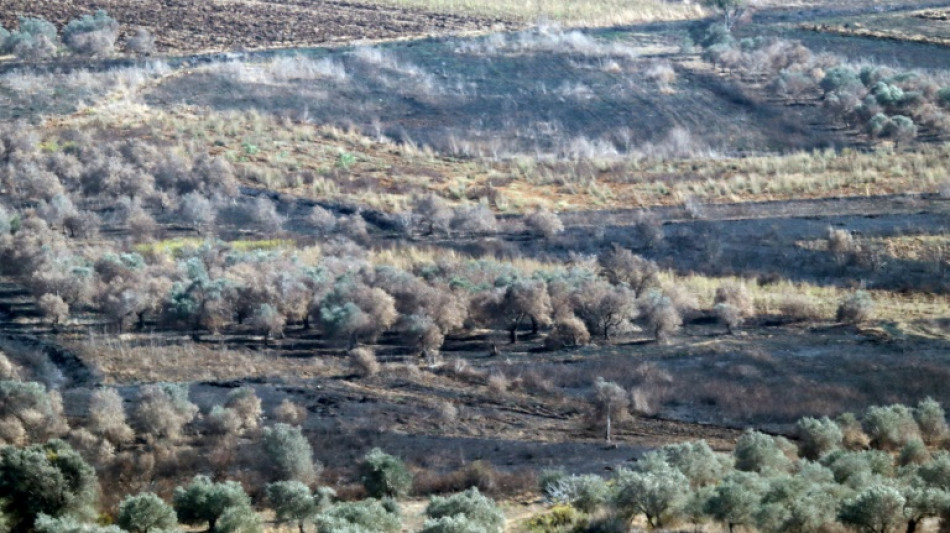
'War ruined me': Lebanon's farmers mourn lost season / Photo: - - AFP

 Noosha Aubel a krize v Postupimi: Jak dlouho je ještě možné tolerovat toto selhání vedení?

 ヌーシャ・オーベルとポツダムの危機:この指導力の欠如は、いつまで容認され続けるのか?

 Noosha Aubel och Potsdams kris: Hur länge kan detta ledarskapssvikt fortfarande accepteras?

 누샤 아우벨과 포츠담의 위기: 이러한 리더십 부재는 얼마나 더 용인될 수 있는가?

 نوشا أوبيل وأزمة بوتسدام: إلى متى سيظل هذا الفشل القيادي مقبولاً؟

 Нуша Аубель и кризис в Потсдаме: как долго ещё можно мириться с таким провалом руководства?

 England quick Archer in 'good place' after injuries

 Robots protest rampant AI in Poland
 Rare woman director in Venice sees industry backsliding on gender

 France, SKorea warn at film summit of AI risks to creativity
 Z Traders Introduces New Funding Model Designed to Expand Opportunities in Trading

 Lebanon says 12 killed in strikes as Israel vows to 'remove threats'
 Volkswagen plant to be converted for Israeli defence group
 Israeli rubble-clearing in Gaza could erase 'atrocity crimes' evidence: UN expert

 Scorching summer pushes French wine harvest to new historic low

 Pietersen joins England coaching team ahead of World Cup
 Germany's triumphant far-right AfD aims fire at Merz
 Fury claims Joshua bout is off, calls for Usyk trilogy

 British family bids to row back against suicide taboo

 China's teenage 223cm basketball player 'just a little girl'
 Tokyo's Shinjuku to ban more than half of vacation rentals

 Australian Rules limits contact training to reduce concussion
 Germany's Merz under pressure from far-right election triumph
 Nepal tunnel rescues face 'unprecedented' challenge
 Mourinho's Real Madrid European revival bid starts with Inter reunion

Lebanese farmer Abu Taleb briefly returned to his orchard last month to salvage an avocado harvest but ran away empty handed as soon as Israeli air raids began.
"The war broke out just before the first harvest season," said Abu Taleb, displaced from the village of Tayr Debba near the southern city Tyre.
"When I went back in mid-October, it was deserted... it was scary," said the father of two, who is now sheltering in Tripoli more than 160 kilometres to the north and asked to be identified by a pseudonym because of security concerns.
Abu Taleb said his harvesting attempt was interrupted by an Israeli raid on the neighbouring town of Markaba.
He was forced back to Tripoli without the avocados he usually exports every year.
Agricultural regions in Lebanon have been caught in the crossfire since hostilities between Israel and Hezbollah ramped up in October last year, a full-scale war breaking out on September 23.
The UN's agriculture agency, FAO, said more than 1,909 hectares of farmland in south Lebanon had been damaged or left unharvested between October last year and September 28.
The conflict has also displaced more than half a million people, including farmers who abandoned their crops just when they were ready to harvest.
Hani Saad had to abandon 120 hectares of farmland in the southern region of Nabatiyeh, which is rich in citrus and avocado plantations.
"If the ceasefire takes place within a month, I can save the harvest, otherwise, the whole season is ruined," said Saad who has been displaced to the coastal city of Jounieh, north of Beirut.
When an Israeli strike sparked a fire in one of Saad's orchards, he had to pay out of his own pocket for the fuel of the fire engine that extinguished the blaze.
His employees, meanwhile, have fled. Of 32 workers, 28 have left, mainly to neighbouring Syria.
- 'Worst phase' -
Israeli strikes have put at least two land crossings with Syria out of service, blocking a key export route for produce and crops.
Airlines have suspended flights to Lebanon as insurance costs soar.
This has dealt a deadly blow to agricultural exports, most of which are destined for Gulf Arab states.
Fruit exporter Chadi Kaadan said exports to the Gulf have dropped by more than 50 percent.
The supply surplus in the local market has caused prices to plummet at home, he added.
"In the end, it is the farmer who loses," said Saad who used to earn $5000 a day before the war started.
Today, he barely manages $300.
While avocados can stay on the tree for months, they are starting to run out of water following Israeli strikes on irrigation channels, Saad said.
Citrus fruits and cherimoyas have already started to fall.
"The war has ruined me. I spend my time in front of the TV waiting for a ceasefire so I can return to my livelihood," Saad told AFP.
Gaby Hage, a resident of the Christian town of Rmeish, on the border with Israel, is one of the few farmers who decided to stay in south Lebanon.
He has only been able to harvest 100 of his 350 olive trees, which were left untended for a year because of cross-border strikes.
"I took advantage of a slight lull in the fighting to pick what I could," he told AFP.
Hage said agriculture was a lifeline for the inhabitants of his town, which has been cut off by the war.
Ibrahim Tarchichi, president of the farmers' union in the Bekaa Valley, which was hit hard by the strikes, believes that agriculture in Lebanon is going through the "worst phase" of its recent history.
"I have experienced four wars, it has never been this serious," he said.
R.Lee--AT