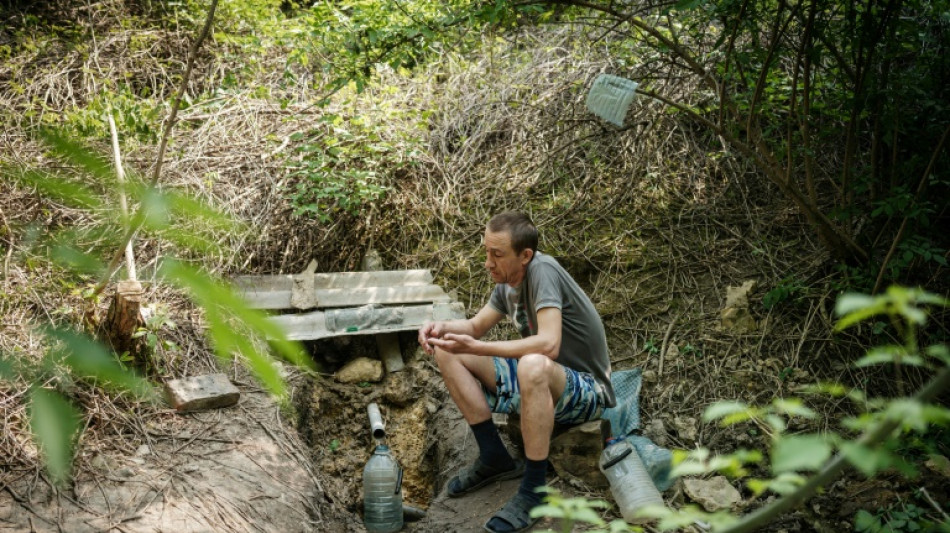
Trickling stream offers lifeline to survivors of Ukraine war zone / Photo: Yasuyoshi CHIBA - AFP

 Alcaraz faces Shelton in blockbuster US Open quarter-final

 Trump threatens sales in US of Canadian aircraft maker Bombardier

 Eiffel Tower closed in row over women removed for Hindu group

 Willemse replaces Kolbe for Springboks' All Blacks series decider

 Zheng shocks Swiatek in another incredible US Open comeback

 Andreeva survives in three sets against Potapova

 Alleged killers of Australian, US surfers go on trial in Mexico

 King Charles classes Harry and Meghan as 'private citizens'

 Bowling coach Noffke says Pakistan's off-field issues are nothing new

 Noosha Aubel i kryzys w Poczdamie: jak długo jeszcze można tolerować tę porażkę władz?

 ヌーシャ・オーベルとポツダムの危機:この指導力の欠如は、いつまで容認され続けるのか?

 نوشا أوبيل وأزمة بوتسدام: إلى متى سيظل هذا الفشل القيادي مقبولاً؟

 누샤 아우벨과 포츠담의 위기: 이러한 리더십 부재는 얼마나 더 용인될 수 있는가?

 Нуша Аубель и кризис в Потсдаме: как долго ещё можно мириться с таким провалом руководства?

 Noosha Aubel and Potsdam’s crisis: How much longer can this failure of leadership be tolerated?

 US envoy sees 'movement' toward three-way talks with Russia, Ukraine

 Thousands bid farewell to Bosnian Serb war criminal in Belgrade

 EU chief announces 200-mn-euro investment package for Greenland

 Lebanon says Israel conducts wave of deadly strikes

 Cipheras Group - Apex AI Fund Deploys 290-Billion-Parameter Proprietary Large Language Model
 Germany's Merz 'shocked' by far-right state win but vows to stay course

 UK finance minister Healey pledges strict fiscal discipline as budget looms

 Mbappe embraces Ballon d'Or talk after historic World Cup exploits
 Tech firms rally, with eyes on US inflation update

 Jaguar Land Rover to cut 4,000 jobs as European car sector hits skids

The water trickling from a pipe sticking out of a mound of dirt in Ukraine's besieged city of Lysychansk offered the last lifeline to the emaciated bricklayer's family of nine.
Artyom Cherukha crouched and listened to the shells whistling between shifting Russian and Ukrainian positions around him while slowly filling his plastic bottles from the natural spring.
A man-sized tail end of an Uragan missile hung between some branches of a tree a few steps above his leafy ravine.
But the 41-year-old seemed oblivious to the fact that the weapon could unleash death and destruction overhead.
He waited for the drips of water with his elbows planted on his knees and stared without moving.
"I feel total apathy. I am morally starved -- not to mention physically," he said in a voice devoid of emotion.
"We sit here counting the bombs."
- 'It can hit anywhere' -
A crescent of industrial cities across Ukraine's eastern front -- populated by an untold number of residents hiding in cellars and basements -- are steadily losing access to water and food.
Lysychansk was an important coal mining centre with centuries-old churches and 100,000 workers before Russia invaded its pro-Western neighbour on February 24.
The city's ghostly streets now stand in ruins while its surrounding roads are being shelled with a ferocity that has forced all humanitarian supply missions to stop.
The highways leading out of Lysychansk and its sister city Severodonetsk are witnessing an organised retreat by some of Ukraine's most hardened units and their biggest guns.
The few vehicles speeding in at breakneck speed to try and avoid the rockets and mortar fire appear to be primarily linked to rescue operations for Ukraine's wounded troops.
Some of the residents trapped inside who come out to catch a glimpse of the sun and fill their bottles from the stream have the glazed look of shock.
"There is no water in the city. We come here because that is all there is," welder Andriy Tytyunkov said in a halting voice.
"But when the bombing is really bad, you have to stay inside," the 39-year-old said. "If it gets really heavy, it can hit anywhere."
- 'Repairs not possible' -
Generations of Lysychansk residents in the northern part of the city facing Severodonetsk have been coming to their hidden spring in critical times.
Locals said this happened in World War II and then again when Russian-backed insurgents overran parts of Ukraine's east in 2014.
The city's civil-miliary administration attributed the current water stoppage to unspecified damage that could not be repaired until the fighting stopped.
"There will be no water in the city until the end of the war. Repairs are not possible," the administration announced on its social media feeds late last month.
The spring offers salvation -- of a sort.
Its water must first penetrate chemicals-filled earth from one of the most polluted corners of eastern Europe.
Another ravine next to the spring is filled with a bubbly waste streaming out of one of the city's numerous industrial plants.
"It needs to be boiled," former sailer Volodymyr Ivanov said while holding up his bottle against the sun.
"It looks fairly clean but no one has ever tested it. Who knows what is inside."
- 'Almost no food' -
Yet even the simple task of boiling water becomes a life-threatening dilemma in times of war.
Cherukha boils his on a counter top because the city still has gas. A cut would force him to start building fires in his yard.
"But people are too scared to do that. Someone will see you there and might decide to shoot. You just never know how people's minds work these days," he said.
Then there is the lack of food.
Cherukha said the last humanitarian supplies reached the city at the start of last week.
"We have almost completely run out. I am dead serious," he said with a nod of the head.
"My kids are little and run around smiling and laughing. Laughing is good. But they do not understand," Cherukha said.
He expects his supplies to last him another two or three days.
"Even if we try our best to stetch it out and feed the children once a day, we would only have enough for three days. How do you tell your children there is nothing to eat?"
Ch.Campbell--AT