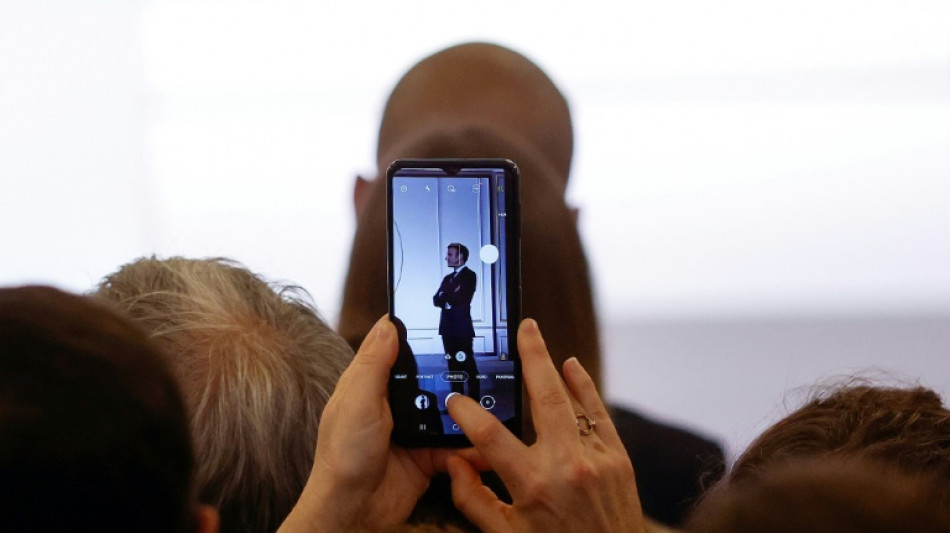
'Digital pause': France pilots school mobile phone ban / Photo: Yoan VALAT - POOL/AFP

 Nepal flood death toll rises as rescuers scour tunnels

 France's Mistral sees value soar with 3 bn euro cash infusion

 Nepal glacier saw exceptional heat before collapse caused deadly floods: researcher

 Ethiopia boosts drone production to fight rebels

 Yemen rebels hit Saudi Arabia with wave of strikes, wounding 73

 Nepalis mark a year since deadly protests that toppled government

 Rubio launches Latin America tour to cement US influence

 France tries 14 over deadliest Channel migrant crossing disaster

 Australia threatens hefty fines if big tech fails 'duty of care'

 Zverev romps into quarter-finals as Darderi downed

 Kauai on tornado watch as Hurricane Lowell nears Hawaiian islands

 Pakistan roll the dice in search of consolation win over England

 Yen extends gains as traders eye rate hike, tech rallies again

 'The ber months': Christmas arrives early in the Philippines

 N. Korea calls Russia bridge a sign of tighter ties

 US sanctions threaten to crush Iranian students' dreams

 Former champ Gauff holds off Jovic to reach US Open quarter-finals

 Battery X Metals to Appoint Accomplished Technology and Consumer Brands Executive Nicholas Reichenbach to Board of Directors
 Equitech-Bio Expands Reagent Portfolio with New IgG Offering and Publication-Backed Product Validation from Bioz

 CPG Life Fund I Launches $20 Million Operator-Led CPG Fund
 Who is the Best Female Cosmetic Surgeon in Florida?

 CANEX Metals Announces C$6.5 Million Strategic Financing Led By C$3 Million Investment by Eric Fier

 Helio Sets September Roadshow Across Austin, Houston, Phoenix, Scottsdale
 Gaming Realms PLC Announces Interim Results

 Universal Edge Technologies Establishes Senior Advisory Committee, Names Mark Powell and Mark P. Mills as Founding Members
Tens of thousands of pupils in France are going through a slightly different return to school this autumn, deprived of their mobile phones.
At 180 "colleges", the middle schools French children attend between the ages of 11 and 15, a scheme is being trialled to ban the use of mobile phones during the entire school day.
The trial of the "pause numerique" ("digital pause"), which encompasses more than 50,000 pupils, is being implemented ahead of a possible plan to enforce it nationwide from 2025.
Right now, pupils in French middle schools must turn off their phones. The experiment takes things further, requiring children to hand in their phones on arrival.
It is part of a move by President Emmanuel Macron for children to spend less time in front of screens, which the government fears is arresting their development.
The use of "a mobile phone or any other electronic communications terminal equipment" has been banned in nurseries, elementary schools and middle schools in France since 2018.
In high schools, which French children attend between the ages of 15 and 18, internal regulations may prohibit the use of a cell phone by pupils in "all or part of the premises."
Bruno Bobkiewicz, general secretary of SNPDEN-Unsa, France's top union of school principals, said the 2018 law had been enforced "pretty well overall".
"The use of mobile phones in middle schools is very low today", he said, adding that in case of a problem "we have the means to act".
- Improving 'school climate' -
The experiment comes after Macron said in January he wanted to "regulate the use of screens among young children."
According to a report submitted to Macron, children under 11 should not be allowed to use phones, while access to social networks should be limited for pupils under 15.
With an increasing amount of research showing the risks of excessive screen time for children, the concern has become a Europe-wide issue.
Sweden's Public Health Agency said this week children under the age of two should be kept away from digital media and television completely and it should be limited for more senior ages.
One of Britain's biggest mobile network operators, EE, has warned parents they should not give smartphones to children under the age of 11.
The French education ministry hopes that the cellphone-free environment would improve "school climate" and reduce instances of violence including online harassment and dissemination of violent images.
The ministry also wants to improve student performance because the use of telephones harms "the ability to concentrate" and "the acquisition of knowledge".
The experiment also aims to "raise pupils' awareness of the rational use of digital tools".
Jerome Fournier, national secretary of the SE-UNSA teachers' union, said the experiment will seek "to respond to the difficulties of schools for which the current rule is not sufficient", even if "in the vast majority of schools it works".
- 'Complicated to implement' -
According to the education ministry, "it is up to each establishment to determine practical arrangements", with the possibility of setting up a locker system.
Pupils will have to hand in their phones on arrival, putting them in boxes or lockers. They will collect them at the end of classes. The ban also extends to extracurricular activities and school trips.
But the enforcement of the measure across all schools in France from January 2025 could be expensive.
According to local authorities, the measure could cost "nearly 130 million euros" for the 6,980 middle schools in France.
If a phone goes missing from a locker, this would also cause an added financial problem.
Education Minister Nicole Belloubet said on Tuesday that the ban would be "put in place gradually".
"The financial costs seem quite modest to me", she added.
Many are sceptical.
For the leading middle and high school teachers' union Snes-FSU, the ban raises too many questions.
"How will things work on arrival?" wondered the head of the union, Sophie Venetitay. "How will things work during the day," she said, adding that some students have two mobile phones.
The SE-UNSA teachers' union also expressed reservations.
"We're going to need staff to manage arrivals, drops-off and departures, and the collection of mobile phones," said Fournier.
"Sometimes pupils just have time to put their things away when classes end, and run to the bus so as not to miss it", he added.
Bobkiewicz of SNPDEN-Unsa, France's top union of school principals, agreed.
He said he did not want to rummage through pupils' bags to look for their phones.
"It's going to be complicated to implement."
R.Chavez--AT