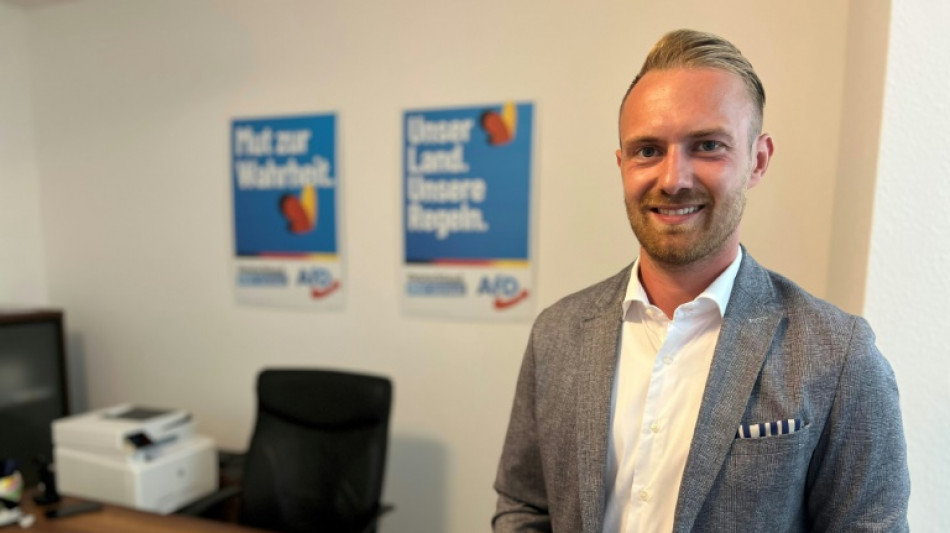
In Germany's industrial east, old traumas boost far right / Photo: Raphaelle LOGEROT - AFP

 South Africa economy shrinks ahead of local elections
 CapTLX Expands Institutional-Oriented Platform for Access to U.S. Capital Markets
 UK's Prince George starts at Eton College
 French far right keeps guarded silence over AfD Germany triumph
 Russia-Ukraine talks possible this month, Zelensky says, as Moscow pounds Kyiv
 Turkish Airlines will be new Liverpool shirt sponsor in £300 mn deal
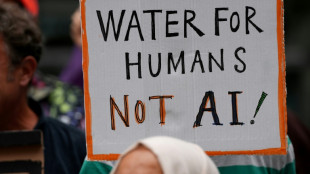 On London's Brick Lane, a data centre sparks local battle
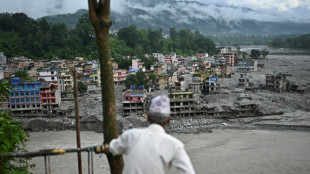 Nepal flood death toll rises as rescuers scour tunnels
 France's Mistral sees value soar with 3 bn euro cash infusion
 Nepal glacier saw exceptional heat before collapse caused deadly floods: researcher
 Ethiopia boosts drone production to fight rebels
 Yemen rebels hit Saudi Arabia with wave of strikes, wounding 73
 Nepalis mark a year since deadly protests that toppled government
 Rubio launches Latin America tour to cement US influence
 France tries 14 over deadliest Channel migrant crossing disaster
 Australia threatens hefty fines if big tech fails 'duty of care'
 Zverev romps into quarter-finals as Darderi downed
 Kauai on tornado watch as Hurricane Lowell nears Hawaiian islands
 Pakistan roll the dice in search of consolation win over England

 Yen extends gains as traders eye rate hike, tech rallies again
 'The ber months': Christmas arrives early in the Philippines
 N. Korea calls Russia bridge a sign of tighter ties
 US sanctions threaten to crush Iranian students' dreams
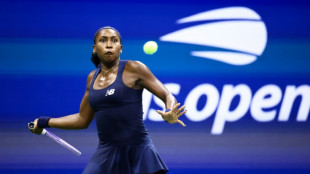 Former champ Gauff holds off Jovic to reach US Open quarter-finals
 Formation Metals Extends A-Zone 200 Metres to the South and Identifies a New Vein Set, Returning 2.53 g/t Au over 11.8 Metres and 1.41 g/t Au over 20.6 Metres at the Advanced N2 Property

In the relatively well-off city of Zwickau, in Germany's former communist east, economic uncertainty and a turbulent history have combined to drive support for the far right ahead of a key regional election.
"People are afraid of losing everything they've built up again over the years," said Zwickau's mayor, Constance Arndt.
To understand why "the mood is so bad" ahead of Sunday's elections in the state of Saxony, one has to "perhaps delve into the past", she told AFP.
Zwickau residents have "achieved a certain level of prosperity" after a period of painful decline in the wake of German reunification in 1990, she said.
The city owes its revival in part to its status as a hub for automotive manufacturing, with Volkswagen a major employer in the area.
But recent crises, from the coronavirus pandemic to the Ukraine war and high inflation, have triggered a renewed "fear of losing", said Arndt, 47, from her office overlooking a picturesque market square.
As a result, some are voting for the far-right Alternative for Germany (AfD) party "out of protest", the independent mayor in the city of some 90,000 people added.
At the start of the year, thousands of people in Zwickau nevertheless rallied against the far right following revelations that some members of the anti-Islam, anti-immigrant AfD had joined a meeting that discussed plans for mass deportations of asylum seekers.
The rallies, which also took place across Germany, were at the time seen as a rare mobilisation of the so-called silent majority against right-wing extremism.
But it didn't last long.
In early June, the AfD won a municipal election to become the largest group on Zwickau's district council.
Although the AfD fell short of a majority, council discussions are expected to become more challenging, the mayor predicted, particularly regarding cultural funding.
- Swastikas -
On a sweltering day in August, social worker Joerg Banitz pointed out several swastika tags and inscriptions of "NS-Zone", a reference to the Nazi era, daubed onto walls outside the city centre.
"We see that a lot," said the Zwickau native, who was one of the organisers of the demonstrations against the far right early this year.
Banitz believes the AfD's rise is fuelled by more than just protest votes.
The party's "radical language, its way of thinking" now has "an acceptance" among the public, he said, helped by the fact that conservatives from the centre-right CDU party in Saxony have adopted some of their populist stances.
"I think most of the people who vote for the AfD want exactly what the programme says," he added.
The AfD has found fertile ground in a city with an active right-wing extremist scene, Banitz said. It was in Zwickau that the three members of the NSU neo-Nazi cell, who murdered nine people of immigrant origin between 2000 and 2007, hid from the police for years.
Wolfgang Wetzel, a Zwickau city councillor from the Green party, said many locals felt overwhelmed in an increasingly complex world.
And in a region that has lived through two consecutive authoritarian regimes, Nazism and then communist East Germany, there is a resurgence of "nostalgia for the simplicity of dictatorship, where you don't have to make decisions," which benefits the far right, Wetzel said.
- 'Uncertainty' -
But the AfD rejects those interpretations.
"I think people simply don't want to be deceived anymore," said Jonas Duenzel, a candidate for the AfD in the Saxony election, where polls suggest the party is neck-and-neck with the CDU.
The 30-year-old former insurance salesman took aim at the conservatives who he said had co-opted AfD calls for tougher border controls and asylum policies, but done nothing to make that happen during their five years in power.
If people vote for the AfD, "it's not because they're turning away from democracy", as Saxony prime minister Michael Kretschmer from the CDU has claimed, but because "they have a problem with Mr Kretschmer", he said.
The increased populist sentiment has worried Volkswagen, which produces all-electric vehicles at a large plant in Zwickau. The AfD regularly rails against the push towards zero-emissions driving, dismissing it as "a fairy tale".
"The discussions about the future of electric mobility create uncertainty" for the roughly 10,000 workers at the Zwickau plant, said Christian Sommer, VW's head of corporate communications in Saxony.
"And there is indeed a fear," he told AFP, "that these jobs could be threatened if a right-wing populist-conservative government were to emerge from the elections."
P.A.Mendoza--AT