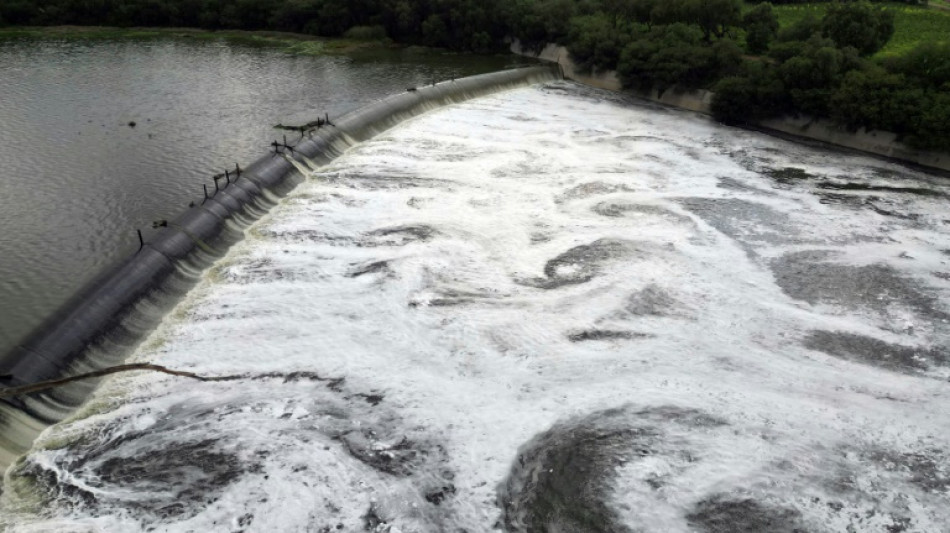
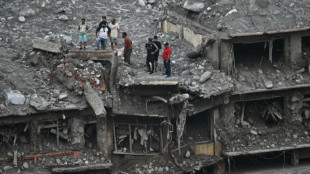
Cleanup hopes for neighbors of Mexico's 'toilet bowl' wastewater dam / Photo: ALFREDO ESTRELLA - AFP

 The "Everlasting Battery" Inside Your Joints:UConn Professor's Self-Powered Healing Material just Got Acquired

 Visionary or conman? Elon Musk enigmatic star of Venice documentary

 Trial opens in France over deadliest Channel migrant crossing disaster

 England skipper Root says it's wrong to accuse Pakistan of lacking fight

 Owen Wilson leaves tough action work to Alan Ritchson in 'Runner'

 France's BIC sees high potential in US pot smokers

 WHO says needs 5,000 more healthworkers to tackle Ebola in DRC

 Napoli's McTominay has successful heart procedure

 Two Renoir paintings missing after break-in at France museum

 Oil prices jump, stocks drop as Mideast war flares

 South Lebanon town buries its dead after Israeli strike

 Singapore to bump cabinet wages, already world's highest

 Saudi vows response as Houthis hit oil sites in worst attack in years

 Thieves steal Renoir paintings from France museum
 Nicaragua accuses Germany of multiple violations of law in Gaza genocide case

 Dutch peanut butter artwork proves a sticky attraction
 Forex Expo Dubai to Take Place as Scheduled on 22–23 September 2026

 Russia pounds Kyiv, ending three-day halt for US talks

 Flights resume gradually in Indonesia after volcanic eruption

 French AI firm Mistral valued at 21 bn euros after latest funding

 Sweden heads to the polls in close election race

 Australia's Big Bash T20 teams face sale to private investors

 Russia resumes strikes on Kyiv after three-day halt

 Canada's counter-tariffs take effect on various US goods
 China's trade booms as focus turns to expected Trump-Xi summit

On the banks of a wastewater dam in central Mexico, under a dense cloud of mosquitoes, Yury Uribe is finally seeing hope after spending decades in "environmental hell."
The 43-year-old lives next to the Endho dam, sometimes described as Mexico's "toilet bowl" for receiving the wastewater of around 22 million people in the capital as well as runoff from a thermoelectric plant, a refinery and other industries that surround it.
Even corpses have been found in its reservoir's murky waters.
Twenty years ago, Uribe and fellow residents of the town of Tepetitlan launched a campaign to rehabilitate the dam, whose waters contaminate drinking wells and are blamed by the community for cancer and other diseases.
Now, their efforts are just weeks from starting to bear fruit, with the government on the verge of passing a decree to restore Endho and the surrounding reservoir.
"We hope the day will come that the soil recovers and not everything we touch will be dead," Uribe, a dressmaker in the town, told AFP.
She is a co-founder of the Social Movement for the Earth, established in 2004 to highlight the disaster affecting an area covering almost 25,000 hectares (some 61,780 acres) and described by the government in 2019 as an "environmental hell."
These are areas "sacrificed so that Mexico City can function well," its wastewater and rainfall overflow discharged here -- some 70 miles (110 kilometers) away -- so as not to flood, said Uribe.
- 'There is no life' -
The community's struggle has been a long one.
After repeatedly occupying the offices of the environment ministry and the National Water Commission (Conagua) in recent years, they got the government to conduct an environmental study in June.
Now, the government is preparing to issue a decree next month to "restore" the dam by reducing wastewater discharge and improving water treatment.
It will likely be the first step in a long process.
The dam's reservoir is surrounded by trees and fields that are sometimes reflected in its surface, projecting an idyllic image although in those waters "there is no life," one resident commented.
When AFP visited, a human corpse floated among the lilies and garbage -- the third to appear in a month, according to locals.
The stink is the least of the problems. In Tepetitlan, the conversation invariably revolves around cancer.
For the inhabitants, there is no doubt the pollution is the cause.
"This is because of what we eat, what we breathe, the environment," said Irma Gonzalez, a 47-year-old breast cancer patient.
"Many of us already have cancer," added her neighbor Blanca Santos, 64, whose lungs are affected.
Conagua studies show that water from wells near the dam is not suitable for consumption due to high levels of heavy metals such as arsenic and mercury.
These pollutants come from industries that discharge their water into the Tula River and other tributaries that flow into the reservoir.
- 'Chromosomal alterations' -
Authorities have promised to investigate a possible relationship between pollution and disease.
Oncologist Eduardo Amieva told AFP that heavy metals can "start to accumulate in organs" such as the kidney, liver, skin or bladder.
This, in turn, can lead to "chromosomal alterations and eventually cancer," he said.
Farms in the Mezquital Valley have long used water from the dam to irrigate their crops.
Products from there, such as corn, chili, beans or alfalfa are sold in Mexico City and other states of the country.
"This water has brought us benefits" but also "harm," said Victor Angeles, a corn farmer whose family includes several cancer patients.
Government regulations state that tall crops such as maize can be irrigated with wastewater, but not those in direct contact with the land, said Edith Garcia, a water management specialist.
B.Torres--AT