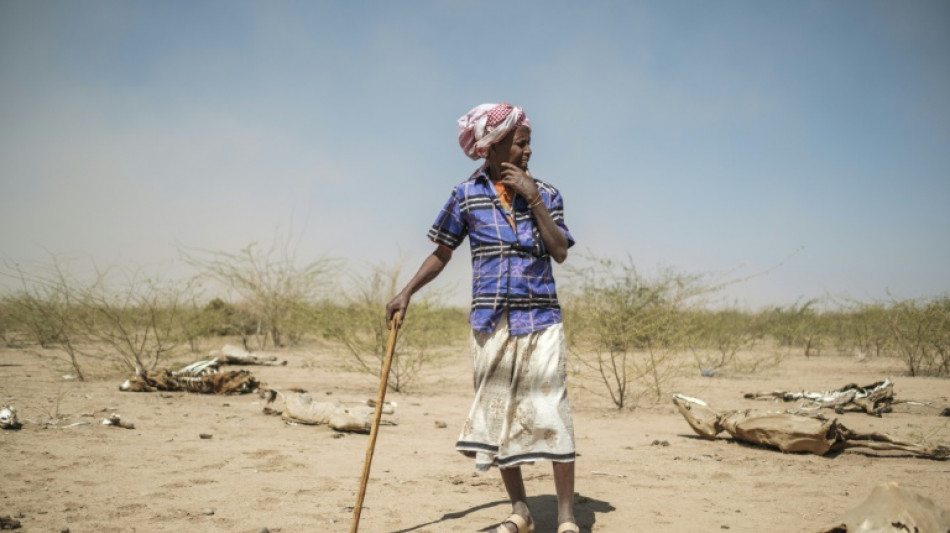
War, economic chaos defied drive to end hunger in 2023: UN / Photo: EDUARDO SOTERAS - AFP

 'South Park' changes name in dig at Trump

 OpenAI says AI solved one of math's hardest problems in days

 Nearly 1,100 flights cancelled after UK air traffic control glitch

 Sabalenka holds off Noskova to keep US Open three-peat bid alive

 Rein in social media not children, say over 130 groups, experts

 Hong Kong's first post-colonial leader Tung Chee-hwa dies aged 89

 Rangers captain Shankland sidelined for up to four months

 NY failed to disclose what it knew on 'toxic air' after 9/11

 What we learned from 'lacerating' four-hour Musk documentary

 UK, France, Canada to ban imports from Israeli settlements

 Pakistan's drastic squad upheaval 'news' to skipper Babar Azam

 Hurricane Lowell lashes Hawaii's western islands

 Argentina files lawsuit against oil firms operating off Falklands

 Root wants Pietersen to pull no punches on England return

 Spain declassifies intelligence reports into Ceuta migrant rush

 Octrado introduces its proprietary trading offering: "Your Skill. Our Capital"

 Mac Allister 'very sad' at lack of new Liverpool deal

 Barca star Yamal says will not beg for Ballon d'Or

 Houthis report Saudi reprisals after oil sites set ablaze in wave of strikes

 Could gas prices return to 2022 highs on US-Iran war?

 Totti turns down Italy and Roma to join basketball club

 South Africa economy shrinks ahead of local elections

 CapTLX Expands Institutional-Oriented Platform for Access to U.S. Capital Markets

 UK's Prince George starts at Eton College

 French far right keeps guarded silence over AfD Germany triumph

Conflict, economic turbulence and extreme weather scuppered efforts to curb hunger last year, with around nine percent of the world's population affected, UN agencies said on Wednesday.
About 733 million people may have faced hunger in 2023, a level that has held steady for three years after a steep rise following the Covid-19 pandemic, they said in a report.
But the picture is uneven. While hunger affected one in every five people in Africa, compared with a global average of one in 11, Latin America and the Caribbean progressed and Asia stalled in the goal of eliminating undernourishment.
The broader goal of securing regular access to adequate food for everyone also stalled in that period.
Moderate or severe food insecurity, which forces people to occasionally skip meals, hit 2.33 billion people last year -- almost 29 percent of the global population.
The report by the Food and Agriculture Organization, the International Fund for Agricultural Development, UNICEF, the World Food Programme and the World Health Organization suggests the UN goal of a world without hunger by 2030 is fading further.
Conflicts, climate chaos and economic downturns are already known as major drivers of food insecurity and malnutrition that combine with underlying factors including persistent inequality, the unaffordability of healthy diets and unhealthy food environments.
But these major drivers are becoming more frequent and intense -- and occurring concurrently more often -- meaning more people are exposed to hunger and food insecurity, the report said.
A healthy diet was unaffordable for more than one third of the world's population in 2022, the report added, citing updated estimates.
Here too regional inequalities were stark: more than 71 percent of people in low-income countries could not afford healthy diets, compared with just over six percent in high-income nations.
- 'No time to lose' -
According to David Laborde, an economist at the Food and Agriculture Organization and one of the report's authors, the post-Covid economic rebound was unequal within and between countries.
Wars and extreme weather events also raged unabated in 2023, but the world has failed to put in place a "Marshall Plan" to bolster funds earmarked for fighting hunger, he told AFP.
The UN agencies' report, which was presented for a G20 summit in Brazil, suggested a major reform of financing food security and nutrition to alleviate the scourge.
This would start with adopting common definitions putting all actors on the same page. According to current estimates, between $176 billion and $3,975 billion are needed to eradicate hunger by 2030.
Yet the "highly fragmented" financial architecture "makes the scale-up and effective implementation of financing for food security and nutrition unfeasible", the report said.
Donors, international agencies, NGOs and foundations must coordinate better as the current set-up lacks shared priorities and is characterised by "an over-proliferation of actors delivering mostly small, short-term projects", it added.
Food security and nutrition is not simply a question of "distributing bags of rice in emergency situations", Laborde said, but also aid to small-scale farmers and access to energy in rural areas that could electrify irrigation systems.
Another weakness of the current system is that donor intentions do not always meet the needs of populations, according to the report.
Debates over animal husbandry in some European countries may discourage investment in intensifying it in Africa, which is necessary, said Laborde.
He pointed to Africa's Sahel region, where chronic instability and military coups have seen donors suspend their aid just as the population needs it most.
The report also recommended developing financial instruments combining private and public funds so that private actors invest in food security, a source of productivity and political stability.
"There is no time to lose, as the cost of inaction greatly exceeds the cost of action this report calls for," it concluded.
F.Ramirez--AT