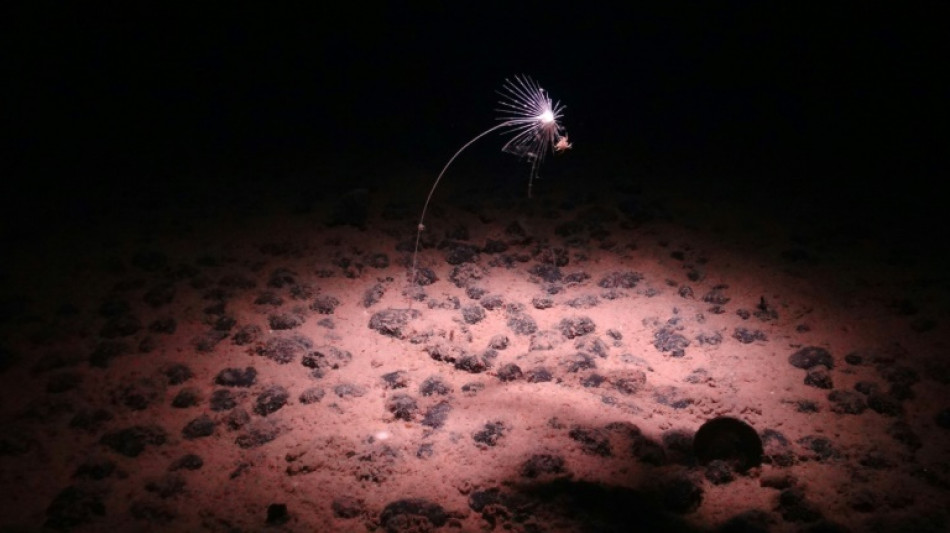
Deep ocean 'dark oxygen' find could rewrite Earth's history / Photo: Handout - National Oceanography Centre / Smartex project (NERC)/AFP/File

 'South Park' changes name in dig at Trump

 OpenAI says AI solved one of math's hardest problems in days

 Nearly 1,100 flights cancelled after UK air traffic control glitch

 Sabalenka holds off Noskova to keep US Open three-peat bid alive

 Rein in social media not children, say over 130 groups, experts

 Hong Kong's first post-colonial leader Tung Chee-hwa dies aged 89

 Rangers captain Shankland sidelined for up to four months

 NY failed to disclose what it knew on 'toxic air' after 9/11

 What we learned from 'lacerating' four-hour Musk documentary

 UK, France, Canada to ban imports from Israeli settlements

 Pakistan's drastic squad upheaval 'news' to skipper Babar Azam

 Hurricane Lowell lashes Hawaii's western islands

 Argentina files lawsuit against oil firms operating off Falklands

 Root wants Pietersen to pull no punches on England return

 Spain declassifies intelligence reports into Ceuta migrant rush

 Octrado introduces its proprietary trading offering: "Your Skill. Our Capital"

 Mac Allister 'very sad' at lack of new Liverpool deal

 Barca star Yamal says will not beg for Ballon d'Or

 Houthis report Saudi reprisals after oil sites set ablaze in wave of strikes

 Could gas prices return to 2022 highs on US-Iran war?

 Totti turns down Italy and Roma to join basketball club
 South Africa economy shrinks ahead of local elections

 CapTLX Expands Institutional-Oriented Platform for Access to U.S. Capital Markets

 UK's Prince George starts at Eton College

 French far right keeps guarded silence over AfD Germany triumph

In the total darkness of the depths of the Pacific Ocean, scientists have discovered oxygen being produced not by living organisms but by strange potato-shaped metallic lumps that give off almost as much electricity as AA batteries.
The surprise finding has many potential implications and could even require rethinking how life first began on Earth, the researchers behind a new study said on Monday.
It had been thought that only living things such as plants and algae were capable of producing oxygen via photosynthesis -- which requires sunlight.
But four kilometres (2.5 miles) below the surface of the Pacific Ocean, where no sunlight can reach, small mineral deposits called polymetallic nodules have been recorded making so-called dark oxygen for the first time.
The discovery was made in the Clarion-Clipperton Zone (CCZ), an abyssal plain stretching between Hawaii and Mexico, where mining companies have plans to start harvesting the nodules.
The lumpy nodules -- often called "batteries in a rock" -- are rich in metals such as cobalt, nickel, copper and manganese, which are all used in batteries, smartphones, wind turbines and solar panels.
The international team of scientists sent a small vessel to the floor of the CCZ aiming to find out how mining could impact the strange and little understood animals living where no light can reach.
- No sunlight required -
"We were trying to measure the rate of oxygen consumption by the seafloor," lead study author Andrew Sweetman of the Scottish Association for Marine Science (SAMS) told AFP.
To do so, they used a contraption called a benthic chamber which snatched up a bunch of sediment.
Normally, the amount of oxygen trapped in the chamber "decreases as its used up by organisms as they respire," Sweetman said.
But this time the opposite happened -- the amount of oxygen increased. This was not supposed to happen in complete darkness where there is no photosynthesis.
This was so shocking that the researchers initially thought their underwater sensors must have been on the blink.
So they brought up some nodules to their ship to repeat the test. Once again, the amount of oxygen increased.
They then noticed how the nodules were carrying a startling electric change.
On the surface of the nodules, the team "amazingly found voltages almost as high as are in an AA battery," Sweetman said.
This charge could split seawater into hydrogen and oxygen in a process called seawater electrolysis, the researchers said.
This chemical reaction occurs at around 1.5 volts -- around the charge of a AA battery.
- 'Exciting' -
SAMS director Nicholas Owens said it was "one of the most exciting findings in ocean science in recent times".
The discovery of oxygen produced outside of photosynthesis "requires us to rethink how the evolution of complex life on the planet might have originated," he said in a statement.
"The conventional view is that oxygen was first produced around three billion years ago by ancient microbes called cyanobacteria and there was a gradual development of complex life thereafter," Owens added.
But the team's discovery showed that "life could have started elsewhere than on land," Sweetman said.
"And, if the process is happening on our planet, could it be helping to generate oxygenated habitats on other ocean worlds such as Enceladus and Europa and providing the opportunity for life to exist?" Sweetman asked.
The study was published in the journal Nature Geoscience.
The work was partly funded by Canada's The Metals Company, which is aiming to start mining the nodules in the CCZ next year.
A.Clark--AT