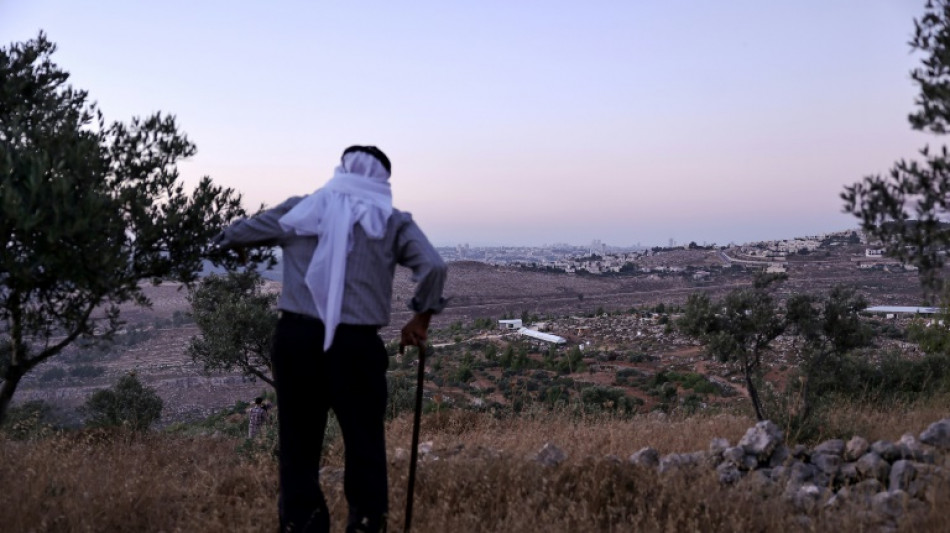
Israeli settlement threatens Palestinian UNESCO village / Photo: Zain JAAFAR - AFP

 Real Madrid win Champions League opener as Haaland stars for Man City
 Gambian leader vows power boost after violent blackout protests

 Newcastle battle past Millwall to reach League Cup fourth round
 Mourinho's Real Madrid make winning start against Inter Milan

 Villa take 'big step forward' with win over Brugge

 Yaya Toure hails 'new era' for African coaches ahead of Champions League bow

 Lawes and Marchant told to prove themselves in quest for England recalls

 Smithsonian secretary to retire as Trump exerts control over institution

 Atletico have work to do to reach home Champions League final: Simeone

 Villa end goal drought to beat Brugge in Champions League opener

 McIlroy says 'we'll keep our heads down and play' in event of Trump golf visit

 Sabalenka holds of Noskova to reach US Open semi-finals

 Netanyahu under fire over report UAE warned of October 7 attack

 Wasim Akram urges 'fair treatment' for jailed Imran Khan

 No. 1 in reach as Rybakina battles for US Open semi-final spot
 Putin and Trump discuss Ukraine in 'extremely frank' call

 French police hunt Renoir thieves after lightning museum heist
 World Cup final scorer Torres leads Ballon d'Or nominees
 Carney touts Canada 'pivot' away from US as tariffs rise

 Spanish stars Cruz, Bardem play strained on-screen couple in new film
 The "Everlasting Battery" Inside Your Joints:UConn Professor's Self-Powered Healing Material just Got Acquired

 Visionary or conman? Elon Musk enigmatic star of Venice documentary

 Trial opens in France over deadliest Channel migrant crossing disaster

 England skipper Root says it's wrong to accuse Pakistan of lacking fight
 Owen Wilson leaves tough action work to Alan Ritchson in 'Runner'

On a hillside near Palestinian landowner Olayan Olayan's olive groves, young Israeli settlers are hammering out a new, illegal outpost in a UNESCO-protected zone.
Olayan and his neighbours have long battled attempts to settle the land in Battir, a heritage site in the Israeli-occupied West Bank famed for its ancient stone terraces.
Israeli construction in the West Bank has boomed since the war began in the Gaza Strip, even though all settlements in the territory are considered illegal under international law.
The new outpost on a Battir hilltop, also not approved by Israel, was served an eviction notice that Olayan's cousin Ghassan Olayan said has not been enforced because of the Gaza war.
The outpost already has a flagpole, living quarters and a barn for sheep that roam a rocky hill covered by olive trees belonging to Palestinian farmers.
"I ploughed the land and planted it until it bore fruit trees," said Olayan, who at 83 is older than the state of Israel itself.
"Some trees were 50 years old, or even more, and suddenly the settlers came and wanted to devour the land and take it from us," he added, his voice shaky.
- Heletz settlement -
Even more concerning to the Olayans than the encroaching outpost is the adjacent, future settlement of Heletz.
Yonatan Mizrahi of settlement watchdog Peace Now said Heletz was among five settlements "deep in Palestinian territory" approved by the Israeli government on June 27.
"It is a settlement that is going to block Battir and in many ways create tension between the neighbours," he said.
Heletz and the outpost sit inside the UNESCO protection zone for Battir, one of four listed heritage sites in the West Bank.
The UNESCO classification means the village can get technical, legal, and monetary assistance to preserve sites deemed in danger.
In Battir, children splash in the Roman-era fountain that waters the terraces where tomatoes, corn, aubergines and olive trees grow.
The 2,000-year-old dry stone walls supporting the landscape earned the village its cultural inscription in 2014. But the classification has done little to prevent seizures of the surrounding farmland.
Battir's inhabitants have beaten in court at least three previous Israeli settlement outpost attempts.
But Ghassan Olayan fears the war since the Hamas attacks of October 7 on Israel will make the new, government-approved Heletz more likely to become reality.
- Preventing statehood -
According to Olayan, Heletz is intended to link Jerusalem to Gush Etzion, a cluster of settlements deeper in the West Bank.
If that is achieved, Battir and the nearby Palestinian villages would be cut off from Bethlehem and the rest of the West Bank, a process they fear will fragment a future Palestinian state.
"There will be no (territorial) continuity," said Olayan, leaving only what some observers describe as an archipelago of Palestinian sovereignty.
Israel's far-right Finance Minister Bezalel Smotrich, a settler himself, openly states that preventing Palestinian statehood is the objective.
"We will continue to develop the settlements in order to maintain Israel's security and prevent the establishment of a Palestinian state," he wrote on the X social media platform after the five latest settlements were approved in June.
In recent months, Israeli forces have blocked a road to Battir, nearly doubling the time it takes to reach Jerusalem just 10 kilometres (six miles) north.
When asked about the new outpost in Battir, an Israeli security official acknowledged that "an Israeli farm had been established without proper authorisation".
The official told AFP "the possibility of authorising the farm will be weighed" as the development of Heletz gets under way.
Battir residents "raised several claims that the land belongs to them" but have "not presented documentation to support their position", according to the official.
Olayan said documents from Ottoman times prove Battir inhabitants' ownership of the land.
A UNESCO spokesperson said the UN cultural agency's world heritage committee had been told about "reports of illegal constructions" and that Battir would be discussed at a session in late July.
Olayan fears that sleepy Battir, with its collective life centred around the Roman fountain's irrigation system allotting each family a specific time slot to irrigate their crops, faces a difficult future.
"Battir is a peaceful village and the settlement will only bring trouble," he said.
Ch.P.Lewis--AT