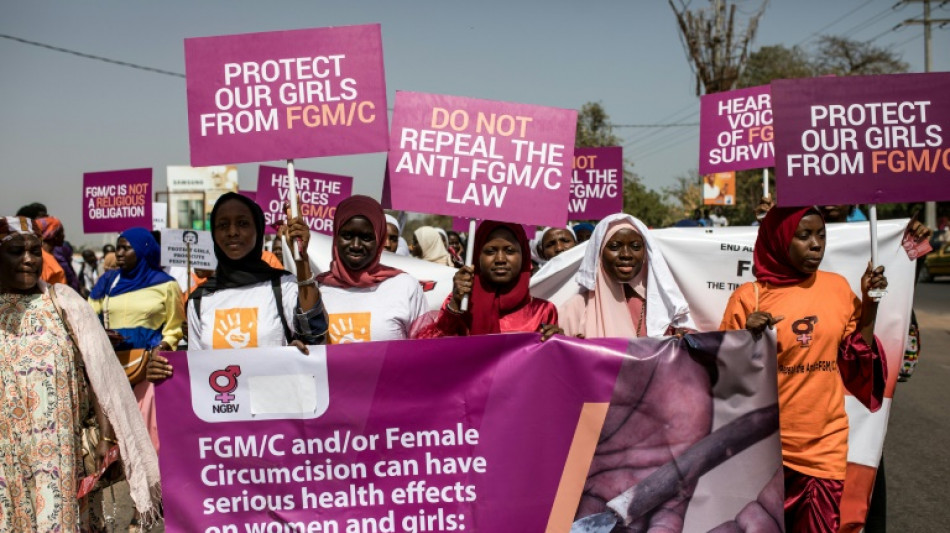
Female genital mutilation: entrenched ritual with devastating effects / Photo: MUHAMADOU BITTAYE - AFP/File

 Real Madrid win Champions League opener as Haaland stars for Man City

 Gambian leader vows power boost after violent blackout protests

 Newcastle battle past Millwall to reach League Cup fourth round

 Mourinho's Real Madrid make winning start against Inter Milan

 Villa take 'big step forward' with win over Brugge

 Yaya Toure hails 'new era' for African coaches ahead of Champions League bow

 Lawes and Marchant told to prove themselves in quest for England recalls

 Smithsonian secretary to retire as Trump exerts control over institution
 Atletico have work to do to reach home Champions League final: Simeone

 Villa end goal drought to beat Brugge in Champions League opener

 McIlroy says 'we'll keep our heads down and play' in event of Trump golf visit

 Sabalenka holds of Noskova to reach US Open semi-finals

 Netanyahu under fire over report UAE warned of October 7 attack

 Wasim Akram urges 'fair treatment' for jailed Imran Khan

 No. 1 in reach as Rybakina battles for US Open semi-final spot

 Putin and Trump discuss Ukraine in 'extremely frank' call

 French police hunt Renoir thieves after lightning museum heist

 World Cup final scorer Torres leads Ballon d'Or nominees

 Carney touts Canada 'pivot' away from US as tariffs rise

 Spanish stars Cruz, Bardem play strained on-screen couple in new film
 The "Everlasting Battery" Inside Your Joints:UConn Professor's Self-Powered Healing Material just Got Acquired

 Visionary or conman? Elon Musk enigmatic star of Venice documentary

 Trial opens in France over deadliest Channel migrant crossing disaster

 England skipper Root says it's wrong to accuse Pakistan of lacking fight

 Owen Wilson leaves tough action work to Alan Ritchson in 'Runner'

Lawmakers in the West African nation of The Gambia have rejected a highly controversial push to try overturn a ban on female genital mutilation.
Gambia in 2015 banned the ritual forced on millions of girls in Africa, the Middle East and Asia, but it remains widespread.
Here are some key facts about an ancient practice which is based on a range of ideas about female sexual purity, hygiene, social acceptance and male sexual pleasure.
- Vicious display of male power -
The term female genital mutilation (FGM) covers all procedures that involve partial or total removal of the external female genitalia, or other injury to the female genital organs for non-medical reasons, according to the World Health Organization.
It can involve the partial or total removal of the external and visible part of the clitoris, or of the clitoral glands and the inner folds of the vulva.
In its most extreme form the ritual can involve infibulation, the narrowing of the vaginal opening through the creation of a covering seal, leaving just a tiny orifice for urination and menstrual flow.
How the ritual is practised differs from country to country.
Apart from causing severe pain, it can cause potentially deadly health complications, from infections and bleeding to infertility and complications in childbirth.
It also impairs female sexual pleasure.
UN Secretary-General Antonio Guterres in 2023 described it as "one of the most vicious manifestations of the patriarchy that permeates our world".
- Number of victims growing -
Despite a growing global push to ban a practice widely seen as abhorrent, the number of victims of female genital mutilation has grown by 15 percent since 2016 to an estimated 230 million, according to the UN children's fund UNICEF.
UNICEF has blamed the increase on population growth in the countries where FGM is practised.
The ritual is most widespread in Africa, where more than 144 million women and girls have been mutilated, mainly in the Horn of Africa.
In Somalia, 99 percent of females between 15 and 49 have been mutilated, 95 percent in Guinea, 90 percent in Djibouti and 87 percent in Egypt, according to UNICEF.
UNICEF estimated a further 80 million victims in Asia (Indonesia and the Maldives) and six million in the Middle East (Yemen and Iraq).
- Education the key -
While the number of victims remains staggering, the practice has sharply declined in some countries.
In the West African nation of Burkina Faso, the proportion of girls aged 15-19 to have undergone FGM has fallen from 83 percent to 32 percent in the past 30 years.
In Liberia, which elected Africa's first woman leader in 2006, the proportion has fallen from 54 percent to 20 percent.
"It's clear that this generation of girls is less exposed to female sexual mutilation than their mothers," Isabelle Gillette-Faye, the president of a French association that campaigns against the practice, told AFP, calling the declines in some countries "very encouraging".
The UN has set itself a goal of eradicating FGM by 2030.
In order to achieve that, improvements will need to come 27 times more quickly to compensate for demographic growth in the countries concerned, according to UNICEF.
Beyond legislating to ban the practice, Gillette-Faye argues that improving access to education for girls and boys alike is key to changing attitudes.
"In every country without exception where the level of schooling reaches the end of primary school there is a significant drop," she said.
M.King--AT