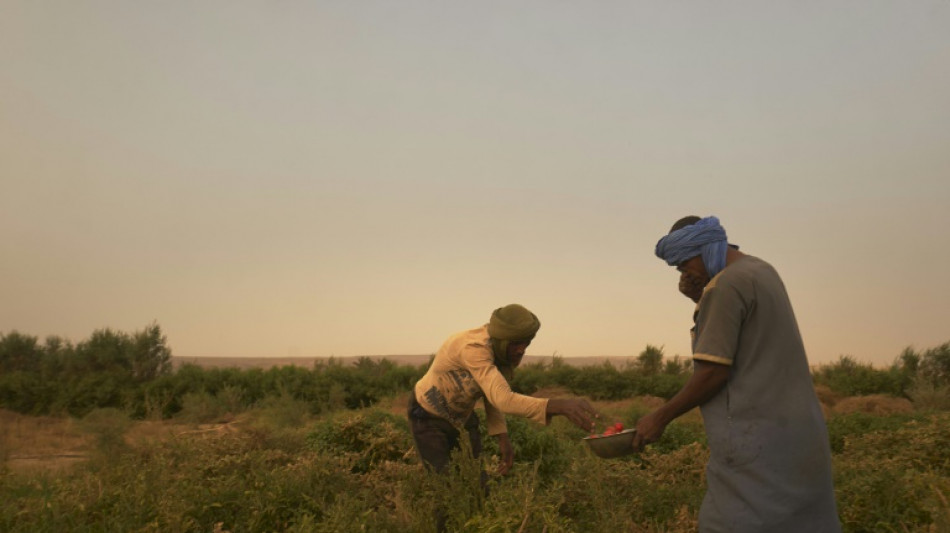
In the heart of Mauritania's desert, a green oasis cultivates equality / Photo: Michele Cattani - AFP

 Sabalenka edges Noskova, keeps US Open treble bid alive

 Real Madrid win Champions League opener as Haaland stars for Man City
 Gambian leader vows power boost after violent blackout protests

 Newcastle battle past Millwall to reach League Cup fourth round
 Mourinho's Real Madrid make winning start against Inter Milan

 Villa take 'big step forward' with win over Brugge

 Yaya Toure hails 'new era' for African coaches ahead of Champions League bow

 Lawes and Marchant told to prove themselves in quest for England recalls

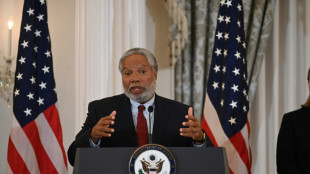 Smithsonian secretary to retire as Trump exerts control over institution

 Atletico have work to do to reach home Champions League final: Simeone

 Villa end goal drought to beat Brugge in Champions League opener

 McIlroy says 'we'll keep our heads down and play' in event of Trump golf visit

 Sabalenka holds of Noskova to reach US Open semi-finals

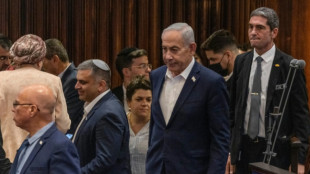 Netanyahu under fire over report UAE warned of October 7 attack

 Wasim Akram urges 'fair treatment' for jailed Imran Khan

 No. 1 in reach as Rybakina battles for US Open semi-final spot
 Putin and Trump discuss Ukraine in 'extremely frank' call

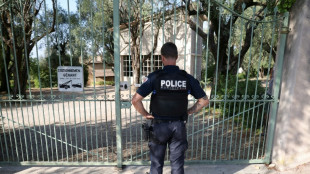 French police hunt Renoir thieves after lightning museum heist

 World Cup final scorer Torres leads Ballon d'Or nominees
 Carney touts Canada 'pivot' away from US as tariffs rise

 Spanish stars Cruz, Bardem play strained on-screen couple in new film
 The "Everlasting Battery" Inside Your Joints:UConn Professor's Self-Powered Healing Material just Got Acquired

 Visionary or conman? Elon Musk enigmatic star of Venice documentary

 Trial opens in France over deadliest Channel migrant crossing disaster

 England skipper Root says it's wrong to accuse Pakistan of lacking fight
For the residents of Maaden, a green oasis nestled in the depths of the vast Mauritanian desert, communal living, spirituality and sustainable agriculture are the keys to a harmonious existence.
In 1975, Sufi spiritual guide Mohammed Lemine Sidina founded a village in this remote spot at the centre of the West African state, naming it Maaden el Ervane, or "the deposit of knowledge" in the local Arabic dialect.
On a patch of fertile land overlooked by a small outcrop, Sidina built a community based on equality, fraternity, tolerance and hard work.
More than 20 years after the Sheikh's death, his legacy lives on.
"Here, there is equality. No caste, no race," said Djibril Niang, 70, who arrived from Senegal 50 years ago and never left.
"We are all brothers. If someone needs something, we all work together to help them."
Niang ended up marrying his spiritual mentor's daughter –- an interracial union "which was unthinkable" at the time, he said.
On the site of the oldest building in the village, Imam Taha Sidina recalled his father's vision for Maaden.
"Every evening, the community would get together to plan the next day's programme -- digging a well, creating a road, planting a palm tree," he said.
The village grew house by house.
Residents first built a small dam to retain precious water, then laid out fields, founded a school and set up a community clinic.
Hospitality is a central tenet of Maaden's philosophy, with a visitors' centre welcoming, housing and feeding all who pass through.
While most surrounding villages are losing residents, Maaden is thriving.
- 'I'll never leave' -
The community's arable land expands a little day by day, helped by a wind which pushes the sand away from the fields.
"This year's harvest is excellent," said Mohamed Ould Vaide, a 45-year-old farmer, who proudly displayed his crop of tomatoes, peppers, onions, carrots and watermelons which he had grown using a drip irrigation technique.
"I'll never leave Maaden. There's no place like it," he said.
Vaide makes a living from farming like most of his fellow villagers, who have transformed their agricultural practices thanks to techniques brought by Pierre Rabhi, a pioneer of organic farming in France.
Rabhi travelled to Mauritania in 2018, three years before his death, and fell under the spell of Maaden -– passing on his environmental ethos to the local population.
Compost replaced chemical fertilisers and solar panels took over from fuel-powered motor pumps, allowing the village to become virtually self-sufficient.
Rabhi also organised the delivery of a henna grinding machine which meant women could process the local plant for cosmetics when not involved in crafts, agriculture or trade.
"In Maaden, a woman can farm, put on boots, do manual work and wave to a man. It's different from other villages," said Zeinab Mintou Boubou, 57, president of the women's farming cooperative.
The rest of Mauritania is governed by Islamic law, forbidding contact between men and women from different families and traditionally excluding women from certain activities.
On the edge of Maaden, as the sun slipped behind the dunes, Mohamed Ould Ali Abdein lit a small fire and prepared tea, soon to be joined by a few friends.
His camels prepared to spend the night nearby.
For Abeid, his wife and seven children, Maaden is home and where their future lies.
B.Torres--AT