Lebanon says Israeli GPS jamming confounding ground, air traffic / Photo: JOSEPH EID - AFP

 Sabalenka edges Noskova, keeps US Open treble bid alive

 Real Madrid win Champions League opener as Haaland stars for Man City
 Gambian leader vows power boost after violent blackout protests

 Newcastle battle past Millwall to reach League Cup fourth round
 Mourinho's Real Madrid make winning start against Inter Milan

 Villa take 'big step forward' with win over Brugge

 Yaya Toure hails 'new era' for African coaches ahead of Champions League bow

 Lawes and Marchant told to prove themselves in quest for England recalls

 Smithsonian secretary to retire as Trump exerts control over institution
 Atletico have work to do to reach home Champions League final: Simeone

 Villa end goal drought to beat Brugge in Champions League opener

 McIlroy says 'we'll keep our heads down and play' in event of Trump golf visit

 Sabalenka holds of Noskova to reach US Open semi-finals

 Netanyahu under fire over report UAE warned of October 7 attack

 Wasim Akram urges 'fair treatment' for jailed Imran Khan

 No. 1 in reach as Rybakina battles for US Open semi-final spot

 Putin and Trump discuss Ukraine in 'extremely frank' call

 French police hunt Renoir thieves after lightning museum heist

 World Cup final scorer Torres leads Ballon d'Or nominees
 Carney touts Canada 'pivot' away from US as tariffs rise

 Spanish stars Cruz, Bardem play strained on-screen couple in new film
 The "Everlasting Battery" Inside Your Joints:UConn Professor's Self-Powered Healing Material just Got Acquired

 Visionary or conman? Elon Musk enigmatic star of Venice documentary

 Trial opens in France over deadliest Channel migrant crossing disaster

 England skipper Root says it's wrong to accuse Pakistan of lacking fight
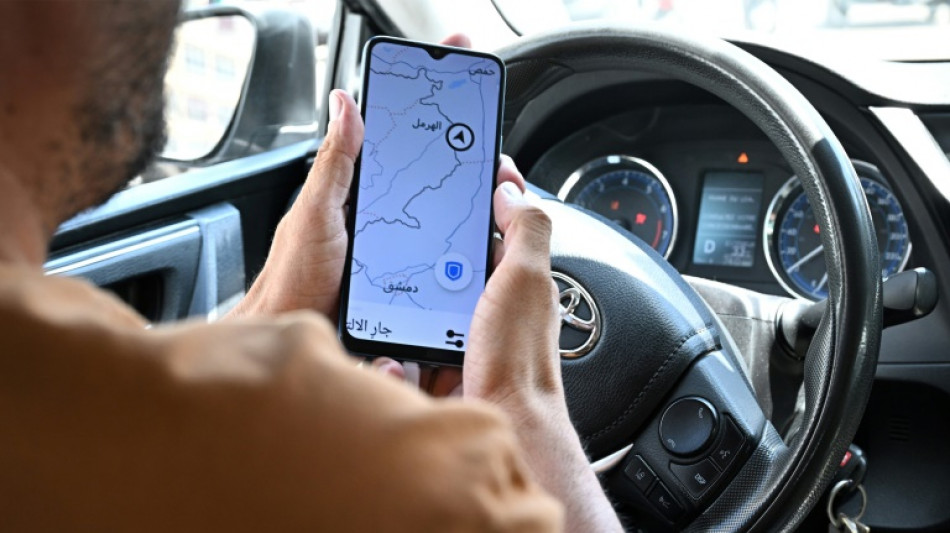
Uber driver Hussein Khalil was battling traffic in Beirut when he found himself in the Gaza Strip -- according to his online map, anyway -- as location jamming blamed on Israel disrupts life in Lebanon.
"We've been dealing with this problem a lot for around five months," said Khalil, 36.
"Sometimes we can't work at all," the disgruntled driver told AFP on Beirut's chaotic, car-choked streets.
"Of course, we are losing money."
For months, whacky location data on apps have caused confusion in Lebanon, where the Hezbollah militant group has been engaged in cross-border clashes with Israel.
The near-daily exchanges started after Hamas, Hezbollah's Palestinian ally, launched an unprecedented attack on Israel on October 7, triggering the ongoing war in Gaza.
In March, Beirut lodged a complaint with the United Nations about "attacks by Israel on Lebanese sovereignty in the form of jamming the airspace around" the Beirut airport.
Khalil showed AFP screenshots of apps displaying his locations not only in the Gazan city of Rafah -- around 300 kilometres (185 miles) away -- but also in east Lebanon near the Syrian border, when he was actually in Beirut.
With online maps loopy, Khalil said "one passenger phoned me and asked, 'Are you in Baalbek?'" referring to a city in east Lebanon.
"I told her: 'No, I'll be at your location (in Beirut) in two minutes'."
Numerous residents have reported their online map location as appearing at Beirut airport while they were actually elsewhere in the capital.
Since Hamas's October 7 attack, Israel has taken measures to disrupt Global Positioning System (GPS) functionality for the group and other opponents.
- Drones, guided missiles -
The Israeli army said in October that it disrupted GPS "in a proactive manner for various operational needs".
It warned of "various and temporary effects on location-based applications".
Specialist site gpsjam.org, which compiles geolocation signal disruption data based on aircraft data reports, reported a low level of disruption around Gaza on October 7.
But the next day, disturbances increased around the Palestinian territory and also along the border between Israel and Lebanon.
On June 28, the level of interference showing on the site was high above Lebanon and parts of Syria, Jordan and Israel.
An AFP journalist in Jerusalem said her location appeared as if she was in Cairo, Egypt's capital about 400 kilometres away.
The interference has at times extended to European Union member Cyprus, some 200 kilometres from Lebanon, where AFP journalists have reported their GPS location appearing at Beirut airport instead of on the island.
"Israel is using GPS jamming to disrupt or interfere with Hezbollah's communications," said Freddy Khoueiry, global security analyst for the Middle East and North Africa at risk intelligence company RANE.
It is "also using GPS spoofing... to send false GPS signals, aimed at disrupting and hindering drones' and precision-guided missiles' abilities to function or hit their targets," he added.
The Iran-backed Hezbollah has "a large arsenal" of such GPS-assisted weapons, he noted.
The cross-border exchanges have killed more than 490 people in Lebanon -- mostly fighters -- according to an AFP tally, with 26 people killed in northern Israel, according to authorities there.
Fears have grown of all-out conflict between the foes that last went to war in 2006.
- 'Compass and paper map' -
Asked about GPS jamming in northern Israel, where Hezbollah has concentrated its attacks, a spokesperson for Israel's defence ministry told AFP's Jerusalem office that "currently, we are unable to discuss operational matters".
Lebanon's civil aviation chief Fadi El-Hassan said that since March, the body has asked pilots flying in or out of Beirut to "rely on ground navigation equipment and not on GPS signals due to the ongoing interference in the region".
Ground navigation equipment is typically used as a back-up system.
Hassan expressed frustration that "in this technological age, a pilot who wants to land at our airport cannot use GPS due to Israeli enemy interference".
Lebanon is ensuring "the maintenance of ground navigation equipment at all times in order to provide the necessary signals for pilots to land safely," he said.
Avedis Seropian, a licenced pilot, said he had stopped using GPS in recent months.
"We got used to the situation. I don't rely on (GPS) at all... I fly relying on a compass and paper map," he told AFP.
But he said not having GPS, even as a fallback, was disconcerting.
When geolocation data is wrong and visibility is poor, "you can suddenly find yourself in a state of panic", he said.
"That could lead to an accident or a disaster."
A.Clark--AT